Acrylamide in food, by measured parts per billion and by lever
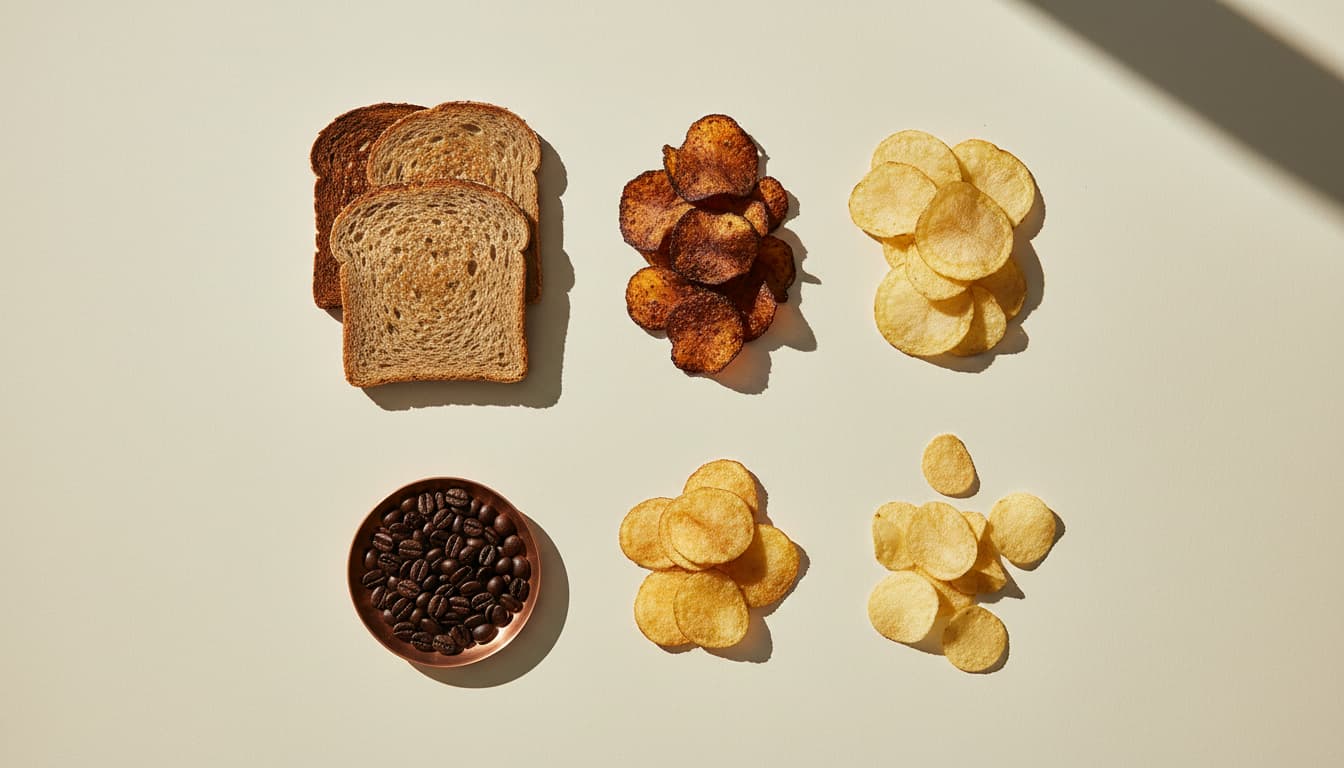
Fast-food french fries measured 381 to 450 parts per billion in the FDA market basket while boiled potatoes were non-detect. The chemistry explains the spread, and four preparation decisions move it.
- 01
The formation chemistry sets the boundaries
Acrylamide forms from a reaction between asparagine and reducing sugars such as glucose and fructose, as part of the Maillard reaction, usually at temperatures above 120 degrees Celsius (248 degrees Fahrenheit) and in low moisture conditions (FDA Guidance for Industry). Foods lacking either precursor, or cooked by methods that cannot exceed the boiling point of water, largely fall outside the problem.
- 02
Where it is and is not found
Acrylamide has been found primarily in food made from plants, such as potatoes, grain products and coffee, and is not typically associated with meat, dairy or seafood products; it is typically found in plant-based foods cooked with high heat, not in raw plant-based foods or foods cooked by steaming or boiling (FDA). It does not come from food packaging or from the environment.
- 03
The measured spread, in parts per billion
Across four FY03 market baskets, with a limit of quantitation of 10 ppb, fast-food french fries measured 381, 432, 416 and 450, and potato chips 467, 264, 536 and 292. Baked potato with peel measured 32, 17, 22 and 29, and boiled potato without peel was non-detect (FDA Total Diet Study). The same tuber spans from non-detect to over 450 ppb depending only on how it was cooked.
- 04
Grain products and coffee, measured
Enriched white bread was non-detect in three of four market baskets and 13 ppb in the fourth, whole wheat bread measured 34, 24, 39 and 59 ppb, and brewed coffee from ground was non-detect in three collections and 12 ppb in one (FDA Total Diet Study). The values sit an order of magnitude below the fried potato products, which is worth holding against the size of the category in a typical diet.
- 05
Method: frying highest, boiling produces none
Comparing frying, roasting and baking potatoes, frying causes the highest acrylamide formation, roasting potato pieces causes less, followed by baking whole potatoes, while boiling potatoes and microwaving whole potatoes with skin on to make microwaved baked potatoes does not produce acrylamide (FDA). This is the single largest lever available in a domestic kitchen.
- 06
Soaking removes precursors before they can react
Soaking raw potato slices in water for 15 to 30 minutes before frying or roasting helps reduce acrylamide formation during cooking, and soaked potatoes should be drained and blotted dry before cooking to prevent splattering (FDA). The industrial equivalent is blanching, which removes reducing sugars and asparagine from the potato surface, decreasing acrylamide in fries (FDA Guidance for Industry).
- 07
Colour is a usable proxy
Generally more acrylamide accumulates when cooking is done for longer periods or at higher temperatures; cooking cut potato products such as frozen french fries or potato slices to a golden yellow colour rather than a brown colour helps reduce formation, since brown areas tend to contain more acrylamide, and toasting bread to a light brown rather than dark brown colour lowers the amount, with very brown areas containing the most (FDA).
- 08
Refrigerating potatoes raises the result
Storing potatoes in the refrigerator can result in increased acrylamide during cooking, so store potatoes outside the refrigerator, preferably in a dark, cool place such as a closet or a pantry, to prevent sprouting (FDA). Potatoes exposed to sustained cold undergo cold sweetening, developing higher levels of reducing sugars, and trade guidelines recommend storage above 43 degrees Fahrenheit for processing potatoes (FDA Guidance for Industry).
- 09
Coffee is roasted, not brewed, into the problem
Acrylamide forms in coffee when coffee beans are roasted, not when coffee is brewed at home or in a restaurant, and so far scientists have not found good ways to reduce acrylamide formation in coffee (FDA). This is the one category in the list where no kitchen-side intervention exists, which is also why the measured brewed values sit close to the limit of quantitation.
What people ask us next.
- Which foods actually contain acrylamide?
- Primarily plant foods cooked with high heat. Acrylamide has been found primarily in food made from plants such as potatoes, grain products and coffee, is not typically associated with meat, dairy or seafood products, and is typically found in plant-based foods cooked with high heat rather than raw plant foods or foods cooked by steaming or boiling (FDA). The largest dietary sources are certain potato products, coffee and grain foods such as breakfast cereal, cookies and toast.
- How large is the difference between cooking methods?
- Two orders of magnitude on the same tuber. In the FY03 market baskets, fast-food french fries measured 381 to 450 parts per billion and potato chips 264 to 536, while baked potato with peel measured 17 to 32 and boiled potato without peel was non-detect against a 10 ppb limit of quantitation (FDA Total Diet Study). Frying causes the highest formation and boiling produces none (FDA).
- Why should potatoes not go in the fridge?
- Because cold raises the precursor. Storing potatoes in the refrigerator can result in increased acrylamide during cooking, so potatoes should be stored outside the refrigerator, preferably in a dark, cool place such as a closet or a pantry, to prevent sprouting (FDA). Potatoes exposed to sustained cold temperatures undergo cold sweetening, developing higher levels of reducing sugars, and reducing sugars are the factor driving formation in potato (FDA Guidance for Industry).
- Does soaking cut potatoes before cooking help?
- Yes, and the window is specified. Soaking raw potato slices in water for 15 to 30 minutes before frying or roasting helps reduce acrylamide formation during cooking, with the soaked potatoes drained and blotted dry before cooking to prevent splattering or fires (FDA). The commercial analogue is blanching, which removes reducing sugars and asparagine from the potato surface and decreases acrylamide in fries (FDA Guidance for Industry).
- Should I cut out coffee or bread to reduce exposure?
- That is not the published advice. The agency recommends adopting a healthy eating plan consistent with the Dietary Guidelines and explicitly does not recommend reducing intake of healthful grain products such as whole grain cereals that are a good source of whole grains and fibre (FDA). For coffee, acrylamide forms during roasting rather than brewing and no good ways to reduce it have been found, so the household levers sit entirely on the potato and browning side.
- How serious is the risk at these levels?
- Unsettled, and stated as such. In laboratory studies acrylamide caused cancer in animals, but at acrylamide levels much higher than those seen in foods, and the agency is conducting research to determine whether the much lower levels of acrylamide in food pose a health risk to people (FDA). A Joint Expert Committee on Food Additives evaluation concluded that acrylamide may be a human health concern (FDA Guidance for Industry).
Every claim, cited.
- [01]US Food and Drug Administration. Acrylamide and Diet, Food Storage, and Food Preparation. Acrylamide forms from natural sugars and the amino acid asparagine in foods; it does not come from food packaging or the environment. In laboratory studies, acrylamide caused cancer in animals, but at acrylamide levels much higher than those seen in foods, and FDA is conducting research to determine whether the much lower levels of acrylamide in food pose a health risk to people. Acrylamide has been found primarily in food made from plants, such as potatoes, grain products, and coffee, and is not typically associated with meat, dairy, or seafood products. Acrylamide is typically found in plant-based foods cooked with high heat, not raw plant-based foods or foods cooked by steaming or boiling. Comparing frying, roasting, and baking potatoes, frying causes the highest acrylamide formation; roasting potato pieces causes less acrylamide formation, followed by baking whole potatoes; boiling potatoes and microwaving whole potatoes with skin on to make microwaved baked potatoes does not produce acrylamide. Soaking raw potato slices in water for 15 to 30 minutes before frying or roasting helps reduce acrylamide formation during cooking, and soaked potatoes should be drained and blotted dry before cooking. Storing potatoes in the refrigerator can result in increased acrylamide during cooking; therefore, store potatoes outside the refrigerator, preferably in a dark, cool place, such as a closet or a pantry, to prevent sprouting. Generally, more acrylamide accumulates when cooking is done for longer periods or at higher temperatures; cooking cut potato products to a golden yellow color rather than a brown color helps reduce acrylamide formation, and brown areas tend to contain more acrylamide. Toasting bread to a light brown color, rather than a dark brown color, lowers the amount of acrylamide, and very brown areas should be avoided since they contain the most acrylamide. Acrylamide forms in coffee when coffee beans are roasted, not when coffee is brewed at home or in a restaurant, and so far scientists have not found good ways to reduce acrylamide formation in coffee. FDA does not recommend reducing intake of healthful grain products (e.g., whole grain cereals) that are a good source of whole grains and fiber.
- [02]US Food and Drug Administration. Guidance for Industry: Acrylamide in Foods. Acrylamide forms in foods from a chemical reaction between asparagine, an amino acid, and reducing sugars such as glucose and fructose; this reaction is part of the Maillard reaction, which leads to color, flavor, and aroma changes in cooked foods. Acrylamide formation usually occurs at elevated temperatures used when frying or baking (above 120 degrees Celsius / 248 degrees Fahrenheit) and in low moisture conditions, although acrylamide has also been identified in some fruit and vegetable products heated at lower temperatures or higher moisture conditions. Acrylamide formation occurs primarily in plant-based foods, notably potato products such as french fries and potato chips, cereal-grain-based foods such as cookies, crackers, breakfast cereals, and toasted bread, and coffee. In potatoes, reducing sugars are present in excess compared with asparagine, and reducing sugar levels are the important factors driving acrylamide formation. Potatoes exposed to sustained cold temperatures can undergo cold sweetening, developing higher levels of reducing sugars in response to cold. Trade associations recommend temperatures greater than 43 degrees Fahrenheit for long-term storage of potatoes used for potato chips or for french fries, with some guidelines recommending near 50 degrees Fahrenheit or greater for chipping potatoes or 47 to 50 degrees Fahrenheit for french fry processing. Sprouting can lead to conversion of stored starch to sugars, increasing potential for acrylamide formation and excessive browning in cooked products. Blanching also removes reducing sugars and asparagine from the potato surface, decreasing acrylamide in fries. An evaluation of acrylamide by the WHO/FAO Joint Expert Committee on Food Additives concluded that acrylamide may be a human health concern.
- [03]US Food and Drug Administration. Survey Data on Acrylamide in Food: Total Diet Study Results, Table 1, FY03 market baskets 1 to 4, values in parts per billion with a general limit of quantitation of 10 ppb and ND denoting non-detect. Potato, french-fried, fast-food: 381, 432, 416, 450. Potato chips: 467, 264, 536, 292. Potato, baked (with peel): 32, 17, 22, 29. Potato, boiled (without peel): ND, ND. Bread, white, enriched: ND, ND, ND, 13. Bread, whole wheat: 34, 24, 39, 59. Coffee, from ground: ND, ND, 12, ND. Decaffeinated coffee, from ground: ND, ND, ND, ND. Sweet potatoes, canned: 153, 95, 66, 59. Each data point represents the analytical result for a composite of three samples of the Total Diet Study food, collected from grocery stores and fast food restaurants in three cities within each of four US regions and prepared table-ready.
The Larderlab Team builds evidence-led frameworks for eating, lifting, and stocking a kitchen. We cite every claim. We publish the spreadsheet when possible. We buy what we review at retail price. When new data lands, we revise with a dated note.
Next in this hub.
Glyphosate in Food: Measured Exposure Against the Reference Dose
Detection is near-universal and the doses are small. US biomonitoring found 81.2 percent detection at a median of 0.392 micrograms per litre, and modelled intakes in a high-exposure cohort sat two orders of magnitude below the reference value. The agency disagreement is real and separate.
9 min · rev 2026-08-30How to Evaluate a Food Claim: The Larderlab Methodology
The seven-step method we run on every ingredient deep-dive: separate the layers of a claim, weigh the evidence tier, check the dose, and find the number that actually settles it.
11 min · rev 2026-06-29Microplastics in Food: The Exposure Is Real, and Two Sources Carry Most of It
The best particle-count estimate is 39,000 to 52,000 particles a year from food, and drinking only bottled water adds 90,000 against 4,000 for tap. One plastic teabag at 95 degrees Celsius releases 11.6 billion particles. The mass estimate spans 0.1 to 5 g a week, a fiftyfold range.
14 min · rev 2026-09-10Get the Larderlab Macro Planner.
A Google Sheet that calculates your protein target, splits it across 3-5 meals, and ranks 20 protein sources by $/gram. Free. Copy-and-modify your own version.
By subscribing, you agree to our Privacy Policy. Unsubscribe anytime.