Ist MSG schädlich für Sie? Was die Doppelblindstudien zeigen
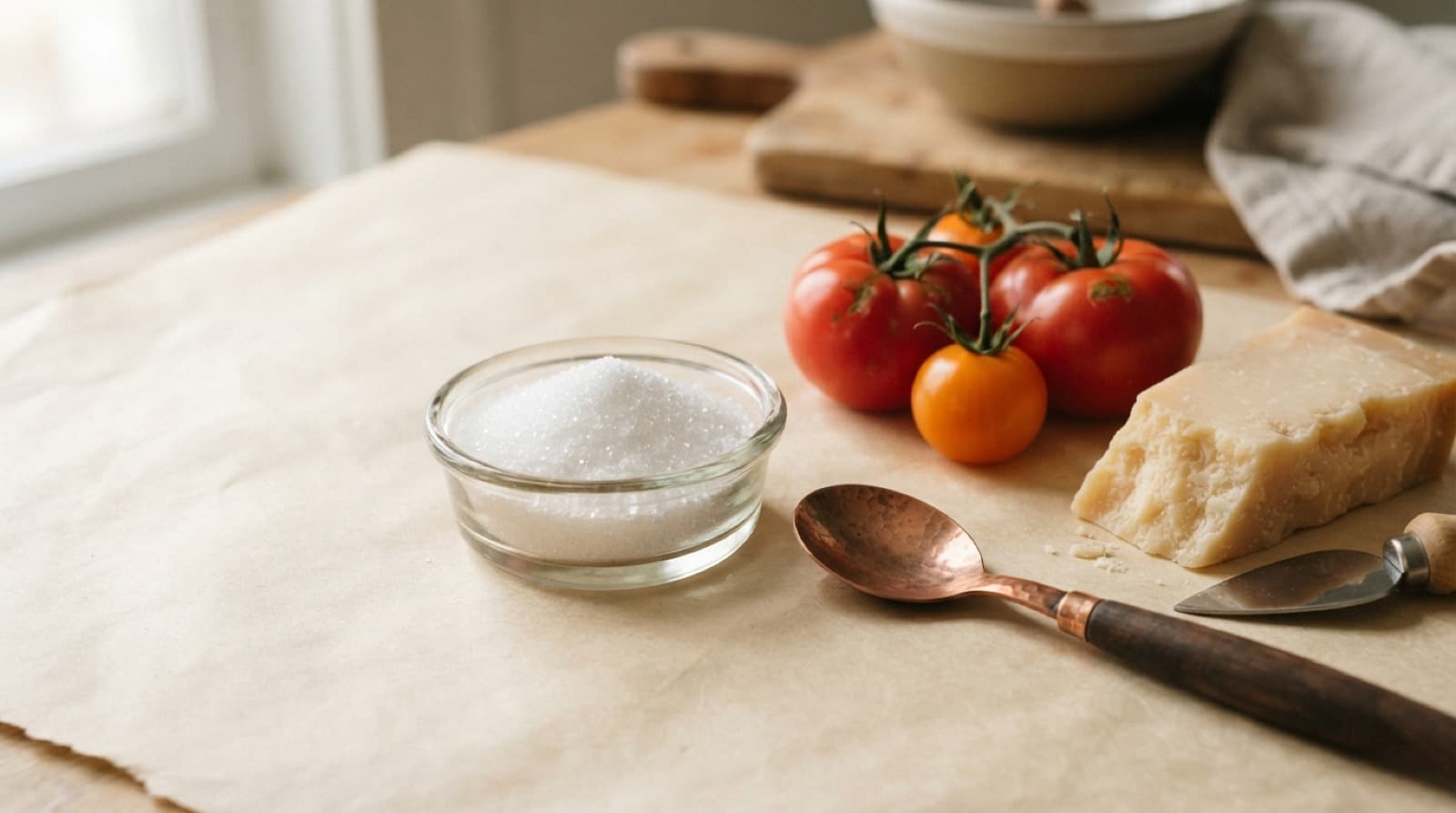
Die doppelblinde Evidenz stützt eine MSG-Empfindlichkeit bei normalen Ernährungsdosen nicht. Was die Studien, die Biochemie und der Schreck von 1968 tatsächlich zeigen.
- 01
Was MSG tatsächlich ist (Mononatriumglutamat)
MSG ist das Natriumsalz der Glutaminsäure, einer der häufigsten Aminosäuren in Lebensmitteln. Im Darm dissoziiert es in Natrium plus freies Glutamat, dasselbe Glutamat, das der Körper bereits täglich in Grammmengen verarbeitet. Freies Glutamat kommt natürlich in Parmesan (~1200 mg/100 g), reifen Tomaten (~140-250 mg/100 g), Sojasauce, Pilzen und menschlicher Muttermilch (~19 mg/100 mL, etwa das 10-fache des freien Glutamats von Kuhmilch) vor. Der Körper unterscheidet chemisch nicht zwischen Glutamat aus MSG und Glutamat aus Lebensmitteln. Dies ist die zentrale Tatsache, die die meiste Angst ignoriert.
- 02
Woher die Angst kam (der Kwok-Brief von 1968)
Der Schreck lässt sich auf eine einzige Quelle zurückführen: einen Brief von 1968 an das New England Journal of Medicine von Robert Ho Man Kwok, der Taubheitsgefühle und Herzklopfen nach dem Essen in chinesischen Restaurants beschrieb und über mehrere Ursachen spekulierte, darunter MSG, Kochwein und Natrium. Es war eine Anekdote, keine Studie. Die Presse nannte es 'China-Restaurant-Syndrom', und eine mediale Kettenreaktion machte MSG zum Schuldigen, bevor es irgendeine kontrollierte Untersuchung gab. Jahrzehntelange placebokontrollierte Arbeit versuchte dann, den Effekt unter Verblindung zu reproduzieren, und scheiterte weitgehend.
- 03
Was die Doppelblindstudien zeigen
Die von der FDA in Auftrag gegebene FASEB-Sicherheitsübersicht von 1995 untersuchte die vorliegende Evidenz und fand keinen einheitlichen, reproduzierbaren Symptomkomplex, der MSG bei Aufnahmemengen im Ernährungsbereich zuzuschreiben wäre. Die multizentrische, doppelblinde, placebokontrollierte Studie von Geha et al. 2000 testete selbstidentifizierte MSG-empfindliche Personen: einige reagierten auf 5 g MSG ohne Nahrung, doch die Reaktionen waren bei erneuter Provokation inkonsistent, wurden bei MSG-Gabe zusammen mit Nahrung nicht reproduziert, und ein erheblicher Anteil reagierte auf Placebo. Das Muster in der Literatur ist eine kleine, nicht reproduzierbare Reaktion bei hohen Nüchterndosen und kein Signal bei kulinarischen Dosen.
- 04
Die Frage der Dosis
Dosis und Kontext bestimmen die gesamte Debatte. Ein typisches gewürztes Restaurantgericht liefert etwa 0,5 g zugesetztes MSG; eine großzügige Hand könnte 1 g erreichen. Die in Studien berichteten vorübergehenden Symptome treten nur oberhalb von ~3 g reinem MSG auf, das als Einzelbolus auf leeren Magen eingenommen wird, ein Szenario, das nicht dazu passt, wie irgendjemand isst. Geha 2000 zeigte, dass die Reaktion verschwand, wenn dieselbe Dosis zusammen mit Nahrung gegeben wurde, was die normale Bedingung ist. 'Empfindlichkeit' in der Literatur ist also ein Artefakt von hoher Dosis, Nüchternheit und Nahrungskarenz, keine Eigenschaft gewürzter Mahlzeiten.
- 05
MSG gegen Speisesalz beim Natrium
MSG besteht zu ~12 % aus Natrium nach Gewicht; Speisesalz (Natriumchlorid) zu ~39 %. Pro Gramm liefert MSG etwa ein Drittel des Natriums. Da MSG die wahrgenommene Herzhaftigkeit bereits bei geringer Beimischung steigert, ermöglicht ein teilweiser Ersatz, dass ein Gericht dasselbe Geschmacksziel mit weniger Gesamtnatrium erreicht. Kontrollierte sensorische Arbeiten haben Gesamtnatriumreduktionen in der Größenordnung von 30-40 % in Lebensmitteln wie Suppen und Brühen gezeigt, wenn MSG einen Teil des Salzes bei gleicher Schmackhaftigkeit ersetzt. Für eine Leserin oder einen Leser, die oder der den Blutdruck steuert oder das Natrium verfolgt, ist dies die praktische Schlussfolgerung, nicht das Vermeiden.
- 06
Regulatorischer Status und das ehrliche Fazit
MSG ist von der FDA als Generally Recognized As Safe (GRAS) eingestuft, derselben Kategorie wie Salz und Pfeffer, ohne erforderliche quantitative Grenze. Die Europäische Behörde für Lebensmittelsicherheit (EFSA) bewertete Glutaminsäure und Glutamate 2017 neu und legte einen Gruppen-ADI (acceptable daily intake) von 30 mg/kg Körpergewicht fest, wobei sie Neurotoxizitäts-Endpunkte bei hohen Tierdosen als Grundlage für diesen vorsorglichen ADI anführte; dieser ADI liegt für die meisten Menschen weit über der typischen Nahrungsaufnahme. Fazit: Die doppelblinde Evidenz stützt keine Empfindlichkeitsreaktion bei normalem Gebrauch, Glutamat ist dasselbe Molekül, das in alltäglichen Lebensmitteln vorkommt, und der einzige offene Vorbehalt sind große Nüchtern-Bolusdosen bei einer Minderheit selbstberichteter Reagierender.
Was als Nächstes gefragt wird.
- Verursacht MSG Kopfschmerzen?
- Die kontrollierte Evidenz ist schwach. Einige Provokationsstudien berichten Kopfschmerzen bei großen Dosen (>3 g) reinen MSGs ohne Nahrung, doch doppelblinde, placebokontrollierte Designs schaffen es häufig nicht, MSG von Placebo zu trennen, und die Reaktionen sind bei erneuter Provokation oft nicht reproduzierbar (Geha et al. 2000). Bei den ~0,5-1 g, die einer typischen Mahlzeit zugesetzt werden, und besonders zusammen mit Nahrung verzehrt, zeigen die doppelblinden Daten keinen Kopfschmerzeffekt, der sich von Placebo unterscheidet, und das Signal bleibt in gepoolten Provokationsstudien nicht zuverlässig bestehen.
- Ist MSG ein Neurotoxin?
- Die Sorge vor 'Exzitotoxizität' stammt aus Tierstudien, in denen Glutamat, das in sehr hohen Dosen injiziert oder zwangsverfüttert wurde, Neuronen schädigte, besonders bei jungen Nagetieren ohne ausgereifte Blut-Hirn-Schranke. Orales Glutamat verhält sich beim Menschen nicht so: Glutamat aus der Nahrung wird größtenteils in der Darmwand verstoffwechselt und erhöht bei normaler Aufnahme das Glutamat im Gehirn nicht. Regulierungsbehörden setzen vorsorgliche Grenzwerte anhand der Tierdaten mit hohen Dosen (EFSA 2017) und kommen zugleich zu dem Schluss, dass der gewöhnliche Ernährungsgebrauch kein neurotoxisches Risiko darstellt.
- Ist MSG natürlich oder künstlich?
- Das Glutamat in MSG ist chemisch identisch mit dem freien Glutamat in Tomaten, Parmesan, Pilzen und Muttermilch. Kommerzielles MSG wird durch bakterielle Fermentation von Kohlenhydraten (Zuckerrohr, Mais oder Rüben) hergestellt, demselben Fermentationsprinzip, das für Joghurt und Essig genutzt wird. Die Einteilung in 'natürlich gegen künstlich' bildet keinen realen chemischen Unterschied ab; das Molekül ist in beiden Fällen dasselbe.
- Enthält MSG weniger Natrium als Speisesalz?
- Ja. MSG besteht zu etwa 12 % aus Natrium nach Gewicht gegenüber etwa 39 % bei Speisesalz, also etwa einem Drittel des Natriums pro Gramm. Da MSG die Herzhaftigkeit bereits in kleinen Mengen steigert, kann der Ersatz eines Teils des Salzes durch MSG das Gesamtnatrium senken und zugleich denselben Geschmack erhalten, mit berichteten Reduktionen von etwa 30-40 % in einigen Lebensmitteln bei gleicher Schmackhaftigkeit.
- Warum fühle ich mich nach Take-out schlecht, wenn es nicht das MSG ist?
- Mehrere Ursachen abseits von MSG sind wahrscheinlicher: eine große, natriumreiche, fettreiche Mahlzeit kann Blähungen sowie vorübergehende Blutdruck- und Herzfrequenzveränderungen verursachen; eine Belastung mit raffinierten Kohlenhydraten kann Müdigkeit nach dem Essen auslösen; Alkohol oder Histamin in gereiften Zutaten (Sojasauce, fermentierte Saucen) können Hautrötung oder Kopfschmerzen auslösen; und allein die Portionsgröße erzeugt Unwohlsein. Verblindete Studien zeigen, dass Menschen diese Beschwerden oft MSG zuschreiben, obwohl der Auslöser die Mahlzeit als Ganzes ist.
- Ist MSG für Kinder sicher?
- Regulierungsbehörden behandeln es bei Ernährungsmengen als sicher für die allgemeine Bevölkerung, einschließlich Kinder, unter dem GRAS-Status der FDA und dem EFSA-Gruppen-ADI von 30 mg/kg Körpergewicht, der populationsweit einschließlich Kinder gilt. Die Daten zur Neurotoxizität bei jungen Nagetieren, die die Sorge schüren, betrafen injizierte oder extreme orale Dosen und eine unreife Blut-Hirn-Schranke, Bedingungen, die nicht auf ein Kind zutreffen, das gewürztes Essen isst. Normale kulinarische Mengen liegen weit unter dem vorsorglichen ADI.
Jede Aussage, belegt.
- [01]FASEB (Life Sciences Research Office). 1995. Analysis of Adverse Reactions to Monosodium Glutamate (MSG). Report prepared for the US FDA.
- [02]Geha RS, Beiser A, Ren C, et al. 2000. Multicenter, double-blind, placebo-controlled, multiple-challenge evaluation of reported reactions to monosodium glutamate. J Allergy Clin Immunol.
- [03]Kwok RHM. 1968. Chinese-Restaurant Syndrome (letter). N Engl J Med 278:796. The original anecdotal report that started the scare.
- [04]US FDA. Questions and Answers on Monosodium Glutamate (MSG). MSG is classified Generally Recognized As Safe (GRAS).
- [05]EFSA Panel on Food Additives. 2017. Re-evaluation of glutamic acid (E 620), sodium glutamate (E 621) and related glutamates as food additives. EFSA Journal 15(7):4910.
Das Larderlab-Team entwickelt evidenzbasierte Rahmenwerke fürs Essen, Trainieren und Bestücken einer Küche. Wir belegen jede Aussage. Wir veröffentlichen die Tabelle, wo möglich. Wir kaufen, was wir testen, zum Ladenpreis. Wenn neue Daten erscheinen, überarbeiten wir mit einer datierten Notiz.
Als Nächstes in diesem Ressort.
Weiderind vs. Getreidemast: das Verhältnis wird besser, die Milligramm nicht
Die USDA führt grasgefüttertes Rinderhack mit 88 mg Omega-3 gesamt pro 100 g, davon 1 mg EPA und kein DHA. Das Fettsäureverhältnis verbessert sich auf Gras tatsächlich. Die absoluten Mengen bleiben zu klein für ein Omega-3-Ziel.
8 Min. · Rev. 2026-08-25Wildlachs vs Zuchtlachs: Omega-3, Schadstoffe und Kosten im Vergleich
Zuchtlachs ist fetter und oft höher im Gesamt-Omega-3 pro Portion, während Wildlachs magerer ist mit besserem Omega-Verhältnis und weniger Kalorien. Der ehrliche Vergleich zu Nährstoffen, Schadstoffen, Farbe, Kosten und warum beide eine gesunde Wahl sind.
8 Min. · Rev. 2026-08-12Wie man eine Lebensmittelbehauptung bewertet: die Larderlab-Methodik
Die sieben Schritte, die wir auf jeden Zutaten-Deep-Dive anwenden: die Ebenen einer Behauptung trennen, die Evidenzstufe gewichten, die Dosis prüfen und die Zahl finden, die es tatsächlich entscheidet.
11 Min. · Rev. 2026-06-29Holen Sie sich den Larderlab-Makroplaner.
Ein Google Sheet, das Ihren Proteinbedarf berechnet, ihn auf 3-5 Mahlzeiten verteilt und 20 Proteinquellen nach $/Gramm sortiert. Kostenlos. Kopieren und nach Belieben anpassen.
Mit der Anmeldung stimmen Sie unserer Datenschutzerklärung zu. Jederzeit kündbar.