Glykämischer Index, glykämische Last und warum der Kontext entscheidet
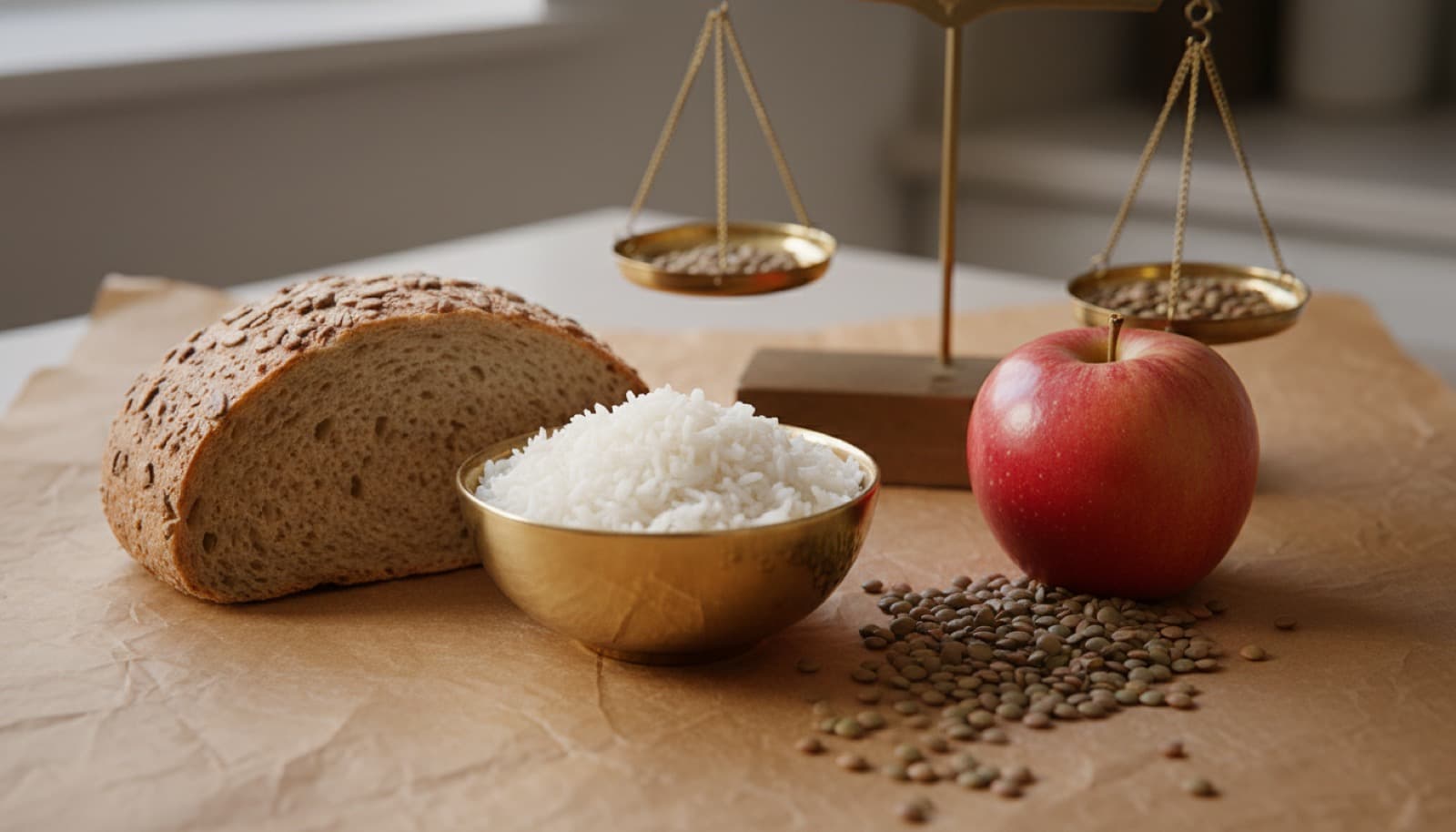
Glykämischer Index gegenüber glykämischer Last, eine Referenztabelle gängiger Lebensmittel und warum der Mahlzeitenkontext jede einzelne GI-Zahl schlägt.
- 01
Was der GI tatsächlich misst (0-100 gegenüber einer Glukose-Referenz)
Der glykämische Index stuft ein Lebensmittel danach ein, wie stark 50 g seiner verfügbaren Kohlenhydrate den Blutzucker über 2 Stunden anheben, skaliert gegen eine Referenz (reine Glukose = 100, oder in manchen Laboren Weißbrot = 100, was die Werte um etwa das 1,4-fache erhöht). Es handelt sich um die inkrementelle Fläche unter der Glukosekurve für das Testlebensmittel, geteilt durch dieselbe Fläche für die Referenz, mal 100. Die Methode ist entscheidend: Das Protokoll umfasst 10-15 Personen, nüchtern, wobei jedes Lebensmittel 2-3 Mal getestet wird (Jenkins 1981; Brouwer-Brolsma 2020, Standardisierungs-Review). Zwei Fakten, die die Zahl verbirgt: Sie ist auf 50 g Kohlenhydrate festgelegt, unabhängig davon, wie viel Sie tatsächlich essen, und sie sagt nichts über die übrigen Makronährstoffe auf dem Teller aus.
- 02
Glykämische Last = GI × Kohlenhydrate/100 (die wichtigere Zahl)
Der GI beschreibt die Kohlenhydratqualität pro 50 g; die glykämische Last skaliert ihn auf eine reale Portion: GL = GI × verfügbare Kohlenhydrate pro Portion / 100. Wassermelone ist das Lehrbuchbeispiel, GI ~76 (hoch), aber nur ~6 g Kohlenhydrate pro 120-g-Portion, also GL ~5 (niedrig). Ein Bagel kommt auf GI ~70 mit ~50 g Kohlenhydraten, GL ~35. Kategorien: niedrige GL <=10, mittlere 11-19, hohe >=20 pro Portion (Foster-Powell 2002, Tabellen). Die praktische Erkenntnis: Ein Lebensmittel mit hohem GI in einer kleinen Portion kann eine geringere Glukoseantwort hervorrufen als ein Lebensmittel mit mittlerem GI in einer großen Portion. Die GL ist der nähere Stellvertreter dafür, was Ihr Blutzucker am Tisch tatsächlich tut.
- 03
Eine Referenztabelle gängiger Lebensmittel (niedrig / mittel / hoch)
Bänder: niedrig <=55, mittel 56-69, hoch >=70 (Glukose-Referenzskala). Niedrig: Kichererbsen GI ~28, Linsen ~32, Vollmilch ~31, Apfel ~36, Kidneybohnen ~24, Erdnüsse ~14, geschnittene Haferkörner ~55. Mittel: brauner Reis ~68, Süßkartoffel gekocht ~63, Basmatireis ~58, Haushaltszucker/Saccharose ~65, reife Banane ~62. Hoch: Weißbrot ~75, Cornflakes ~81, weißer Jasminreis ~73, Instant-Kartoffelpüree ~87, Glukose 100 (die GI-Werte je Lebensmittel schwanken um rund +/-10-20 Punkte zwischen Laboren, laut den International GI Tables, Atkinson 2021). Verknüpft man jeden Wert mit seiner GL bei einer normalen Portion, verschiebt sich die Rangfolge: Linsen bleiben bei beiden niedrig, aber der GI einer Ofenkartoffel (hoch) überzeichnet eine kleine Beilagenportion.
- 04
Warum der GI in der Praxis unzuverlässig ist (Variabilität, Reifegrad, Verarbeitung)
Dasselbe Lebensmittel liefert je nach Sorte, Reifegrad, Verarbeitung und der essenden Person unterschiedliche GI-Werte. Eine grüne Banane testet ~30 Punkte niedriger als eine vollreife. Al dente gekochte Pasta liegt ~15-20 Punkte unter weich gekochter. Die Schwankung der GI-Messung selbst von Tag zu Tag innerhalb derselben Person beträgt rund 25 %, und die Variation zwischen Personen ist noch größer (Vega-Lopez 2007 fand für dasselbe Weißbrot einen Variationskoeffizienten innerhalb der Person von ~20-30 %). Veröffentlichte GI-Werte tragen zudem Standardfehler, die die einzelne tabellierte Zahl ausblendet. Das Ergebnis: Der gelistete GI eines Lebensmittels ist ein Populationsmittelwert mit einem breiten Konfidenzintervall, keine feste Eigenschaft, nach der Sie eine Mahlzeit punktgenau planen können.
- 05
Was die glykämische Antwort einer Mahlzeit senkt (Fett, Protein, Ballaststoffe, Säure, Reihenfolge)
Der isoliert gemessene GI eines Lebensmittels stimmt selten mit seiner Wirkung innerhalb einer gemischten Mahlzeit überein. Hebel, die die Kurve abflachen: Protein und Fett verlangsamen die Magenentleerung; lösliche Ballaststoffe (Hafer, Hülsenfrüchte, Flohsamen) dämpfen den Anstieg; Säure (Essig ~20 mL zu einer Mahlzeit senkt die Glukosespitze um ~20-30 %, Johnston 2004; Ostman 2005); und die Essreihenfolge, Gemüse und Protein vor Kohlenhydraten senken die Glukosespitze nach der Mahlzeit um ~30-40 % gegenüber Kohlenhydraten zuerst (Shukla 2015; Imai 2014). Werden ~2 EL Olivenöl oder eine Proteinquelle zu weißem Reis gegeben, reduziert sich dessen reale glykämische Antwort spürbar. Deshalb sagen die GL und die Mahlzeitenzusammensetzung, nicht der isolierte GI des Kohlenhydrats, die Spitze voraus.
- 06
Wen es tatsächlich betreffen sollte (Diabetes/Insulinresistenz gegenüber der Allgemeinbevölkerung)
Die stärkste Evidenz besteht bei Menschen mit gestörter Glukosekontrolle. Bei Typ-2-Diabetes senken Diäten mit niedrigem GI den HbA1c um ~0,3-0,5 Prozentpunkte gegenüber hohem GI (Brand-Miller 2003, Metaanalyse; Ojo 2018). Für Menschen mit Insulinresistenz, Prädiabetes oder PCOS ist eine GL-bewusste Ernährung ein sinnvoller Hebel. Für metabolisch gesunde Erwachsene mit normalem Nüchternglukosewert und HbA1c ist die langfristige Ergebnisdatenlage schwächer und durch Ballaststoff- und Vollwertkostzufuhr verzerrt; der einem niedrigen GI zugeschriebene Nutzen folgt oft eher dem Gesamtballaststoffgehalt und der Lebensmittelqualität als der GI-Zahl selbst. Erkenntnis für die Allgemeinbevölkerung: Die Gesamtmenge der Kohlenhydrate, die Ballaststoffe und das Körpergewicht wiegen schwerer als die Jagd nach Lebensmitteln mit niedrigem GI.
- 07
GI gegenüber CGM-Daten (was kontinuierliche Glukosemessgeräte enthüllen)
Kontinuierliche Glukosemessgeräte legten offen, wie schlecht der Populations-GI das Individuum vorhersagt. Zeevi 2015 (Cell, n=800, ~46.000 Mahlzeiten) fand, dass dasselbe Lebensmittel große und reproduzierbare Unterschiede in der Glukoseantwort nach der Mahlzeit zwischen Personen erzeugte, wobei die individuellen Antworten durch ein Modell, das das Darmmikrobiom einbezog, besser vorhergesagt wurden als durch den GI des Lebensmittels. Brot hob den Blutzucker bei manchen Teilnehmern stärker an als Glukose und bei anderen schwächer. Die Folgerung ist nicht, dass der GI nutzlos ist, sondern dass er ein grober Populationsmittelwert ist; ein CGM misst Ihre eigene Antwort direkt. Für Nicht-Diabetiker ist der Nutzen eines routinemäßigen CGM-Einsatzes unbewiesen (Klonoff 2017), aber die Daten widerlegen die Vorstellung, dass ein tabellierter GI-Wert für alle gleichermaßen gilt.
Was als Nächstes gefragt wird.
- Was ist ein guter Wert des glykämischen Index?
- Auf der Glukose-Referenzskala (Glukose = 100) ist niedrig <=55, mittel 56-69 und hoch >=70. Aber das GI-Band allein ist das falsche Ziel. Die glykämische Last, GI × verfügbare Kohlenhydrate pro Portion / 100, mit niedrig <=10, mittel 11-19, hoch >=20, ist die nützlichere Zahl, weil sie berücksichtigt, wie viel Sie tatsächlich essen. Ein Lebensmittel mit 'hohem GI' in einer kleinen Portion kann im niedrigen GL-Band landen.
- Glykämischer Index gegenüber glykämischer Last, was ist der Unterschied?
- Der GI misst, wie schnell 50 g Kohlenhydrate aus einem Lebensmittel den Blutzucker anheben, unabhängig von der Portion. Die GL skaliert das auf eine reale Portion: GL = GI × Gramm verfügbare Kohlenhydrate pro Portion / 100. Wassermelone hat einen hohen GI (~76), aber eine niedrige GL (~5), weil eine Portion nur ~6 g Kohlenhydrate enthält. Die GL ist der bessere Prädiktor der tatsächlichen Blutzuckerantwort bei einer normalen Portion.
- Spielt der glykämische Index eine Rolle, wenn Sie kein Diabetiker sind?
- Weniger, als das Marketing suggeriert. Die stärksten Ergebnisdaten betreffen Typ-2-Diabetes, wo Diäten mit niedrigem GI den HbA1c um ~0,3-0,5 Punkte senken (Brand-Miller 2003). Für metabolisch gesunde Erwachsene folgt der scheinbare Nutzen einer Ernährung mit niedrigem GI weitgehend dem Gesamtgehalt an Ballaststoffen und der Vollwertqualität, die mit dem GI verzerrt sind. Die Gesamtmenge der Kohlenhydrate, die Ballaststoffzufuhr und das Körpergewicht wiegen schwerer als der GI einzelner Lebensmittel.
- Senkt die Essreihenfolge (Gemüse zuerst) Glukosespitzen?
- Ja, messbar. Gemüse und Protein vor Kohlenhydraten zu essen senkt die Glukosespitze nach der Mahlzeit um rund 30-40 % gegenüber dem Verzehr von Kohlenhydraten zuerst, wobei der Effekt sowohl bei Typ-2-Diabetikern als auch bei gesunden Erwachsenen gezeigt wurde (Shukla 2015, Diabetes Care; Imai 2014). Der Mechanismus ist eine verlangsamte Magenentleerung und eine Inkretin-Antwort (GLP-1). Es ist einer der günstigeren Hebel, um die Glukosekurve einer Mahlzeit abzuflachen, ohne zu ändern, was Sie essen.
- Warum schwanken die Werte des glykämischen Index zwischen Quellen so stark?
- Weil der GI ein gemessener Populationsmittelwert ist, keine feste Konstante. Die Werte verschieben sich mit Sorte, Reifegrad (eine reife Banane kann ~30 Punkte höher testen als eine grüne), Garung (al dente gekochte Pasta ~15-20 Punkte niedriger als weiche) und der Testgruppe. Die Messvariation innerhalb einer Person allein beträgt ~20-30 % (Vega-Lopez 2007). Verschiedene Tabellen verwenden zudem unterschiedliche Referenzen (Glukose = 100 gegenüber Weißbrot = 100, Letzteres erhöht die Werte um etwa das 1,4-fache). Behandeln Sie jeden einzelnen gelisteten GI als Schätzung mit einem breiten Fehlerbalken.
- Hat weißer Reis immer einen hohen glykämischen Index?
- Nein. Weißer Jasminreis testet tendenziell hoch (~73), aber weißer Basmatireis ist konstant niedriger (~58, mittel) aufgrund seines höheren Amylosegehalts, mit berichteten Werten von ~50-58 über verschiedene Labore. Reis zu kochen, abzukühlen und wieder aufzuwärmen erhöht die resistente Stärke und senkt die Antwort weiter. Und in einer gemischten Mahlzeit dämpft das Hinzufügen von Fett, Protein oder Säure, oder ihn nach dem Gemüse zu essen, die Spitze unabhängig vom isolierten GI des Reises.
Jede Aussage, belegt.
- [01]Jenkins DJA et al. 1981. Glycemic index of foods: a physiological basis for carbohydrate exchange. Am J Clin Nutr 34(3):362-366.
- [02]Atkinson FS, Foster-Powell K, Brand-Miller JC. 2008. International tables of glycemic index and glycemic load values: 2008. Diabetes Care 31(12):2281-2283.
- [03]Foster-Powell K, Holt SHA, Brand-Miller JC. 2002. International table of glycemic index and glycemic load values: 2002. Am J Clin Nutr 76(1):5-56.
- [04]Shukla AP et al. 2015. Food order has a significant impact on postprandial glucose and insulin levels. Diabetes Care 38(7):e98-e99.
- [05]Harvard T.H. Chan School of Public Health, The Nutrition Source. Carbohydrates and Blood Sugar: glycemic index and glycemic load.
Das Larderlab-Team entwickelt evidenzbasierte Rahmenwerke fürs Essen, Trainieren und Bestücken einer Küche. Wir belegen jede Aussage. Wir veröffentlichen die Tabelle, wo möglich. Wir kaufen, was wir testen, zum Ladenpreis. Wenn neue Daten erscheinen, überarbeiten wir mit einer datierten Notiz.
Als Nächstes in diesem Ressort.
Weiderind vs. Getreidemast: das Verhältnis wird besser, die Milligramm nicht
Die USDA führt grasgefüttertes Rinderhack mit 88 mg Omega-3 gesamt pro 100 g, davon 1 mg EPA und kein DHA. Das Fettsäureverhältnis verbessert sich auf Gras tatsächlich. Die absoluten Mengen bleiben zu klein für ein Omega-3-Ziel.
8 Min. · Rev. 2026-08-25Wildlachs vs Zuchtlachs: Omega-3, Schadstoffe und Kosten im Vergleich
Zuchtlachs ist fetter und oft höher im Gesamt-Omega-3 pro Portion, während Wildlachs magerer ist mit besserem Omega-Verhältnis und weniger Kalorien. Der ehrliche Vergleich zu Nährstoffen, Schadstoffen, Farbe, Kosten und warum beide eine gesunde Wahl sind.
8 Min. · Rev. 2026-08-12Wie man eine Lebensmittelbehauptung bewertet: die Larderlab-Methodik
Die sieben Schritte, die wir auf jeden Zutaten-Deep-Dive anwenden: die Ebenen einer Behauptung trennen, die Evidenzstufe gewichten, die Dosis prüfen und die Zahl finden, die es tatsächlich entscheidet.
11 Min. · Rev. 2026-06-29Holen Sie sich den Larderlab-Makroplaner.
Ein Google Sheet, das Ihren Proteinbedarf berechnet, ihn auf 3-5 Mahlzeiten verteilt und 20 Proteinquellen nach $/Gramm sortiert. Kostenlos. Kopieren und nach Belieben anpassen.
Mit der Anmeldung stimmen Sie unserer Datenschutzerklärung zu. Jederzeit kündbar.