Green tea extract, EGCG dose, and the liver threshold
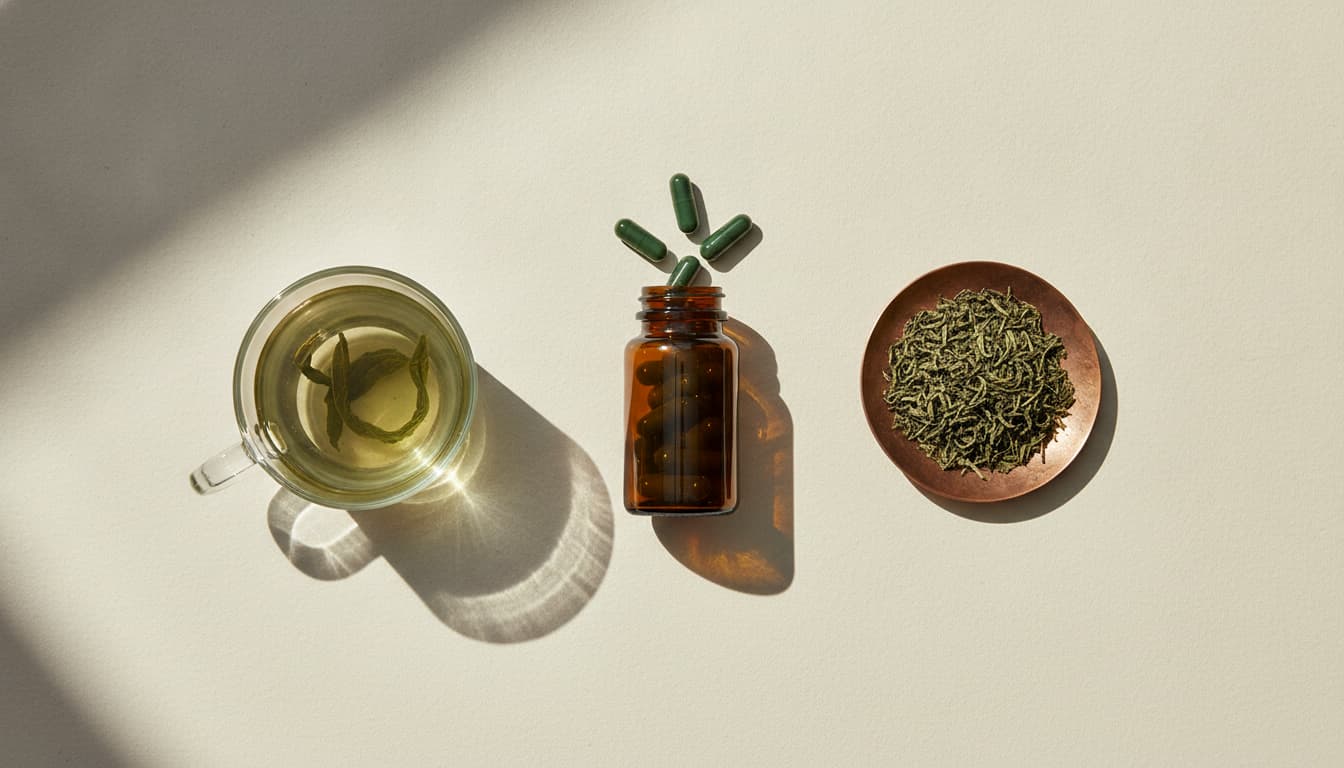
EFSA found that 800 mg of EGCG a day from a supplement raised serum transaminases, while five or more cups of brewed green tea containing up to 700 mg showed no such signal. The dose, the format, and why the difference matters.
- 01
The regulatory threshold: 800 mg of EGCG a day from a supplement
EFSA concluded that intake of doses equal to or above 800 mg of EGCG a day taken as a food supplement resulted in statistically significant increases in serum transaminases compared with control groups in intervention studies (EFSA 2018). That is the single most useful number in this topic: a specific daily EGCG figure, tied to a specific product format, associated with a specific measurable liver marker. High-EGCG capsules routinely reach it, which is the entire practical point.
- 02
Brewed tea reached almost the same dose with no signal
The same EFSA opinion found catechins from green tea infusion prepared in the traditional way to be safe at intakes corresponding to those reported in European member states, and specifically noted no evidence of elevated ALT at a consumption of five or more cups a day or containing 700 mg of EGCG a day (EFSA 2018). Seven hundred milligrams from a teapot produced nothing while 800 mg from a capsule produced transaminase elevations. The near-identical totals are what prove the format, not the arithmetic, is doing the damage.
- 03
Why format matters: bolus dosing and an empty stomach
A systematic review of laboratory toxicology and 159 human intervention studies found the liver to be the target organ and hepatotoxicity the critical effect, strongly associated with bolus dose via gavage and with fasting, and positively correlated with total catechin and EGCG content. In humans, hepatic adverse events appeared with concentrated catechin-rich preparations taken as large bolus doses, but not when consumed as brewed tea or as extracts in beverages or food (Hu et al. 2018). A capsule swallowed before breakfast is the exact condition the toxicology identifies.
- 04
The conservative numbers: 338 mg solid, 704 mg beverage
The same review derived a safe intake level of 338 mg of EGCG a day for tea preparations ingested as a solid bolus dose, and suggested an observed safe level of 704 mg a day might be considered for preparations in beverage form (Hu et al. 2018). The two figures differ by more than a factor of two for the identical compound, which is the clearest possible statement of the format effect. Note that the authors were employed by a supplement manufacturer, disclosed in the paper, so EFSA's 800 mg finding is the more independent anchor.
- 05
The benefit side is thin, which changes the calculation
The dominant commercial claim for concentrated green tea extract is weight loss, and it is the subject of a Cochrane review of green tea preparations for weight loss and weight maintenance in overweight or obese adults (Jurgens et al. 2012). A modest and contested effect on body weight is a weak counterweight to a dose-dependent hepatic signal with a defined threshold. Anyone taking high-EGCG capsules should be able to state what outcome they expect and at what magnitude, because the risk side of this ledger has a number on it.
- 06
What to watch for, and when
A dedicated review of green tea hepatotoxicity documents the clinical picture behind the transaminase data (Mazzanti et al. 2015). The practical implications are ordinary liver-injury vigilance: fatigue, nausea, right-upper-quadrant discomfort, dark urine, pale stools, or jaundice while taking a concentrated extract are reasons to stop and request liver function tests rather than to wait. The signal EFSA identified is a laboratory marker, which means it can be rising before anyone feels anything, and it resolves in most cases once the product is discontinued.
- 07
The label problem sits on top of the dose problem
Dietary supplements are not pre-approved for safety, effectiveness, or label accuracy before marketing (FDA), which means the EGCG content printed on a bottle is an unverified claim. For a compound where the difference between no signal and a measurable liver effect sits between 700 and 800 mg a day, label accuracy is not a secondary concern. Third-party lot testing is the only way to know the actual dose, and stacking two products that each contain green tea extract is the most common way people exceed the threshold without noticing.
What people ask us next.
- Is green tea extract bad for your liver?
- At high doses in supplement form, it carries a measurable risk. EFSA concluded that 800 mg or more of EGCG a day taken as a food supplement produced statistically significant increases in serum transaminases versus control in intervention studies (EFSA 2018). A systematic review of 159 human intervention studies found the liver to be the target organ, with hepatic adverse events appearing dose-dependently for concentrated catechin-rich preparations taken as large bolus doses (Hu et al. 2018).
- How much EGCG a day is safe?
- Two defensible figures exist. EFSA identified 800 mg a day from a supplement as the level at which transaminase elevations appeared (EFSA 2018). A systematic review derived a more conservative safe intake level of 338 mg a day for solid bolus dose forms, and an observed safe level of 704 mg a day for beverage forms (Hu et al. 2018). Staying below 338 mg a day from capsules is the cautious reading; 800 mg is the level with a documented signal attached.
- Is drinking green tea as risky as taking the extract?
- No, and the contrast is stark. EFSA found catechins from traditionally prepared green tea infusion to be safe at intakes reported across European member states, with no evidence of elevated ALT at five or more cups a day or at 700 mg of EGCG a day from infusion (EFSA 2018). That is nearly the same EGCG total as the 800 mg supplement threshold, which is why the conclusion is about product format and dosing conditions rather than the compound itself.
- Why does the same compound behave differently in a capsule?
- Because the toxicology tracks internal dose and dosing conditions, not daily totals. The systematic review found hepatotoxicity strongly associated with bolus dose via gavage and with fasting, and positively correlated with total catechin and EGCG content, concluding that internal dose of catechins is a key determinant of occurrence and severity (Hu et al. 2018). A capsule delivers the full amount at once, often on an empty stomach; tea delivers it diluted and spread over hours alongside other food and fluid.
- Should you take green tea extract for weight loss?
- The claim is the subject of a Cochrane review of green tea preparations for weight loss and weight maintenance in overweight or obese adults (Jurgens et al. 2012), and it is the claim used to justify most high-EGCG products. Weighing a small and contested body-weight effect against a dose-dependent liver signal with a threshold identified at 800 mg of EGCG a day (EFSA 2018) is not a close call. Brewed tea captures the polyphenol intake without the concentrated dose.
- How would you know if green tea extract were affecting your liver?
- Often only from a blood test, which is the reason the threshold matters. The signal EFSA identified is elevated serum transaminases, a laboratory marker that can rise before any symptom appears (EFSA 2018). Symptoms that do appear follow the usual pattern for drug-induced liver injury and are documented in the dedicated hepatotoxicity review (Mazzanti et al. 2015): fatigue, nausea, right-upper-quadrant discomfort, dark urine, or jaundice, each a reason to stop the product and get liver tests.
Every claim, cited.
- [01]EFSA ANS Panel. 2018. Scientific opinion on the safety of green tea catechins. EFSA Journal 16(4):5239. Intake of 800 mg EGCG/day or above as a food supplement produced statistically significant increases in serum transaminases versus control; catechins from traditionally prepared green tea infusion considered safe at reported EU intakes, with no evidence of elevated ALT at five or more cups per day or 700 mg EGCG/day.
- [02]Hu J, Webster D, Cao J, Shao A. 2018. The safety of green tea and green tea extract consumption in adults, results of a systematic review. Regul Toxicol Pharmacol 95:412-433. Liver is the target organ; hepatotoxicity associated with bolus dosing and fasting and correlated with total catechin and EGCG content; safe intake level 338 mg EGCG/day for solid bolus dose, observed safe level 704 mg/day for beverage form. Authors disclosed employment by a supplement manufacturer.
- [03]Mazzanti G, Di Sotto A, Vitalone A. 2015. Hepatotoxicity of green tea: an update. Arch Toxicol 89(8):1175-91. The clinical case literature and proposed mechanisms behind the transaminase signal.
- [04]Jurgens TM, Whelan AM, Killian L, Doucette S, Kirk S, Foy E. 2012. Green tea for weight loss and weight maintenance in overweight or obese adults. Cochrane Database Syst Rev 12:CD008650. The systematic assessment of the dominant commercial claim for concentrated green tea preparations.
- [05]FDA: Questions and Answers on Dietary Supplements. Dietary supplements are not approved for safety, effectiveness, or label accuracy before marketing, so stated EGCG content is unverified without third-party lot testing.
The Larderlab Team builds evidence-led frameworks for eating, lifting, and stocking a kitchen. We cite every claim. We publish the spreadsheet when possible. We buy what we review at retail price. When new data lands, we revise with a dated note.
Next in this hub.
Berberine Side Effects: Why the Gut Takes the Dose and the Liver Takes the Interaction
Absolute oral bioavailability measured 0.36 percent in rats, so the gut receives almost the whole dose and 34.5 percent of patients reported transient gastrointestinal events. Two weeks at 300 mg three times a day raised the CYP2D6 probe ratio ninefold.
14 min · rev 2026-09-05Ashwagandha Benefits: What the Trials Show, and the Liver Signal
Pooled across 12 trials in 1,002 people, stress fell with a standardised mean difference of 1.75 and anxiety by 1.55, but heterogeneity was above 83 percent and the certainty of evidence was rated low. The dose that was tested, and the hepatic case series.
8 min · rev 2026-08-24Third-Party Tested Supplements: What Certification Actually Verifies
Supplements are not FDA-approved for safety and effectiveness before sale. Of 57 botanical sports products analysed, 40 percent held no detectable amount of the labeled ingredient and 12 percent a prohibited compound.
13 min · rev 2026-09-04Get the Larderlab Macro Planner.
A Google Sheet that calculates your protein target, splits it across 3-5 meals, and ranks 20 protein sources by $/gram. Free. Copy-and-modify your own version.
By subscribing, you agree to our Privacy Policy. Unsubscribe anytime.