What ashwagandha actually does, by the evidence
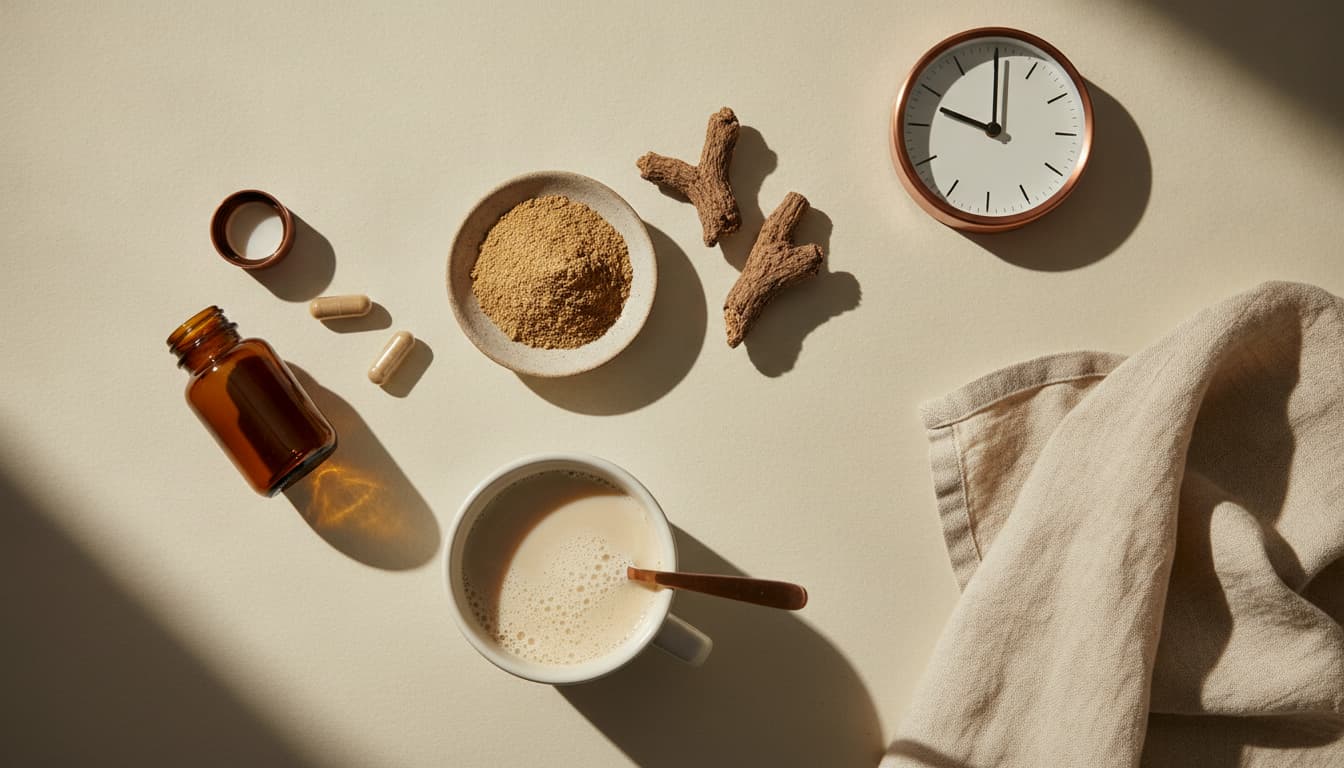
Pooled across 12 trials in 1,002 people, stress fell with a standardised mean difference of 1.75 and anxiety by 1.55, but heterogeneity was above 83 percent and the certainty of evidence was rated low. The dose that was tested, and the hepatic case series.
- 01
The pooled result: large effect, low certainty
A systematic review and dose-response meta-analysis of 12 randomised controlled trials in 1,002 participants aged 25 to 48 found reduced anxiety (SMD -1.55, 95% CI -2.37 to -0.74) and reduced stress (SMD -1.75, 95% CI -2.29 to -1.22) versus placebo. Heterogeneity was 93.8 percent for anxiety and 83.1 percent for stress, and the authors rated the certainty of evidence as low for both, calling for further high-quality studies before clinical efficacy can be considered established (Akhgarjand et al. 2022). Both halves of that sentence matter.
- 02
The dose with pooled support: 300 to 600 mg a day
The non-linear dose-response analysis in the same meta-analysis found a favourable effect on stress at 300 to 600 mg a day (Akhgarjand et al. 2022). That is a rare thing in the botanical literature: a dose window derived from pooled data rather than from whatever quantity a manufacturer chose. It also matches the two most-cited trials, which used 300 mg twice daily for 60 days and 125 or 300 mg twice daily for eight weeks. Products dosed far above that range are not better supported, they are simply further from the tested exposure.
- 03
The cortisol finding, replicated across both main trials
In 64 adults with chronic stress, 300 mg of a high-concentration full-spectrum root extract twice daily for 60 days produced significant reductions across all stress scales (P<0.0001) and a substantial reduction in serum cortisol (P=0.0006) versus placebo (Chandrasekhar et al. 2012). In 60 stressed adults with baseline perceived stress above 20, serum cortisol fell at both 250 mg and 600 mg a day over eight weeks, alongside improved sleep quality (Salve et al. 2019). Two small single-centre trials pointing the same way is the strongest mechanistic thread in this literature.
- 04
Sleep: a secondary outcome, not a tested primary one
Participants receiving ashwagandha in the dose-ranging trial showed significant improvement in sleep quality against placebo, assessed on a seven-point sleep scale (Salve et al. 2019). That is a real finding and it is a secondary outcome in a 60-person study using a single-item instrument, which is a long way from the polysomnography standard applied to sleep interventions. Anyone choosing between options for sleep specifically will find better-characterised evidence in the magnesium-for-sleep analysis on this site, which sets out what form and dose were actually trialled.
- 05
The testosterone claim: markers moved, nothing else did
A 16-week randomised crossover study in overweight men aged 40 to 70 with mild fatigue, using an extract delivering 21 mg of withanolide glycosides a day for eight weeks, found an 18 percent greater increase in DHEA-S (p=0.005) and a 14.7 percent greater increase in testosterone (p=0.010) versus placebo. There were no significant between-group differences in cortisol, estradiol, fatigue, vigour, or sexual and psychological well-being, and the authors requested larger samples before drawing conclusions (Lopresti et al. 2019). A moving marker with no accompanying symptom change is not a vitality result.
- 06
The liver signal: five documented cases, all with jaundice
A case series from Iceland and the US Drug-Induced Liver Injury Network described five patients with liver injury attributed to ashwagandha-containing supplements, three from Iceland in 2017 to 2018 and two from DILIN in 2016. Mean age was 43, all developed jaundice with nausea, lethargy, pruritus, and abdominal discomfort after a latency of 2 to 12 weeks, injury was cholestatic or mixed, and pruritus and hyperbilirubinaemia were prolonged for 5 to 20 weeks. No patient developed hepatic failure and liver tests normalised in 1 to 5 months (Björnsson et al. 2020).
- 07
What follows for a purchase decision
The tested product is a standardised root extract at 300 to 600 mg a day, assessed over 8 to 12 weeks on self-reported stress. Anything sold for testosterone, body composition, or general vitality is trading on markers rather than outcomes. Because supplements are not pre-approved for safety, effectiveness, or label accuracy before marketing (FDA), the withanolide content stated on a label is a claim that needs third-party verification. Given the documented cholestatic cases, new jaundice, itching, or dark urine within three months is a reason to stop and request liver tests.
What people ask us next.
- Does ashwagandha actually work?
- For short-term self-reported stress and anxiety, the pooled data say yes with low confidence. Twelve randomised controlled trials in 1,002 participants found reduced anxiety (SMD -1.55) and stress (SMD -1.75) versus placebo, but with heterogeneity of 93.8 and 83.1 percent and a certainty of evidence rated low by the authors, who called for further high-quality studies (Akhgarjand et al. 2022). For testosterone, vitality, or body composition, there is no comparable pooled support.
- How much ashwagandha should you take?
- The dose window with pooled support is 300 to 600 mg a day of a standardised root extract, identified by the dose-response analysis in the 12-trial meta-analysis (Akhgarjand et al. 2022). That matches the trials: 300 mg twice daily for 60 days (Chandrasekhar et al. 2012), and 125 or 300 mg twice daily for eight weeks (Salve et al. 2019). Doses well above that range have not been shown to work better; they are simply further from what was tested.
- Does ashwagandha lower cortisol?
- In the two most-cited trials, yes. Sixty-four adults with chronic stress taking 300 mg twice daily for 60 days had a substantial reduction in serum cortisol versus placebo (P=0.0006) alongside improvement on all stress scales (Chandrasekhar et al. 2012). Sixty stressed adults had cortisol reductions at both 250 mg and 600 mg a day over eight weeks (Salve et al. 2019). Note that the crossover trial in aging overweight men found no significant between-group cortisol difference (Lopresti et al. 2019), so the effect is not universal across populations.
- Does ashwagandha raise testosterone?
- One trial found the marker moved and nothing else did. In overweight men aged 40 to 70 with mild fatigue, eight weeks of an extract delivering 21 mg of withanolide glycosides daily was associated with an 18 percent greater rise in DHEA-S and a 14.7 percent greater rise in testosterone than placebo, with no significant between-group differences in fatigue, vigour, cortisol, estradiol, or sexual well-being; the authors asked for larger samples (Lopresti et al. 2019). That is a hormonal marker result, not a clinical one.
- Is ashwagandha bad for your liver?
- It carries a rare but documented risk. Five cases of liver injury attributed to ashwagandha-containing supplements were described from Iceland and the US Drug-Induced Liver Injury Network, all with jaundice plus nausea, lethargy, pruritus, and abdominal discomfort after 2 to 12 weeks of use, with cholestatic or mixed injury and prolonged itching and hyperbilirubinaemia for 5 to 20 weeks. No patient developed hepatic failure and liver tests normalised in 1 to 5 months (Björnsson et al. 2020).
- How long does ashwagandha take to work?
- The trials assess at eight weeks or 60 days, and that is the interval to judge it on. The 64-person trial measured outcomes on day 60 with telephone check-ins on days 15, 30, and 45 (Chandrasekhar et al. 2012); the dose-ranging trial assessed at four and eight weeks (Salve et al. 2019). Nothing in this literature supports an acute or same-day effect, so a two-week trial is not a test. Given the hepatic case latency of 2 to 12 weeks, that is also the window in which to watch for jaundice.
Every claim, cited.
- [01]Akhgarjand C, Asoudeh F, Bagheri A, Kalantar Z, Vahabi Z, Shab-Bidar S, Rezvani H, Djafarian K. 2022. Does Ashwagandha supplementation have a beneficial effect on the management of anxiety and stress? A systematic review and meta-analysis of randomized controlled trials. Phytother Res 36(11):4115-4124. 12 RCTs, n=1,002; anxiety SMD -1.55 (95% CI -2.37 to -0.74), stress SMD -1.75 (95% CI -2.29 to -1.22); I-squared 93.8% and 83.1%; certainty of evidence low; favourable stress dose 300-600 mg/day.
- [02]Chandrasekhar K, Kapoor J, Anishetty S. 2012. A prospective, randomized double-blind, placebo-controlled study of safety and efficacy of a high-concentration full-spectrum extract of ashwagandha root in reducing stress and anxiety in adults. Indian J Psychol Med 34(3):255-62. 64 adults, 300 mg twice daily for 60 days; all stress scales P<0.0001; serum cortisol substantially reduced, P=0.0006.
- [03]Salve J, Pate S, Debnath K, Langade D. 2019. Adaptogenic and Anxiolytic Effects of Ashwagandha Root Extract in Healthy Adults: A Double-blind, Randomized, Placebo-controlled Clinical Study. Cureus 11(12):e6466. 60 stressed adults, baseline PSS above 20, randomised to 125 mg, 300 mg or placebo twice daily for 8 weeks; PSS reduced at 250 and 600 mg/day; serum cortisol reduced at both doses; sleep quality improved.
- [04]Lopresti AL, Drummond PD, Smith SJ. 2019. A Randomized, Double-Blind, Placebo-Controlled, Crossover Study Examining the Hormonal and Vitality Effects of Ashwagandha in Aging, Overweight Males. Am J Mens Health 13(2). 21 mg withanolide glycosides/day for 8 weeks; DHEA-S 18% greater (p=0.005) and testosterone 14.7% greater (p=0.010) than placebo; no significant between-group differences in cortisol, estradiol, fatigue, vigour or sexual well-being.
- [05]Björnsson HK, Björnsson ES, Avula B, Khan IA, Jonasson JG, Ghabril M, Hayashi PH, Navarro V. 2020. Ashwagandha-induced liver injury: A case series from Iceland and the US Drug-Induced Liver Injury Network. Liver Int 40(4):825-829. Five cases; mean age 43; all developed jaundice after latency of 2-12 weeks; cholestatic or mixed injury; pruritus and hyperbilirubinaemia prolonged 5-20 weeks; no hepatic failure; liver tests normalised in 1-5 months.
- [06]FDA: Questions and Answers on Dietary Supplements. Dietary supplements are not approved for safety, effectiveness, or label accuracy before marketing.
The Larderlab Team builds evidence-led frameworks for eating, lifting, and stocking a kitchen. We cite every claim. We publish the spreadsheet when possible. We buy what we review at retail price. When new data lands, we revise with a dated note.
Next in this hub.
Creatine Side Effects: What the Trials Actually Show
Water retention, kidney worry, hair loss, bloating: what the controlled trials on creatine monohydrate actually show, by dose and population.
9 min · rev 2026-06-24What Does Omega-3 Do? EPA, DHA, and What the Trials Show
Omega-3s (EPA and DHA) are structural fats that lower triglycerides, support the brain and eyes, and modulate inflammation. What they do, and the dose that does it.
8 min · rev 2026-06-28L-Theanine Benefits: The Caffeine Pairing Has the Evidence, the Solo Dose Mostly Does Not
A 200 ml cup of black tea holds 24.2 mg of L-theanine, so a 200 mg capsule is roughly eight cups. Pooled trials show attention switching accuracy improved with caffeine at a standardised mean difference of 0.33, while EFSA found no cause and effect for theanine alone.
14 min · rev 2026-09-07Get the Larderlab Macro Planner.
A Google Sheet that calculates your protein target, splits it across 3-5 meals, and ranks 20 protein sources by $/gram. Free. Copy-and-modify your own version.
By subscribing, you agree to our Privacy Policy. Unsubscribe anytime.