Is canola oil bad for you? The evidence, calmly
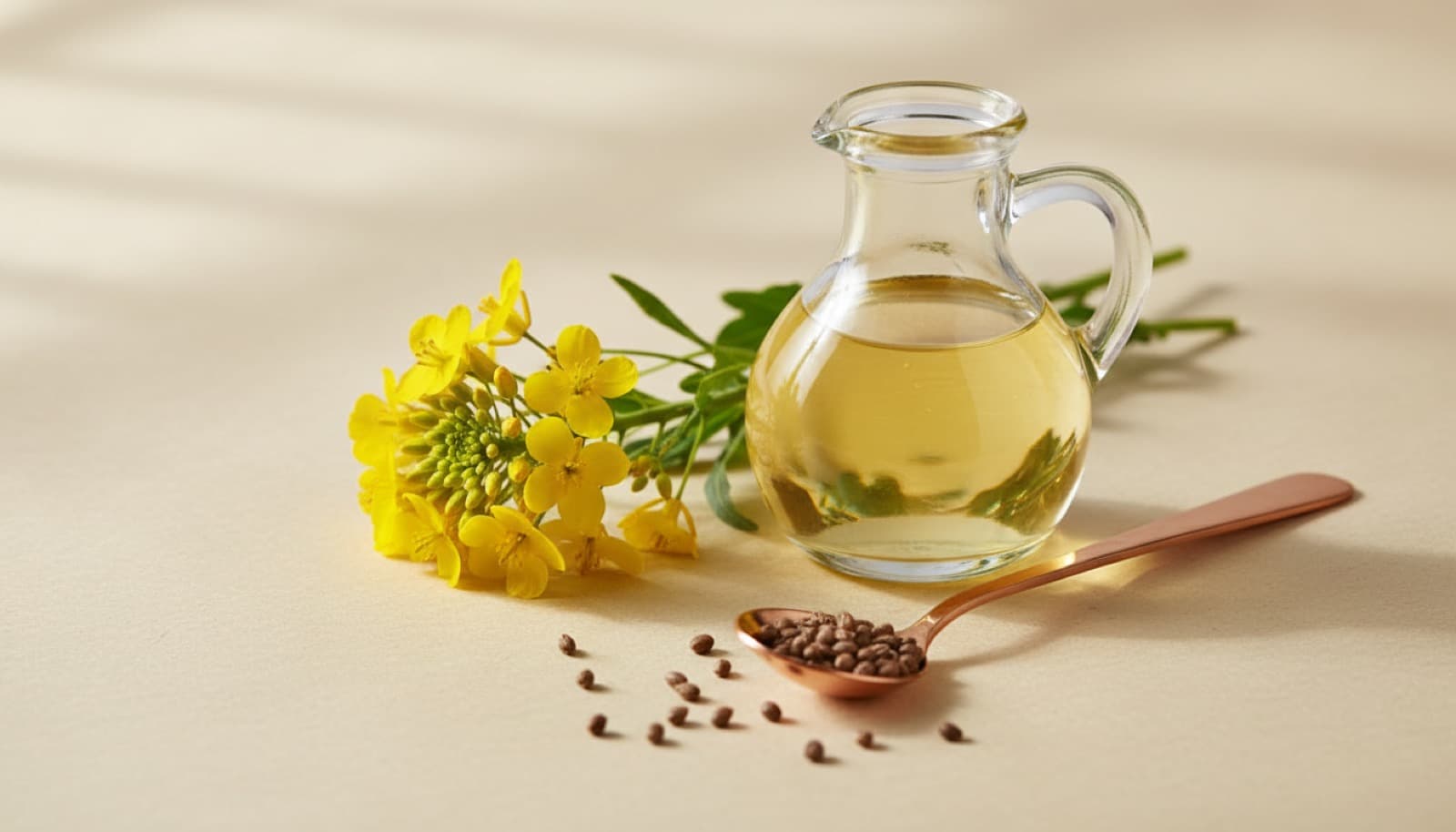
Canola is ~63% monounsaturated, ~10% ALA omega-3, low saturated, and neutral-to-favorable in lipid trials. The fear narrative outruns the data.
- 01
What canola oil actually is (the fatty-acid profile)
Canola is the oil of low-erucic-acid rapeseed (Brassica napus). USDA FoodData Central pegs the profile at ~7% saturated, ~63% monounsaturated (mostly oleic acid), and ~28% polyunsaturated, of which ~19% is linoleic acid (omega-6) and ~9-11% is alpha-linolenic acid (ALA, omega-3). That ALA fraction is the highest of any common supermarket oil except flaxseed, and the omega-6:omega-3 ratio (~2:1) is the lowest among mainstream seed oils. On saturated fat it beats olive oil (~14% sat) and butter (~63% sat). The profile is the opposite of what the panic narrative implies.
- 02
What the clinical trials show (lipids and CVD)
Controlled feeding trials are consistent: substituting canola for saturated fat lowers LDL cholesterol. A systematic review and meta-analysis (Amiri et al. 2020, 27 RCTs) found canola intake reduced LDL-C and total cholesterol versus other fat sources, with no adverse signal on triglycerides or HDL. An earlier review (Lin et al. 2013, Nutr Rev) reached the same direction. No randomized human trial has shown canola at normal dietary intakes producing harm on cardiovascular endpoints. The AHA fats advisory (Sacks et al. 2017) places oils like canola in the recommended-substitution category against saturated fat.
- 03
The omega-6 / linoleic acid concern, in context
The core fear is that canola's ~19% linoleic acid is pro-inflammatory. The human evidence does not support this. Johnson & Fritsche 2012 (J Acad Nutr Diet, systematic review of 15 RCTs) found that raising dietary linoleic acid did not significantly change circulating inflammatory markers (CRP, IL-6, TNF-alpha) in healthy adults. The original observation also conflates a single oil with total-diet intake: linoleic acid is set by the whole diet (Blasbalg 2011 documented the US shift from ~2% to ~7% of energy), not by one tablespoon of canola in a dressing. Context, not the bottle, is the variable.
- 04
Processing, hexane, and refining
Most commodity canola is solvent-extracted with food-grade hexane, then refined, bleached, and deodorized. This is the legitimate-sounding objection, but the residue numbers are small: refining removes the bulk of the solvent, and finished-oil hexane residues measured in low parts-per-million or below are far under intake levels associated with toxicity in the solvent (which is an inhalation, occupational concern, not an oral-trace one). Residues in finished, refined oil are typically well under 1 part per million, and hexane is a permitted extraction solvent under both FDA and EU rules. The trade-off refining buys is a high smoke point and oxidative stability. Expeller- and cold-pressed canola skips the solvent entirely for readers who want to remove the variable.
- 05
Oxidation and high-heat cooking
The real chemistry concern with any polyunsaturated-containing oil is thermal oxidation. Refined canola has a smoke point around ~200-204 C (~400 F), which covers saute, roast, and standard pan-frying. The ALA fraction is the most oxidation-prone component, so canola is a poor choice for repeated-use deep-frying held hot for hours (the same caveat applies to all seed oils, De Alzaa 2018). For a single home cook at or below its smoke point, degradation is minimal. Store it cool and dark; the failure modes are reuse, prolonged high heat, time, and light, not a quick stir-fry.
- 06
The erucic-acid and 'industrial lubricant' myth
The recurring claim that canola is 'engine oil' confuses modern canola with historical high-erucic-acid rapeseed. Erucic acid (a monounsaturated fat linked to heart changes in rodents) made up ~40-50% of old rapeseed oil. Canola was conventionally bred in the 1970s (the name is a contraction of 'Canadian oil, low acid') to contain under 2% erucic acid; US and Canadian food-grade canola is capped at that ceiling. The toxicity studies the myth cites used the old high-erucic oil at doses no human diet reaches. Modern food canola and industrial rapeseed are different products.
- 07
How it compares to olive oil and butter
Extra-virgin olive oil wins on cardiovascular trial depth (PREDIMED, Estruch 2013) and polyphenol content, and is the better default for dressings and moderate-heat cooking. Canola wins on price (often 2-4x cheaper per liter), a higher smoke point than most EVOO, a neutral flavor for baking, and the highest omega-3 (ALA) content of the common oils. Butter and ghee win only on very high, dry-heat searing. The decision matrix: EVOO as the flavor and salad default, canola as the cheap neutral workhorse for high-heat and baking, butter for sear. None of the three is a villain.
What people ask us next.
- Is canola oil inflammatory?
- The human evidence says no at normal intakes. The worry centers on linoleic acid (omega-6, ~19% of canola). Johnson & Fritsche 2012, a systematic review of 15 randomized controlled trials, found that increasing dietary linoleic acid did not significantly raise inflammatory markers (CRP, IL-6, TNF-alpha) in healthy adults. Canola also carries ~9-11% ALA (omega-3), giving it one of the lowest omega-6:omega-3 ratios of any supermarket oil (~2:1). The 'inflammation' claim is largely extrapolated from cell and high-heat oxidation studies, not from feeding trials of the oil itself.
- Is canola a seed oil, and are seed oils bad?
- Yes, canola is a seed oil. 'Seed oils are bad' bundles three separate claims that should be judged separately: linoleic-acid intake has risen over a century (true, Blasbalg 2011), repeated high-heat frying produces oxidation products (true, mostly a restaurant-fryer issue), and 'seed oils cause inflammation in humans' (weak, Johnson & Fritsche 2012). Most online discourse argues the third claim while citing studies from the second. For canola specifically, no RCT shows harm at dietary intakes, and the lipid data is favorable versus saturated fat.
- Is the hexane in canola oil dangerous?
- Most commodity canola is extracted with food-grade hexane, then refined to remove it. Residues in finished oil are typically very low, well under 1 part per million, and hexane is a permitted extraction solvent under FDA and EU rules. Hexane's documented toxicity is primarily an inhalation and occupational exposure concern, not an oral-trace-residue one at the levels found in refined oil. Readers who want to remove the variable entirely can buy expeller-pressed or cold-pressed canola, which uses no solvent.
- Canola vs olive oil for cooking?
- For dressings, finishing, and moderate-heat cooking where flavor matters, extra-virgin olive oil, it has the deepest cardiovascular trial evidence (PREDIMED, Estruch 2013) and polyphenols. For high-heat cooking, neutral-flavor baking, or cost-sensitive volume use, refined canola, smoke point ~200-204 C, neutral taste, and often 2-4x cheaper. Both are reasonable. The common framing of one as healthy and the other as harmful is not supported by trial data; both outperform butter on lipid endpoints in substitution studies.
- Does canola oil contain trans fats?
- Fresh, properly processed canola contains negligible trans fat (well under the 0.5 g per serving that allows a '0 g' US label, typically a fraction of a percent from the deodorization step). Trans fats become a concern only when oil is partially hydrogenated (an industrial process to make margarine and shortening, now largely banned in the US since the 2018 PHO removal) or when any oil is repeatedly overheated in a deep fryer. A bottle of liquid canola used at home is not a meaningful trans-fat source.
- Is cold-pressed or expeller-pressed canola better?
- It depends on what you are optimizing. Expeller- and cold-pressed canola use mechanical pressing with no hexane, retain more of the natural tocopherols and any color and flavor, and remove the solvent-residue question entirely. The trade-offs: lower smoke point than fully refined canola, shorter shelf stability, and a higher price. For high-heat cooking, refined performs better; for a salad dressing or low-heat use where you want the least-processed option, cold-pressed is the pick. Neither version has been shown to differ in health outcomes in trials.
Every claim, cited.
- [01]Amiri M et al. 2020. Effects of canola oil consumption on lipid profile: a systematic review and meta-analysis of randomized controlled clinical trials. J Am Coll Nutr 39(6):549-561.
- [02]Lin L, Allemekinders H, Dansby A et al. 2013. Evidence of health benefits of canola oil. Nutr Rev 71(6):370-385.
- [03]Johnson GH, Fritsche K. 2012. Effect of dietary linoleic acid on markers of inflammation in healthy persons: a systematic review of randomized controlled trials. J Acad Nutr Diet 112(7):1029-1041.
- [04]Sacks FM et al. 2017. Dietary fats and cardiovascular disease: a presidential advisory from the American Heart Association. Circulation 136(3):e1-e23.
- [05]USDA FoodData Central. Oil, canola (fatty-acid composition per 100 g).
The Larderlab Team builds evidence-led frameworks for eating, lifting, and stocking a kitchen. We cite every claim. We publish the spreadsheet when possible. We buy what we review at retail price. When new data lands, we revise with a dated note.
Next in this hub.
Is MSG Bad For You? The Evidence vs the Myth
The double-blind evidence does not support MSG sensitivity at normal dietary doses. What the trials, the biochemistry, and the 1968 scare actually show.
8 min · rev 2026-06-22Low-Histamine Foods: What the Evidence on Histamine Intolerance Shows
Histamine intolerance is not an allergy but a problem degrading histamine, and freshness matters more than any single food. The best-tolerated foods, which ones to avoid, why cooking does not help, and how an elimination diet, not a blood test, confirms it.
9 min · rev 2026-08-04Seed Oil vs Butter vs Olive Oil: The Data-Backed Answer
Three claims conflated into one debate, we separate the linoleic-acid, oxidation, and inflammation questions and state our position.
14 min · rev 2026-04-21Get the Larderlab Macro Planner.
A Google Sheet that calculates your protein target, splits it across 3-5 meals, and ranks 20 protein sources by $/gram. Free. Copy-and-modify your own version.
By subscribing, you agree to our Privacy Policy. Unsubscribe anytime.