How much vitamin C you actually need per day
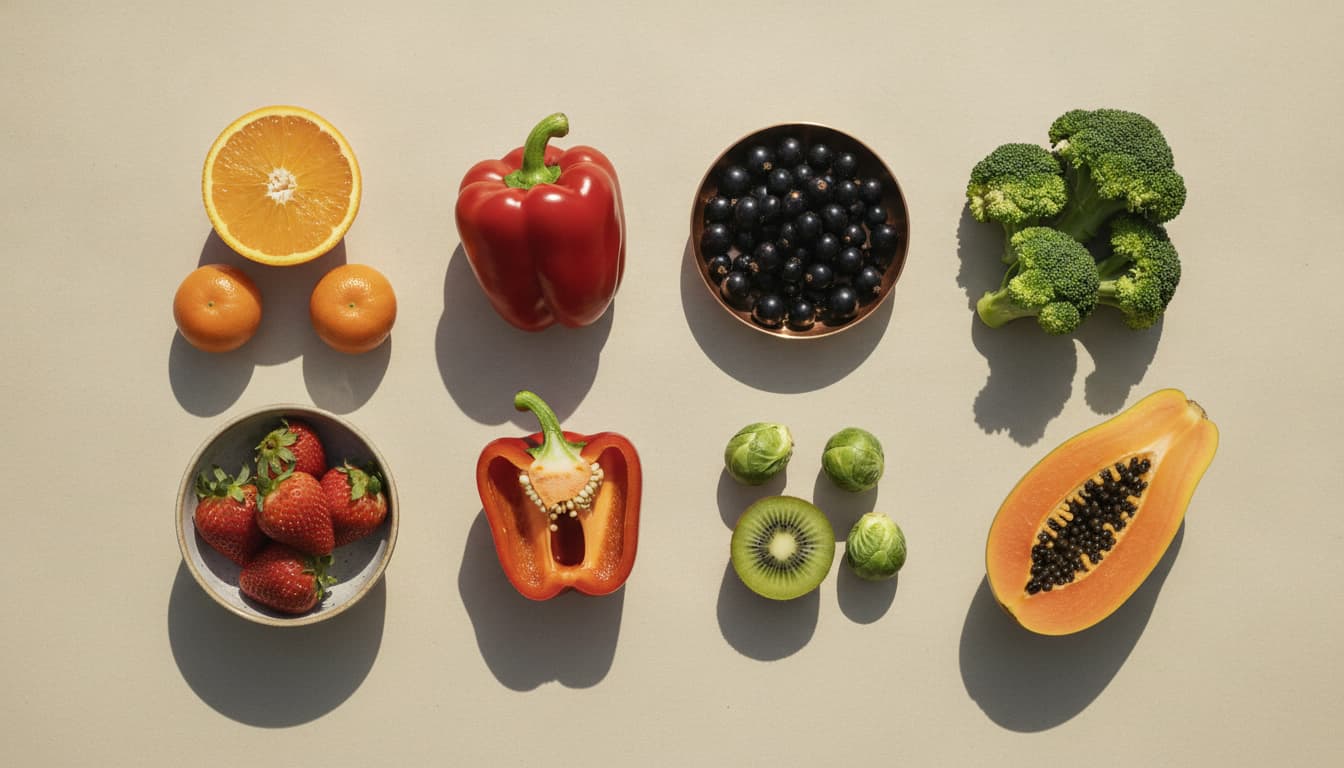
The RDA is 90 mg a day for men and 75 mg for women, and the body cannot store much beyond a saturation point around 200 to 400 mg. What the numbers are, why smokers need more, why megadoses are mostly excreted, and when high doses cause harm.
- 01
The RDA: 90 mg for men, 75 mg for women
The recommended dietary allowance for vitamin C is 90 mg a day for adult men and 75 mg for women, rising to 85 mg in pregnancy and 120 mg while breastfeeding (NIH ODS). These are small amounts by design, set to maintain adequate tissue levels with a safety margin. They are the numbers that actually matter for health, and they are far below the doses in most vitamin C supplements, which is the first sign that typical supplement sizes deliver far more than the body can use.
- 02
Smokers need an extra 35 mg
Smokers require an additional 35 mg of vitamin C a day, bringing the target to 125 mg for men and 110 mg for women, because smoking increases oxidative stress and the metabolic turnover of the vitamin (NIH ODS). People regularly exposed to secondhand smoke may also have higher needs. Even so, the increased target is still easily met by food, a couple of servings of fruit or vegetables, so it is a reason to eat more produce rather than to reach for high-dose supplements.
- 03
Food makes it easy: one orange covers a day
Meeting the vitamin C target through food is effortless: a medium orange provides about 70 mg, a kiwi around 70 mg, half a red bell pepper roughly 95 mg, and servings of broccoli, strawberries, or Brussels sprouts land in a similar range (USDA FoodData Central). A single serving of almost any of these covers a full day. This abundance is why scurvy is rare in people eating any fruit and vegetables, and why a supplement is unnecessary for most, a point we develop in our foods-high-in-vitamin-C ranking.
- 04
The saturation ceiling: 200 to 400 mg
The body's tissues saturate at a vitamin C intake somewhere around 200 to 400 mg a day, and above that point absorption efficiency drops and the kidneys excrete almost all the excess (NIH ODS). Blood levels plateau no matter how much more is taken. This is the single most useful fact about dosing: it means intakes far above a few hundred milligrams do not raise the vitamin C available to your tissues, so routine megadoses mostly produce expensive urine rather than any added benefit.
- 05
Why megadoses do little for colds
The saturation ceiling explains the disappointing evidence on high-dose vitamin C and the common cold: regular supplementation does not prevent colds in the general population and shortens them only marginally, on the order of less than a day (NIH ODS; Cochrane reviews). The idea took hold decades ago but has not held up in trials. There may be a small benefit for people under extreme physical stress, but for everyday cold prevention, high-dose vitamin C is not supported by the evidence.
- 06
The upper limit: 2,000 mg and when it matters
The tolerable upper intake level is 2,000 mg a day, set because higher intakes commonly cause diarrhea, nausea, and abdominal cramps as unabsorbed vitamin C draws water into the gut (NIH ODS). Very high doses also increase urinary oxalate, which can raise kidney stone risk in susceptible people, and people with hemochromatosis should be cautious because vitamin C boosts iron absorption. These downsides, combined with the saturation ceiling, are why staying near the RDA from food is the sensible default.
What people ask us next.
- How much vitamin C do I need per day?
- The RDA is 90 mg a day for adult men and 75 mg for women, rising to 85 mg in pregnancy and 120 mg while breastfeeding, with an extra 35 mg for smokers (NIH ODS). These are small amounts easily met by food: a single orange, kiwi, or half a red bell pepper covers a full day. Most people do not need a supplement, because any diet with some fruit and vegetables reaches the target comfortably.
- Is it safe to take 1,000 mg of vitamin C a day?
- It is below the 2,000 mg upper limit, so it is generally safe for healthy people, but it is also largely unnecessary. The body's tissues saturate around 200 to 400 mg a day, so most of a 1,000 mg dose is simply excreted (NIH ODS). At doses approaching or above 1,000 mg, some people experience diarrhea and stomach upset, and very high intakes can raise urinary oxalate and kidney stone risk in susceptible people. For most, there is no benefit over meeting the RDA from food.
- Does vitamin C prevent colds?
- Not for most people. Large reviews find that regular vitamin C supplementation does not prevent colds in the general population and shortens them only marginally, by less than a day on average (NIH ODS; Cochrane). There may be a small benefit for people under extreme physical stress, such as marathon runners. The popular belief in megadose vitamin C for colds dates back decades but has not been borne out by trials, partly because the body cannot use much beyond its saturation point.
- Can you take too much vitamin C?
- Yes, from supplements. The tolerable upper intake level is 2,000 mg a day, above which unabsorbed vitamin C commonly causes diarrhea, nausea, and abdominal cramps by drawing water into the gut (NIH ODS). Very high doses also increase urinary oxalate, which can raise kidney stone risk in susceptible people, and people with iron-overload conditions like hemochromatosis should be cautious because vitamin C increases iron absorption. You cannot overdose from food, only from high-dose supplements.
- Should I take a vitamin C supplement?
- For most people, no. The RDA of 75 to 90 mg is easily met by a normal diet, since a single serving of many fruits and vegetables covers a full day, and the body cannot store or use much beyond its saturation point around 200 to 400 mg (NIH ODS). Supplements make sense mainly for people with very restricted diets, certain medical conditions, or documented deficiency. For everyone else, food is the better source and provides fiber and other nutrients alongside the vitamin C.
Every claim, cited.
The Larderlab Team builds evidence-led frameworks for eating, lifting, and stocking a kitchen. We cite every claim. We publish the spreadsheet when possible. We buy what we review at retail price. When new data lands, we revise with a dated note.
Next in this hub.
Best Vitamin D Supplement, Ranked by $/1000 IU
Vitamin D3 supplements ranked by $/1000 IU of cholecalciferol, with D3-vs-D2, K2/magnesium cofactor notes, and third-party testing status.
10 min · rev 2026-06-22L-Theanine Benefits: The Caffeine Pairing Has the Evidence, the Solo Dose Mostly Does Not
A 200 ml cup of black tea holds 24.2 mg of L-theanine, so a 200 mg capsule is roughly eight cups. Pooled trials show attention switching accuracy improved with caffeine at a standardised mean difference of 0.33, while EFSA found no cause and effect for theanine alone.
14 min · rev 2026-09-07NMN Supplements: The Regulator Changed Its Mind in 2025, and the Biomarker Still Is Not the Outcome
FDA reversed itself on 29 September 2025 and determined NMN is not excluded from the dietary supplement definition. Blood NAD rose at 300, 600 and 900 mg, while the largest positive outcome trial moved one tissue in 25 people.
14 min · rev 2026-09-05Get the Larderlab Macro Planner.
A Google Sheet that calculates your protein target, splits it across 3-5 meals, and ranks 20 protein sources by $/gram. Free. Copy-and-modify your own version.
By subscribing, you agree to our Privacy Policy. Unsubscribe anytime.