How much iron you actually need per day
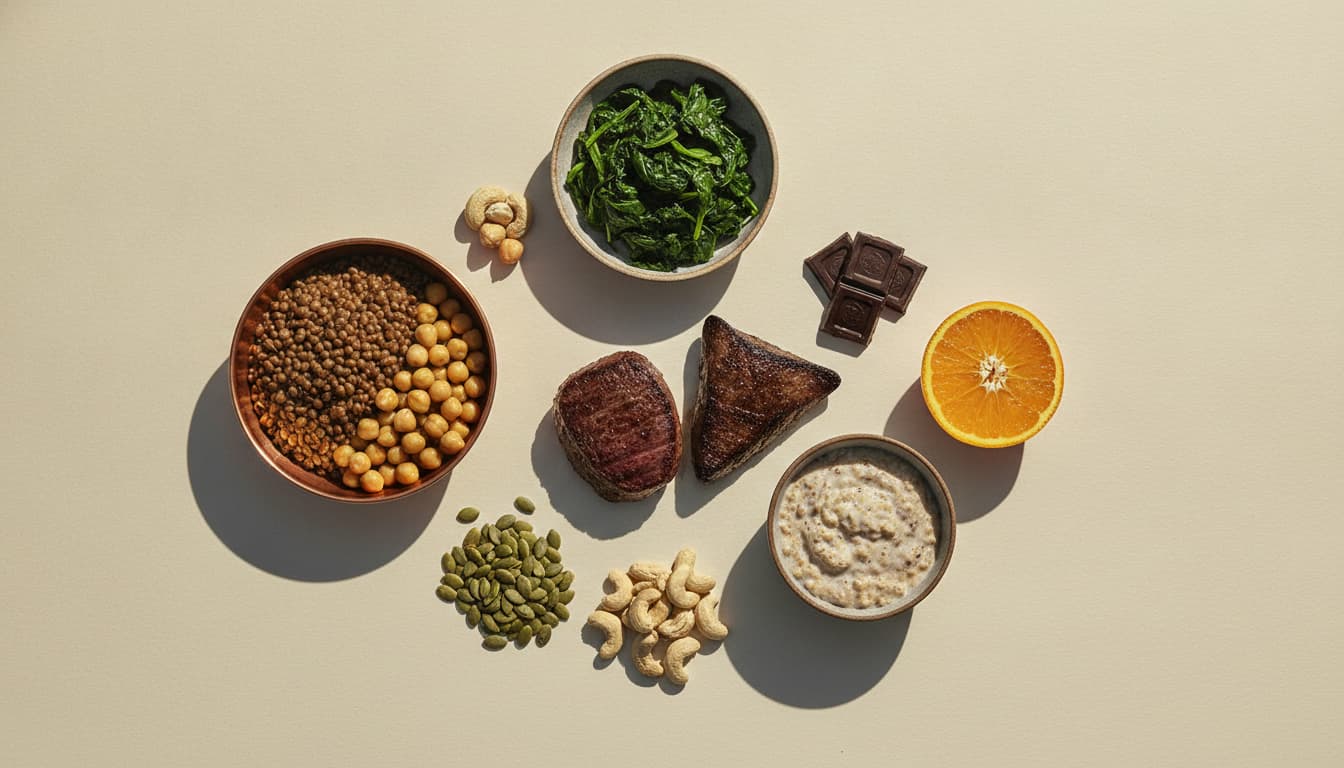
The RDA is 8 mg a day for men but 18 mg for premenopausal women, one of the biggest sex differences in nutrition. The numbers, why heme and non-heme iron differ, why vitamin C helps, and why you should not supplement without testing.
- 01
The numbers: 8 mg men, 18 mg premenopausal women
The RDA for iron is 8 mg a day for adult men and postmenopausal women, but 18 mg for women aged 19 to 50 because of menstrual losses, and 27 mg during pregnancy (NIH ODS). This more-than-double difference for menstruating women is one of the largest sex differences in all of nutrition. It is why iron deficiency is the most common nutrient deficiency worldwide and why the practical advice about iron depends so heavily on age, sex, and life stage rather than a single universal number.
- 02
Heme vs non-heme iron: absorption differs
Heme iron, from meat, poultry, and fish, is absorbed efficiently and consistently, while non-heme iron, from plants, eggs, and fortified foods, is absorbed much less well and depends heavily on the rest of the meal (NIH ODS). This is the central practical fact about iron: the same milligram figure means very different things depending on the source. It is why meat-eaters reach their target more easily and why plant-based eaters need to think about both quantity and absorption.
- 03
Vitamin C helps; tea, coffee, and calcium hinder
Vitamin C markedly boosts the absorption of non-heme iron, so pairing plant iron with citrus, peppers, or tomatoes makes a real difference, while the tannins in tea and coffee, calcium, and the phytates in whole grains and legumes reduce it (NIH ODS). For anyone relying on plant iron, timing matters: having a vitamin-C source with iron-rich meals and separating tea or coffee from them improves uptake. This is one of the most actionable levers in the whole topic.
- 04
Vegetarians need about 1.8 times the RDA
Because non-heme iron from plants is absorbed less efficiently, vegetarians and vegans are advised to aim for roughly 1.8 times the RDA (NIH ODS). Combined with the higher requirement for menstruating women, a premenopausal vegetarian woman has one of the highest iron targets of anyone. The practical response is to eat iron-rich plant foods, legumes, tofu, fortified grains, seeds, and dark greens, regularly and to pair them with vitamin C, rather than assuming a plant-based diet automatically supplies enough.
- 05
Do not supplement without testing
This is the most important safety point: iron is a nutrient where excess is genuinely harmful, and the body cannot easily excrete a surplus (NIH ODS). High intake causes gastrointestinal side effects, and in people with the common genetic condition hemochromatosis, iron overload damages organs. The upper limit is 45 mg a day, and accidental overdose is a leading cause of poisoning in young children. Iron supplements should be taken only when a blood test confirms deficiency, not as a routine just-in-case measure.
- 06
Who actually needs to focus on iron
The message splits sharply by group. Men and postmenopausal women meet their lower 8 mg target from food easily and rarely need to think about iron (NIH ODS). Menstruating women, pregnant women, vegetarians and vegans, endurance athletes, and frequent blood donors are the groups for whom iron genuinely deserves attention. For them, the focus should be iron-rich foods and vitamin-C pairings, with supplements reserved for confirmed deficiency, an approach we develop in our foods-high-in-iron guide.
What people ask us next.
- How much iron do I need a day?
- The RDA is 8 mg a day for adult men and postmenopausal women, but 18 mg for women aged 19 to 50 because of menstrual losses, and 27 mg during pregnancy (NIH ODS). Vegetarians and vegans need roughly 1.8 times these amounts because plant iron is absorbed less efficiently. This is one of the largest sex- and life-stage differences in nutrition, which is why iron advice depends so heavily on who you are rather than a single universal figure.
- Why do women need more iron than men?
- Because menstruation causes regular iron losses. Women aged 19 to 50 need 18 mg a day, more than double the 8 mg for men, to replace the iron lost through menstrual bleeding, and the requirement rises to 27 mg in pregnancy to support the expanding blood volume and the growing fetus (NIH ODS). After menopause, when menstrual losses stop, women's requirement drops to the same 8 mg as men. This is why iron deficiency is concentrated in menstruating and pregnant women.
- What is the difference between heme and non-heme iron?
- Heme iron comes from animal sources, meat, poultry, and fish, and is absorbed efficiently and consistently, while non-heme iron comes from plants, eggs, and fortified foods and is absorbed much less well, with its uptake heavily influenced by other foods in the meal (NIH ODS). This is why the same milligram amount means very different things depending on the source, and why vegetarians, relying on non-heme iron, need to aim higher and pair it with vitamin C.
- Does vitamin C help iron absorption?
- Yes, markedly, for non-heme iron. Having a source of vitamin C, citrus, peppers, tomatoes, or strawberries, in the same meal as plant iron significantly increases how much is absorbed (NIH ODS). Conversely, the tannins in tea and coffee, calcium, and the phytates in whole grains and legumes reduce non-heme iron absorption. For anyone relying on plant iron, pairing it with vitamin C and separating iron-rich meals from tea or coffee are among the most effective steps.
- Should I take an iron supplement?
- Only if a blood test confirms you are deficient, ideally under medical guidance. Iron is a nutrient where excess is genuinely harmful: the body cannot easily excrete a surplus, high intake causes gastrointestinal side effects, and in people with hemochromatosis iron overload damages organs (NIH ODS). The upper limit is 45 mg a day. Taking iron just in case is a real risk, not a harmless habit, so unlike some nutrients, iron should never be supplemented routinely without confirming a need.
Every claim, cited.
The Larderlab Team builds evidence-led frameworks for eating, lifting, and stocking a kitchen. We cite every claim. We publish the spreadsheet when possible. We buy what we review at retail price. When new data lands, we revise with a dated note.
Next in this hub.
How Much Calcium Per Day: The Numbers by Age, and the Supplement Debate
The RDA is 1,000 mg a day for most adults and 1,200 mg for older women and men, but more is not better. The numbers by age, why food beats supplements, the vitamin D connection, and the evidence behind concerns about calcium pills and the heart.
8 min · rev 2026-08-12How Much Magnesium Per Day? The RDA, by Age and Sex
The RDA is 400-420 mg/day for men and 310-320 mg/day for women. The supplemental upper limit is 350 mg/day. The daily magnesium number by age, sex, and source.
8 min · rev 2026-06-28How Much Vitamin C Per Day: The Real Numbers, Not the Megadose Myth
The RDA is 90 mg a day for men and 75 mg for women, and the body cannot store much beyond a saturation point around 200 to 400 mg. What the numbers are, why smokers need more, why megadoses are mostly excreted, and when high doses cause harm.
7 min · rev 2026-08-12Get the Larderlab Macro Planner.
A Google Sheet that calculates your protein target, splits it across 3-5 meals, and ranks 20 protein sources by $/gram. Free. Copy-and-modify your own version.
By subscribing, you agree to our Privacy Policy. Unsubscribe anytime.