Foods high in niacin, ranked by milligrams
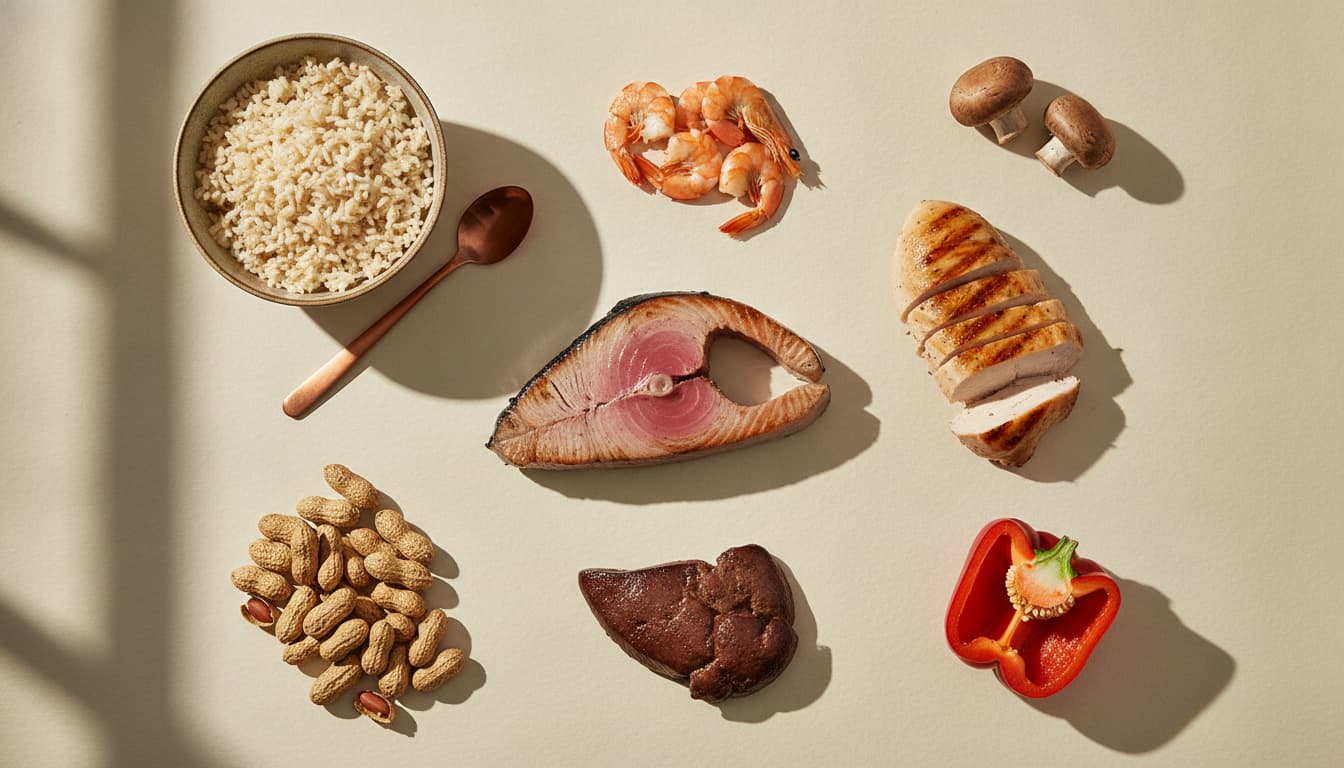
The RDA is 16 mg for men and 14 mg for women, and a single serving of tuna, chicken breast, or turkey covers most of it. The mg-per-serving ranking, why the body also makes niacin from tryptophan, and why the flushing dose is a drug, not a food.
- 01
Tuna: ~11 mg per 3 oz, the leader
A 3 oz serving of cooked tuna carries ~11 mg of niacin, more than a woman's full daily target and most of a man's in one portion (USDA FoodData Central). Light tuna is also lower in mercury than albacore, so it doubles as one of the better everyday fish. It pairs the niacin with lean complete protein and, in the oily species, omega-3 fats, which is why fish sits at the top of so many B-vitamin rankings on this site.
- 02
Chicken breast and turkey: ~10 mg per 3 oz
A 3 oz chicken breast supplies ~10 mg of niacin and turkey a similar amount, so a normal serving covers most of the day (NIH ODS). Poultry is the most accessible reliable source for people who do not eat fish, and the white meat is slightly higher than the dark. The turkey figure also feeds a common myth: it is the tryptophan and niacin content, not a sedative effect, that people misremember as the cause of post-dinner drowsiness.
- 03
Salmon, other fish, and beef: ~7-9 mg per 3 oz
Salmon carries ~8.5 mg of niacin per 3 oz, other fish land in the 7 to 9 mg range, and beef and pork contribute ~4 to 6 mg (USDA). These are the mid-list protein sources that, eaten in normal portions, comfortably close the gap to the daily target. Because niacin is spread across essentially all animal protein, anyone eating meat or fish most days is well above the requirement without trying.
- 04
Peanuts, seeds, and legumes: ~2-4 mg per serving
Peanuts carry ~4 mg of niacin per ounce, with sunflower seeds and legumes lower, making them the leading plant sources outside fortified grains (NIH ODS; USDA). They matter most for vegetarians, who also lean on the tryptophan-to-niacin conversion from plant protein. A handful of peanuts plus fortified bread and a serving of legumes covers the target on a meat-free diet without special planning.
- 05
Fortified grains, brown rice, and mushrooms
Fortified breakfast cereals and enriched breads can supply several milligrams to a full day of niacin per serving, and brown rice, whole wheat, and mushrooms add a couple of milligrams each (USDA). Fortification is the quiet reason pellagra disappeared from wheat-eating countries. Note that the niacin in unprocessed corn is bound and poorly absorbed unless the corn is treated with alkali (nixtamalization), the traditional step that historically prevented pellagra in maize-based diets.
- 06
Flushing niacin: a drug dose, not a food
The high-dose nicotinic acid sold for cholesterol, often 500 to 2,000 mg, is a pharmacological dose that causes an intense, harmless but uncomfortable skin flush, and at that level it lowers LDL and raises HDL (NIH ODS). But large trials adding niacin to statins found no reduction in heart attacks or strokes and more side effects, so the practice has largely been abandoned. The tolerable upper intake level for supplemental niacin is 35 mg. None of this applies to the milligram amounts in food.
How this was specified
- 01Inputs measured
- Retail price (dated) · label claim · Certificate of Analysis · third-party test (Informed Sport / NSF / ConsumerLab / Clean Label) · leucine per serving from COA, not marketing.
- 02Protocols tested
- Per-kg target from four literature ranges (IOM RDA, Phillips 2017, Morton 2018, ISSN). Brands scored against Moore 2015 leucine-per-dose threshold (~0.4 g/kg).
- 03Cost-basis verified
- $/gram of protein and $/gram of leucine at warehouse pricing (Costco), mail-order (Amazon), and DTC retail. Re-checked quarterly, flagged when drift exceeds 15%.
- 04Confidence level
- High on ranked order. Medium on absolute $/g (prices drift). Low on serving-size claims where COA is older than 18 months, flagged [VERIFY].
Every claim, cited.
The Larderlab Team builds evidence-led frameworks for eating, lifting, and stocking a kitchen. We cite every claim. We publish the spreadsheet when possible. We buy what we review at retail price. When new data lands, we revise with a dated note.
Next in this hub.
Foods High in Thiamin (Vitamin B1): The Densest Sources, by Milligrams
The RDA is 1.2 mg a day for men and 1.1 mg for women, and pork, fortified grains, legumes, and sunflower seeds cover it easily. The mg-per-serving ranking, why refined grains are fortified for a reason, and who is actually at risk of deficiency.
7 min · rev 2026-08-14Foods High in Riboflavin (Vitamin B2): The Densest Sources, by Milligrams
The RDA is 1.3 mg a day for men and 1.1 mg for women, and dairy, eggs, organ meats, and fortified cereals cover it easily. The mg-per-serving ranking, why milk in clear bottles loses it, and why bright yellow urine is nothing to worry about.
7 min · rev 2026-08-14Foods High in Vitamin E: The Densest Sources, by Milligrams
The RDA is 15 mg of alpha-tocopherol a day, and a single ounce of sunflower seeds or almonds covers roughly half of it. The mg-per-serving ranking, why the oils and nuts dominate, and why deficiency is rare but supplements can backfire.
8 min · rev 2026-08-06Get the Larderlab Macro Planner.
A Google Sheet that calculates your protein target, splits it across 3-5 meals, and ranks 20 protein sources by $/gram. Free. Copy-and-modify your own version.
By subscribing, you agree to our Privacy Policy. Unsubscribe anytime.