Foods high in vitamin E, ranked by milligrams
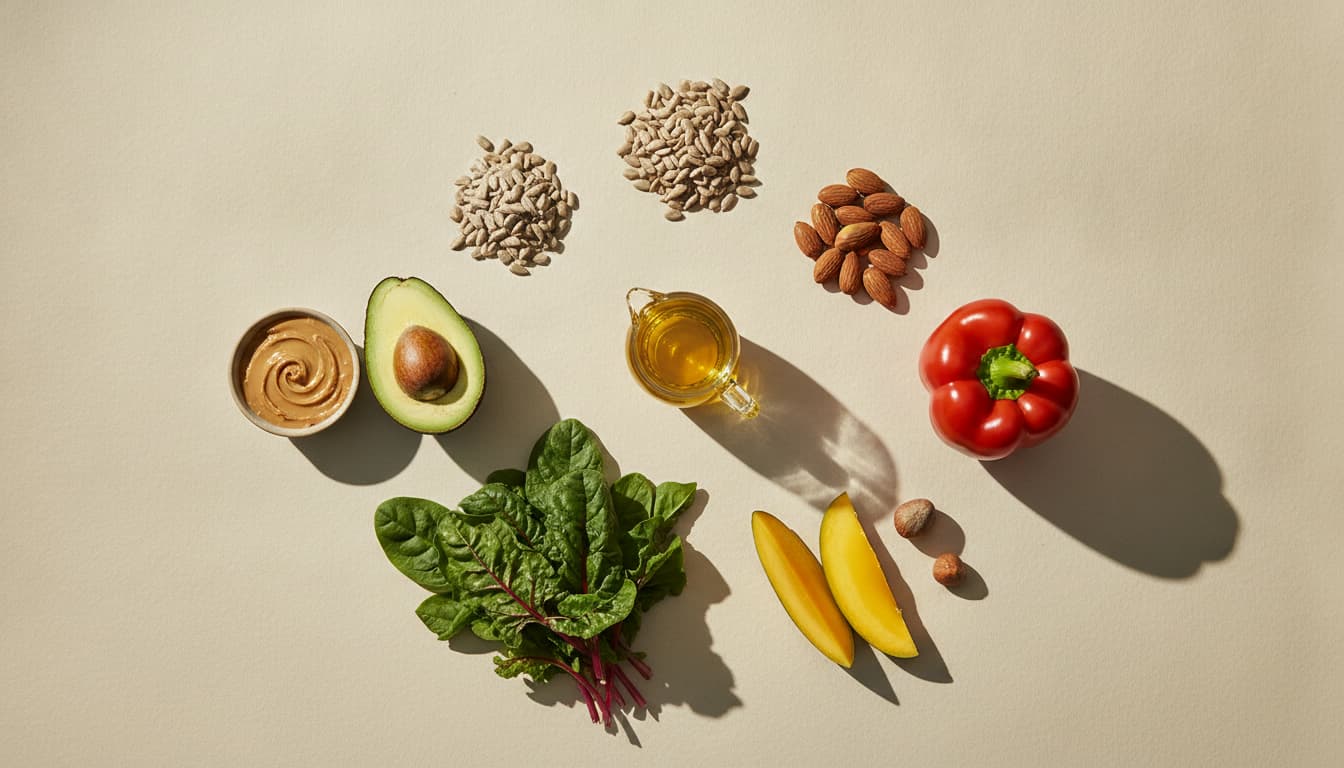
The RDA is 15 mg of alpha-tocopherol a day, and a single ounce of sunflower seeds or almonds covers roughly half of it. The mg-per-serving ranking, why the oils and nuts dominate, and why deficiency is rare but supplements can backfire.
- 01
Wheat germ oil: ~20 mg per tablespoon, the outlier
Wheat germ oil is in a class of its own at roughly 20 mg of alpha-tocopherol per tablespoon, more than a full day's target in a single spoon (USDA FoodData Central). It is too strong-flavored and heat-sensitive to cook with, so it is used raw, drizzled over finished dishes. Almost nobody eats it, but it anchors the top of the ranking and shows just how concentrated vitamin E is in the germ of a seed, the part refined grains discard.
- 02
Sunflower seeds and almonds: ~7.3-7.4 mg per ounce
An ounce of sunflower seeds delivers ~7.4 mg and an ounce of almonds ~7.3 mg, so a small handful of either covers close to half the daily target (NIH ODS). These are the realistic everyday sources: portable, shelf-stable, and eaten in the kind of quantities that add up. They stack vitamin E with magnesium, healthy fats, and plant protein, which is why a seed or nut habit is one of the simplest ways to keep this nutrient topped up without thinking about it.
- 03
Hazelnuts, pine nuts, and peanut butter: ~2-4 mg per serving
Hazelnuts carry ~4.3 mg per ounce, pine nuts and peanut butter land around 2-3 mg per serving, filling the high-middle of the list (USDA). None is a standout on its own, but because they turn up in spreads, trail mixes, and baking, they form a steady background contribution. The pattern holds: the vitamin E in nuts sits in their oil, so the fattier the nut, the more it tends to carry.
- 04
Sunflower, safflower, and olive oil: ~1.9-5.6 mg per tablespoon
Sunflower oil supplies ~5.6 mg per tablespoon, safflower oil a similar amount, and olive oil ~1.9 mg (NIH ODS; USDA). Because oil is used in cooking almost every day, these are the sources most people actually rely on without noticing. It is also why the vitamin E content of a diet tracks closely with the type and amount of cooking oil used, and why very low-fat diets can quietly run short.
- 05
Avocado, leafy greens, red pepper, and mango: ~1-4 mg per serving
Among whole foods, a whole avocado carries ~4 mg, cooked spinach and Swiss chard ~2-3 mg per half cup, and red pepper and mango a milligram or two each (USDA FoodData Central). These are the sources that matter for people who eat little added oil, and they bring fiber, potassium, and carotenoids along with the vitamin E. No single serving is large, but together they explain why a vegetable-rich diet rarely falls short even without nuts or oils.
- 06
Why supplements are the wrong route
High-dose vitamin E supplements, typically 400 IU and up, are the one place to be cautious: large trials found no protection against heart disease or cancer, some evidence of higher all-cause mortality, and at very high doses an increased bleeding risk, especially alongside blood thinners (NIH ODS). Food-form vitamin E has none of these problems. This is the recurring lesson of fat-soluble vitamins on this site: the isolated high dose behaves differently, and often worse, than the same nutrient bound to whole food.
How this was specified
- 01Inputs measured
- Retail price (dated) · label claim · Certificate of Analysis · third-party test (Informed Sport / NSF / ConsumerLab / Clean Label) · leucine per serving from COA, not marketing.
- 02Protocols tested
- Per-kg target from four literature ranges (IOM RDA, Phillips 2017, Morton 2018, ISSN). Brands scored against Moore 2015 leucine-per-dose threshold (~0.4 g/kg).
- 03Cost-basis verified
- $/gram of protein and $/gram of leucine at warehouse pricing (Costco), mail-order (Amazon), and DTC retail. Re-checked quarterly, flagged when drift exceeds 15%.
- 04Confidence level
- High on ranked order. Medium on absolute $/g (prices drift). Low on serving-size claims where COA is older than 18 months, flagged [VERIFY].
Every claim, cited.
The Larderlab Team builds evidence-led frameworks for eating, lifting, and stocking a kitchen. We cite every claim. We publish the spreadsheet when possible. We buy what we review at retail price. When new data lands, we revise with a dated note.
Next in this hub.
Foods High in Thiamin (Vitamin B1): The Densest Sources, by Milligrams
The RDA is 1.2 mg a day for men and 1.1 mg for women, and pork, fortified grains, legumes, and sunflower seeds cover it easily. The mg-per-serving ranking, why refined grains are fortified for a reason, and who is actually at risk of deficiency.
7 min · rev 2026-08-14Foods High in Riboflavin (Vitamin B2): The Densest Sources, by Milligrams
The RDA is 1.3 mg a day for men and 1.1 mg for women, and dairy, eggs, organ meats, and fortified cereals cover it easily. The mg-per-serving ranking, why milk in clear bottles loses it, and why bright yellow urine is nothing to worry about.
7 min · rev 2026-08-14Foods High in Vitamin B6: The Densest Sources, by Milligrams
The RDA is 1.3 mg a day for most adults, and chickpeas, tuna, salmon, and chicken breast each cover a third to half of it per serving. The mg-per-serving ranking, why the vitamin is spread across animal and plant foods, and why the supplement upper limit matters.
8 min · rev 2026-08-06Get the Larderlab Macro Planner.
A Google Sheet that calculates your protein target, splits it across 3-5 meals, and ranks 20 protein sources by $/gram. Free. Copy-and-modify your own version.
By subscribing, you agree to our Privacy Policy. Unsubscribe anytime.