Food date labels, and the one product where the date is a safety date
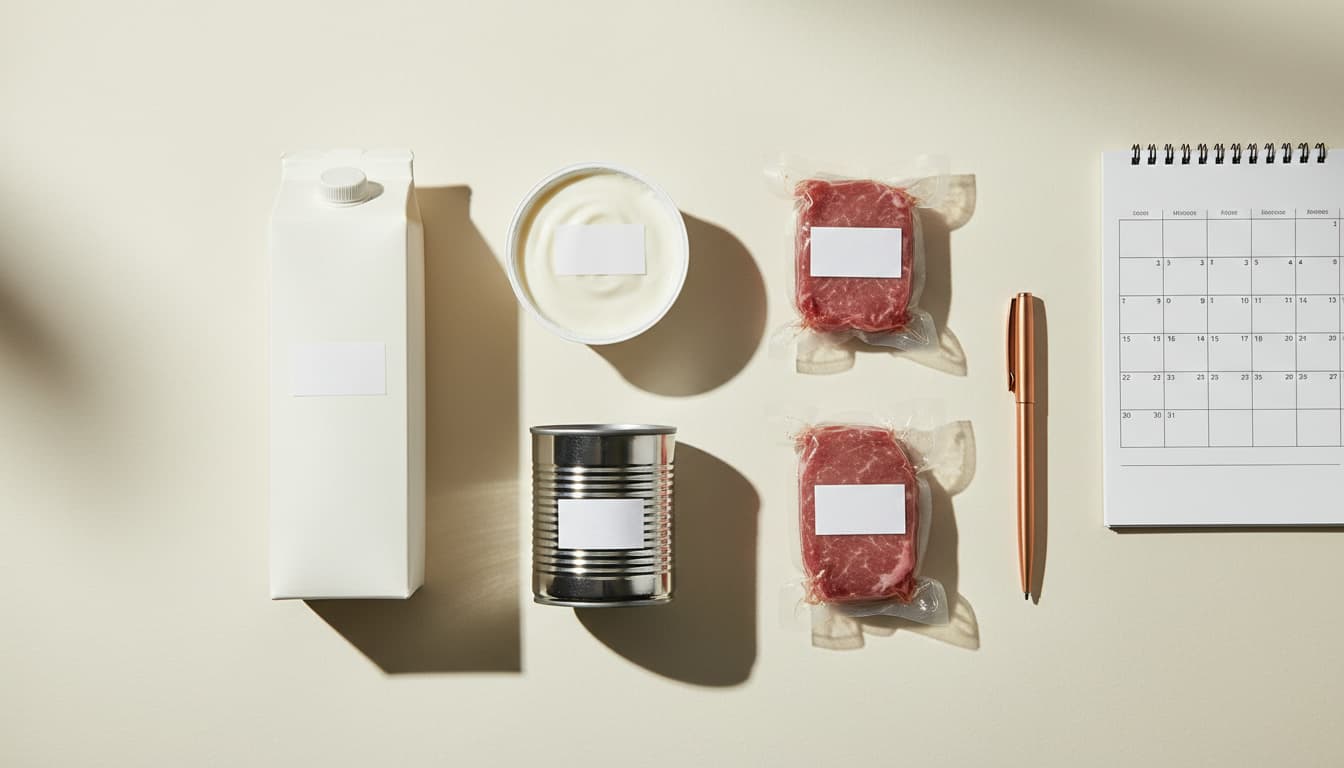
Except for infant formula, product dating is not required by federal regulation and dates are not safety indicators. Four phrases, four different jobs, and a 30 percent waste figure attached to the confusion.
- 01
Only one product carries a regulated date
Except for infant formula, product dating is not required by Federal regulations, and except for infant formula, dates are not an indicator of the product's safety (USDA FSIS). The FDA states the same for packaged food generally: except for infant formula, manufacturers are not required by Federal law or regulation to place quality-based date labels on packaged food (FDA). Everything else on the shelf is voluntary.
- 02
Best if Used By: flavour and quality
A Best if Used By or Best if Used Before date indicates when a product will be of best flavour or quality, and it is not a purchase or safety date (USDA FSIS). This is the phrase both agencies want standardised, on the basis that research shows it conveys to consumers that the product will be of best quality if used by the calendar date rather than that it becomes unsafe afterwards.
- 03
Sell-By: an instruction to the shop, not the shopper
A Sell-By date tells the store how long to display the product for sale for inventory management, and it is not a safety date (USDA FSIS). It was never addressed to the household at all, which is why treating it as a personal deadline discards food that has most of its quality window remaining after purchase.
- 04
Use-By: peak quality, except on infant formula
A Use-By date is the last date recommended for the use of the product while at peak quality, and it is not a safety date except for when used on infant formula (USDA FSIS). Infant formula is required to bear a Use By date up to which the manufacturer has confirmed the product contains no less than a minimum amount of each nutrient identified on the label and will be of acceptable quality (FDA).
- 05
Freeze-By: a timing instruction, not a limit
A Freeze-By date indicates when a product should be frozen to maintain peak quality, and it is not a purchase or safety date (USDA FSIS). It is the only one of the four that tells you to do something rather than to stop doing something, and it is the most useful of the four for a household running a cook-once weekly cadence.
- 06
The format is regulated even though the date is not
Where dates are voluntarily applied to meat, poultry and egg products they must be truthful and not misleading, a calendar date must express both the month and the day of the month, the year must also be displayed on shelf-stable and frozen products, and immediately adjacent to the date there must be a phrase explaining its meaning such as Best if Used By (USDA FSIS). A bare number is not a compliant date.
- 07
The date encodes assumptions you cannot see
The length of time and temperature at which a food is held during distribution and offered for sale, the characteristics of the food and the type of packaging all affect how long a product will be of optimum quality, and manufacturers consider these when setting the date; sausage formulated to preserve quality or beef in a modified atmosphere pack typically holds quality longer (USDA FSIS). The date describes a handling assumption, not your kitchen.
- 08
The waste figure attached to the confusion
USDA estimates that 30 percent of the food supply is lost or wasted at the retail and consumer levels, and one source of that waste arises from consumers or retailers throwing away wholesome food because of confusion about the meaning of dates displayed on the label (USDA FSIS). This is the reason the standardisation push exists at all, and the reason a household date policy is worth writing down.
What people ask us next.
- Is food unsafe after the best by date?
- No. Except for infant formula, dates are not an indicator of the product's safety and product dating is not required by Federal regulations (USDA FSIS). A Best if Used By or Best if Used Before date indicates when a product will be of best flavour or quality and is not a purchase or safety date. The quality of perishable products may deteriorate after the date passes, but such products should still be safe if handled properly.
- What is the difference between sell-by and use-by?
- They address different parties. A Sell-By date tells the store how long to display the product for sale for inventory management and is not a safety date. A Use-By date is the last date recommended for the use of the product while at peak quality, and it is not a safety date except for when used on infant formula (USDA FSIS). Neither is a deadline for the household, with that single exception.
- Why is infant formula treated differently?
- Because its date is a specification rather than a quality estimate. Infant formula products are required to bear a Use By date, up to which the manufacturer has confirmed that the product contains no less than a minimum amount of each nutrient identified on the product label, and that the product will be of an acceptable quality (FDA). It is a nutrient-content guarantee, and it is the only date on a food package required by federal law.
- How should I judge whether something has actually gone off?
- By inspection against the storage conditions the date assumes. Consumers must evaluate the quality of the product prior to its consumption to determine if the product shows signs of spoilage, and products past their date that have changed noticeably in colour, consistency or texture are best avoided (USDA FSIS; FDA). Keeping the refrigerator at 40 degrees Fahrenheit or below and the freezer at 0 degrees Fahrenheit or below is what makes that judgement reliable.
- Which phrase should I trust most on a label?
- Best if Used By, because both agencies are pushing it as the standard and it is the phrase with the clearest meaning. FSIS recommends that manufacturers and retailers that apply product dating use a Best if Used By date, and FDA supports efforts by the food industry to make Best if Used By the standard phrase to indicate the date when a product will be at its best flavour and quality (USDA FSIS; FDA). Anything else on the pack is a variation on the same quality claim.
Every claim, cited.
- [01]USDA Food Safety and Inspection Service. Food Product Dating. Except for infant formula, product dating is not required by Federal regulations. For meat, poultry, and egg products under FSIS jurisdiction, dates may be voluntarily applied provided they are labeled in a manner that is truthful and not misleading; a calendar date must express both the month and the day of the month, and in the case of shelf-stable and frozen products the year must also be displayed; immediately adjacent to the date must be a phrase explaining the meaning of that date such as Best if Used By. Except for infant formula, dates are not an indicator of the product's safety and are not required by Federal law. A Best if Used By/Before date indicates when a product will be of best flavor or quality and is not a purchase or safety date. A Sell-By date tells the store how long to display the product for sale for inventory management and is not a safety date. A Use-By date is the last date recommended for the use of the product while at peak quality and is not a safety date except for when used on infant formula. A Freeze-By date indicates when a product should be frozen to maintain peak quality and is not a purchase or safety date. Factors including the length of time and the temperature at which a food is held during distribution and offered for sale, the characteristics of the food, and the type of packaging affect how long a product will be of optimum quality. The quality of perishable products may deteriorate after the date passes; however, such products should still be safe if handled properly, and consumers must evaluate the quality of the product prior to its consumption. USDA estimates that 30 percent of the food supply is lost or wasted at the retail and consumer levels, and one source of food waste arises from consumers or retailers throwing away wholesome food because of confusion about the meaning of dates displayed on the label; FSIS recommends that food manufacturers and retailers that apply product dating use a Best if Used By date.
- [02]US Food and Drug Administration. How to Cut Food Waste and Maintain Food Safety. Except for infant formula, manufacturers are not required by Federal law or regulation to place quality-based date labels on packaged food. There are no uniform or universally accepted descriptions used on food labels for open dating in the United States, and as a result there are a wide variety of phrases used for product dating. FDA supports efforts by the food industry to make Best if Used By the standard phrase to indicate the date when a product will be at its best flavor and quality. Consumers should examine foods past their Best if used by date for signs of spoilage, and if the products have changed noticeably in color, consistency or texture consumers may want to avoid eating them. Manufacturers apply date labels at their own discretion and for a variety of reasons, the most common being to inform consumers and retailers of the date to which they can expect the food to retain its desired quality and flavor. Use a refrigerator thermometer to be sure the temperature is at 40 degrees Fahrenheit or below to keep foods safe, and the temperature of the freezer should be 0 degrees Fahrenheit or below. Avoid overpacking, because cold air must circulate around refrigerated foods to keep them properly chilled.
The Larderlab Team builds evidence-led frameworks for eating, lifting, and stocking a kitchen. We cite every claim. We publish the spreadsheet when possible. We buy what we review at retail price. When new data lands, we revise with a dated note.
Next in this hub.
Pantry Staples: How to Stock a Kitchen by Cost-Per-Use
The shelf-stable short list that covers most meals, ranked by cost-per-use and shelf life. The buy-in-bulk rules, the storage gear that pays off, and what not to stockpile.
12 min · rev 2026-06-29How Long Do Canned Goods Last: The Date, the Can and the Storage
High-acid cans hold best quality for 12 to 18 months and low-acid cans for 2 to 5 years, while USDA FSIS treats commercially canned food as safe indefinitely below 90 degrees Fahrenheit. The can is the control, not the date.
12 min · rev 2026-09-04How Long Does Food Last? Shelf Life by Staple, with Storage Fixes
USDA-cited shelf life for the pantry, fridge, and freezer staples, plus the storage change that extends each one. The dates that mean quality vs the dates that mean safety.
10 min · rev 2026-06-29Get the Larderlab Macro Planner.
A Google Sheet that calculates your protein target, splits it across 3-5 meals, and ranks 20 protein sources by $/gram. Free. Copy-and-modify your own version.
By subscribing, you agree to our Privacy Policy. Unsubscribe anytime.