Does coffee raise cholesterol, and which brew method matters
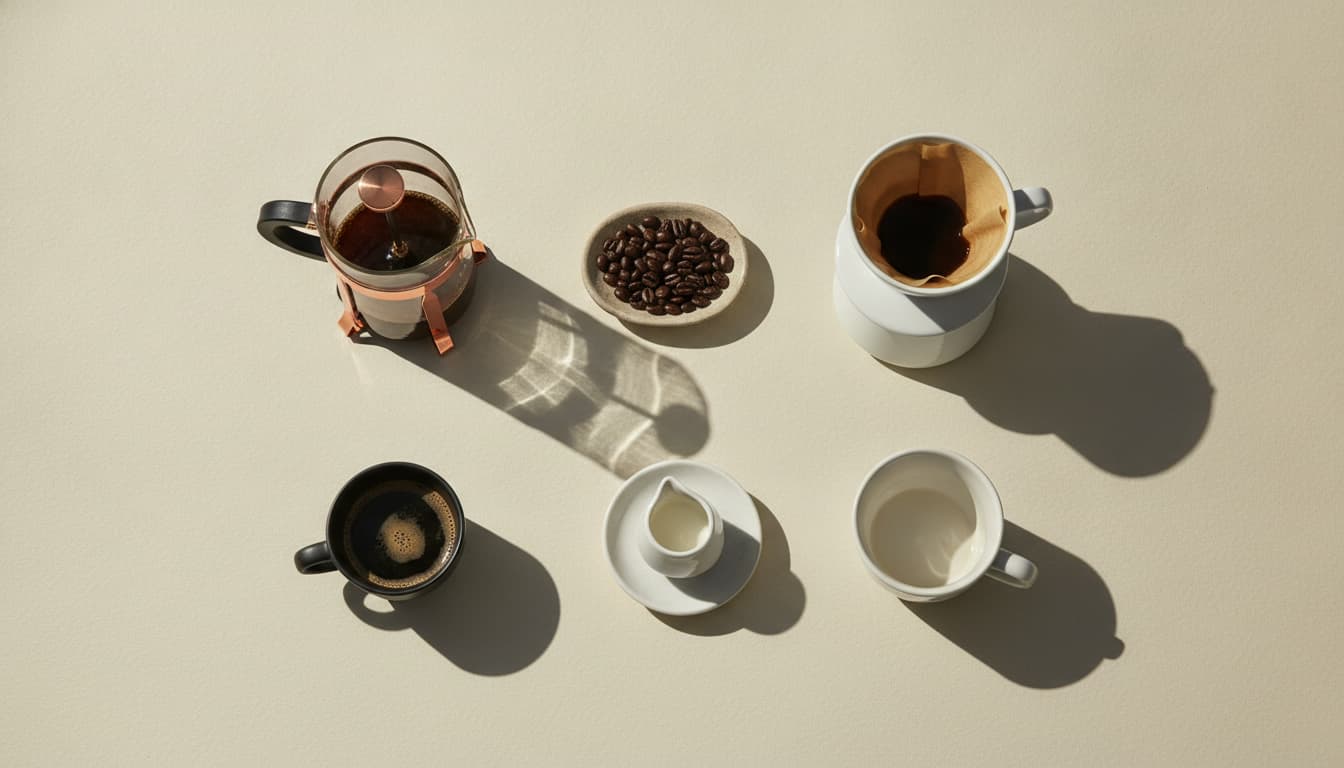
Pooled across 12 randomised trials in 1,017 people, 45 days of coffee raised total cholesterol by 8.1 mg/dL and LDL by 5.4 mg/dL, with unfiltered coffee driving the effect. Boiled coffee carries 7.2 mg of cafestol a cup; drip-filtered carries almost none.
- 01
The pooled effect: 8.1 mg/dL total cholesterol, 5.4 mg/dL LDL
A meta-analysis of 12 randomised controlled trials in 1,017 subjects found that drinking coffee for 45 days was associated with an increase of 8.1 mg/dL in total cholesterol (95% CI 4.5 to 11.6, P<0.001), 5.4 mg/dL in LDL cholesterol (95% CI 1.4 to 9.5, P=0.009), and 12.6 mg/dL in triglycerides (P=0.007). Meta-regression revealed a positive dose-response relation for all three (Cai et al. 2012). An earlier meta-analysis of randomised trials reached the same qualitative conclusion (Jee et al. 2001).
- 02
The mechanism: two diterpenes, removed by a paper filter
The compounds responsible are cafestol and kahweol, two diterpenes in coffee oil identified as the cholesterol-raising factor from coffee beans (Urgert and Katan 1997). Because they are lipids suspended in the brew rather than dissolved solutes, a paper filter physically retains them. That single physical fact is why the same beans, ground the same way, produce measurably different lipid effects depending on the appliance, and why the fix requires no change in caffeine intake or consumption volume.
- 03
Cafestol per cup, by brew method
An analytical study using HPLC quantified the spread. Scandinavian-style boiled coffee and Turkish-style coffee contained the highest amounts, equivalent to 7.2 and 5.3 mg of cafestol per cup and 7.2 and 5.4 mg of kahweol per cup. Espresso contained intermediate amounts, about 1 mg of cafestol and 1 mg of kahweol per cup. Instant and drip-filtered brews contained negligible amounts (Gross et al. 1997). Boiled coffee therefore carries roughly seven times the cafestol of espresso and effectively all of it relative to filtered.
- 04
Unfiltered coffee drove the pooled effect
The meta-analysis reported that the increase in total cholesterol was greater in trials using unfiltered coffee and caffeinated coffee as the treatment, and concluded that the intake of coffee, especially unfiltered coffee, contributed significantly to the increase in total cholesterol, LDL and triglycerides, with the changes related to level of intake (Cai et al. 2012). That aligns exactly with the cafestol measurements and means the headline pooled number overstates the risk for a filter-coffee drinker and understates it for a French press habit.
- 05
Population data: espresso registers at three to five cups a day
A cross-sectional analysis of 21,083 adults aged 40 and over in the Tromsø Study found three to five cups of espresso daily associated with 0.09 mmol/L higher total cholesterol in women (95% CI 0.01 to 0.17) and 0.16 mmol/L in men (95% CI 0.07 to 0.24) versus none. Six or more cups of boiled or plunger coffee was associated with 0.30 mmol/L in women and 0.23 mmol/L in men (Svatun et al. 2022). At roughly 38.7 mg/dL per mmol/L, the boiled figure of 0.30 is about 11.6 mg/dL.
- 06
Filtered coffee at high volume: small, and only in women
Even filtered coffee was not entirely inert at high intake. Six or more cups of filtered coffee daily was associated with 0.11 mmol/L higher total cholesterol in women (95% CI 0.03 to 0.19) but not in men, and there were significant sex differences for all coffee types except boiled and plunger coffee (Svatun et al. 2022). Instant coffee showed a significant linear trend but no dose-response once non-drinkers were excluded. The practical reading is that filtering removes most but not necessarily all of the effect at very high volumes.
- 07
Who has most to gain from switching
The pooled trials found that people with hyperlipidaemia were more sensitive to the cholesterol-raising effect of coffee (Cai et al. 2012). Combined with the dose-response relation, this identifies the group for whom the brew method is worth changing: anyone already managing an elevated LDL who drinks several cups of unfiltered coffee a day. For someone with normal lipids drinking two filtered cups, the expected effect is small enough that the appliance is a matter of taste rather than of cardiovascular risk.
What people ask us next.
- Does coffee raise cholesterol?
- Yes, and the size depends on the brew. A meta-analysis of 12 randomised controlled trials in 1,017 subjects found 45 days of coffee associated with an increase of 8.1 mg/dL in total cholesterol, 5.4 mg/dL in LDL cholesterol, and 12.6 mg/dL in triglycerides, with the increase greater in trials using unfiltered coffee and a positive dose-response relation for all three lipids (Cai et al. 2012). The responsible compounds are the diterpenes cafestol and kahweol.
- Which coffee brewing method is best for cholesterol?
- Drip-filtered or instant. An analytical study found Scandinavian-style boiled coffee at 7.2 mg of cafestol per cup and Turkish-style at 5.3 mg, espresso at an intermediate 1 mg, and instant and drip-filtered brews at negligible amounts (Gross et al. 1997). The paper filter physically retains the diterpenes, which are lipids suspended in the brew. Switching appliances changes the lipid effect without changing caffeine, polyphenols, or how much coffee is consumed.
- Is French press coffee bad for cholesterol?
- It is the highest-risk common method. Plunger coffee is unfiltered, so the cafestol and kahweol pass into the cup. In 21,083 adults, six or more cups of boiled or plunger coffee daily was associated with 0.30 mmol/L higher total cholesterol in women and 0.23 mmol/L in men versus none, roughly 11.6 and 8.9 mg/dL (Svatun et al. 2022), and the pooled trial data found unfiltered coffee drove the larger increases (Cai et al. 2012).
- Does espresso raise cholesterol?
- Moderately, and at ordinary intakes. Espresso contains intermediate diterpene amounts, about 1 mg of cafestol and 1 mg of kahweol per cup versus 7.2 mg of cafestol in boiled coffee (Gross et al. 1997). In the Tromsø Study, three to five cups of espresso a day was associated with 0.16 mmol/L higher total cholesterol in men (95% CI 0.07 to 0.24) and 0.09 mmol/L in women (95% CI 0.01 to 0.17), with the association significantly stronger in men (Svatun et al. 2022).
- Does decaf coffee affect cholesterol differently?
- The pooled analysis found the increase in total cholesterol was greater in trials using caffeinated coffee as the treatment (Cai et al. 2012), so caffeine appears to contribute something beyond the diterpenes. But the diterpene load is set by brewing rather than by caffeine content, so a decaffeinated French press still delivers cafestol. The reliable lever remains the filter, not the caffeine, and the analysis of daily caffeine limits on this site covers the separate caffeine question.
- Should you stop drinking coffee if your cholesterol is high?
- Change the method before considering the quantity. People with hyperlipidaemia were more sensitive to the cholesterol-raising effect in the pooled trials (Cai et al. 2012), which makes them the group with most to gain from filtering. Switching from a press or boiled coffee to a drip filter removes most of the diterpene load (Gross et al. 1997) while preserving the caffeine and the polyphenol intake, which for many people is the largest single polyphenol source in the diet.
Every claim, cited.
- [01]Cai L, Ma D, Zhang Y, Liu Z, Wang P. 2012. The effect of coffee consumption on serum lipids: a meta-analysis of randomized controlled trials. Eur J Clin Nutr 66(8):872-7. 12 studies, n=1,017; 45 days of coffee associated with +8.1 mg/dL total cholesterol (95% CI 4.5-11.6, P<0.001), +5.4 mg/dL LDL-C (95% CI 1.4-9.5, P=0.009), +12.6 mg/dL triglycerides (P=0.007); increases greater with unfiltered and caffeinated coffee; hyperlipidaemic subjects more sensitive; positive dose-response.
- [02]Gross G, Jaccaud E, Huggett AC. 1997. Analysis of the content of the diterpenes cafestol and kahweol in coffee brews. Food Chem Toxicol 35(6):547-54. Scandinavian-style boiled 7.2 mg cafestol and 7.2 mg kahweol per cup; Turkish-style 5.3 mg cafestol and 5.4 mg kahweol; espresso about 1 mg of each; instant and drip-filtered negligible.
- [03]Svatun AL, Lochen ML, Thelle DS, Wilsgaard T. 2022. Association between espresso coffee and serum total cholesterol: the Tromso Study 2015-2016. Open Heart 9(1):e001946. N=21,083, age 40 and over; 3-5 cups espresso/day +0.09 mmol/L women and +0.16 mmol/L men; 6 or more cups boiled/plunger +0.30 mmol/L women and +0.23 mmol/L men; 6 or more cups filtered +0.11 mmol/L women only; significant sex differences for all types except boiled/plunger.
- [04]Urgert R, Katan MB. 1997. The cholesterol-raising factor from coffee beans. Annu Rev Nutr 17:305-24. Identification and characterisation of cafestol and kahweol as the responsible diterpenes.
- [05]Jee SH, He J, Appel LJ, Whelton PK, Suh I, Klag MJ. 2001. Coffee consumption and serum lipids: a meta-analysis of randomized controlled clinical trials. Am J Epidemiol 153(4):353-62. The earlier pooled analysis reaching the same qualitative conclusion.
The Larderlab Team builds evidence-led frameworks for eating, lifting, and stocking a kitchen. We cite every claim. We publish the spreadsheet when possible. We buy what we review at retail price. When new data lands, we revise with a dated note.
Next in this hub.
Foods High in Cholesterol: Which Ones Actually Matter for Your Heart
Dietary cholesterol turned out to have far less effect on blood cholesterol than saturated fat does, which is why the old 300 mg limit was dropped. The ranking of high-cholesterol foods, why eggs and shrimp are not the problem they were made out to be, and what actually raises LDL.
8 min · rev 2026-08-11Foods High in Purines: The Ones That Actually Raise Uric Acid
Purines break down into uric acid, and for people with gout the highest-risk foods are organ meats, certain seafood, and alcohol, especially beer. The ranking, why vegetable purines behave differently, and why sugar and drinks matter as much as meat.
8 min · rev 2026-08-11Grass-Fed vs Grain-Fed Beef: The Ratio Improves, the Milligrams Do Not
USDA lists grass-fed ground beef at 88 mg of total omega-3 per 100 g, of which 1 mg is EPA and none is DHA. The fatty acid ratio genuinely improves on grass. The absolute amounts stay too small to matter for an omega-3 target.
8 min · rev 2026-08-25Get the Larderlab Macro Planner.
A Google Sheet that calculates your protein target, splits it across 3-5 meals, and ranks 20 protein sources by $/gram. Free. Copy-and-modify your own version.
By subscribing, you agree to our Privacy Policy. Unsubscribe anytime.