How much vitamin D per day, by age and need
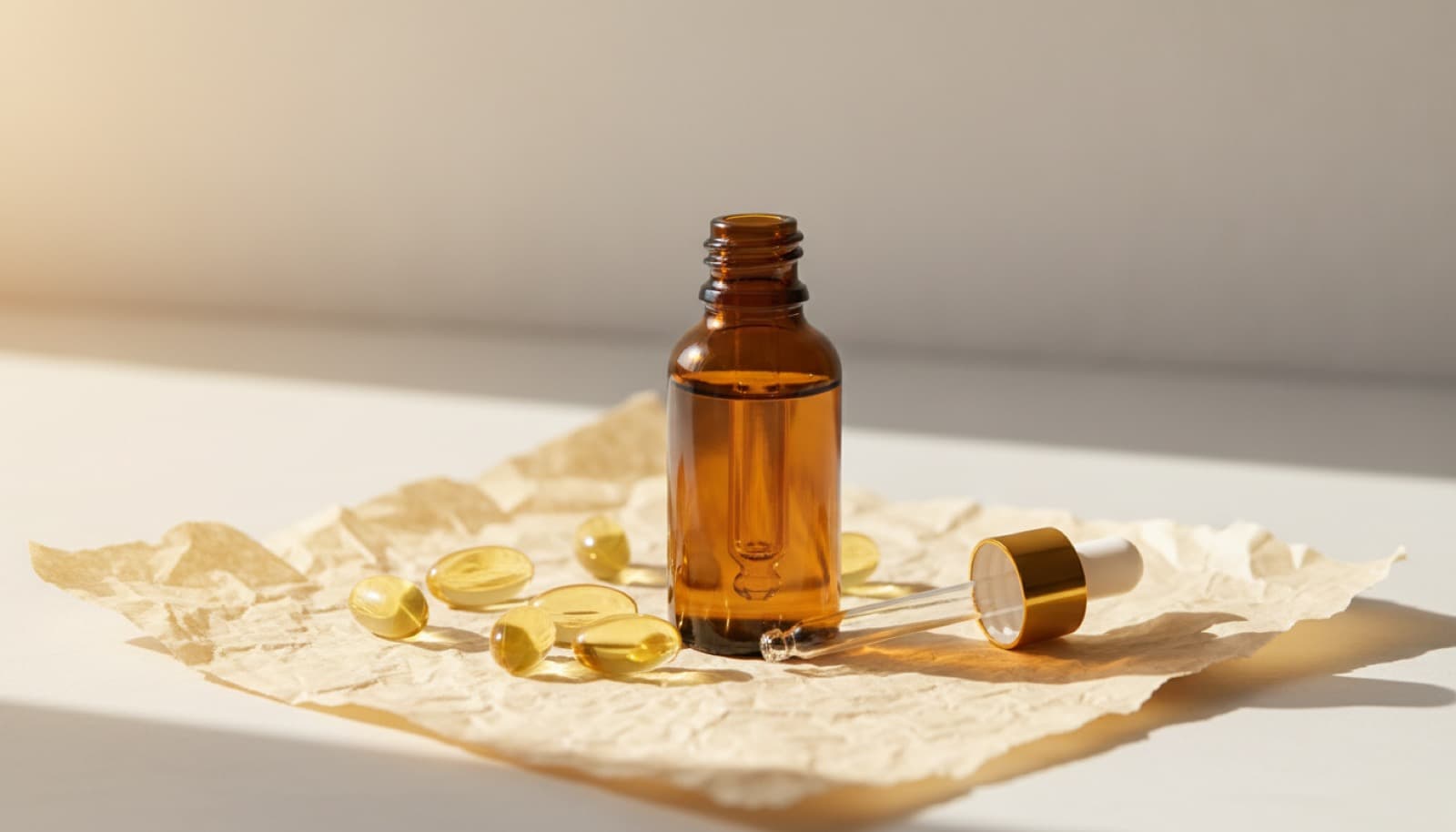
The RDA is 600 IU/day under 70 and 800 IU/day over 70. Common maintenance is 1000-2000 IU/day; the upper limit is 4000 IU/day. The daily number by age, blood level, and source.
What people ask us next.
- How much vitamin D should I take per day?
- The RDA is 600 IU/day for adults aged 1-70 and 800 IU/day from age 71 (IOM 2011; NIH ODS). Common real-world maintenance is 1000-2000 IU/day, the range that more reliably holds a sufficient blood level; VITAL used 2000 IU/day. The tolerable upper limit is 4000 IU/day. Without a blood test, 1000-2000 IU/day of D3 is a reasonable low-risk default for most adults.
- Is 2000 IU of vitamin D per day too much?
- No. 2000 IU/day is well under the 4000 IU/day upper limit and is the dose used in the VITAL trial (Manson et al. 2019). It is a common maintenance dose that helps hold serum 25-OH-D in the 30-50 ng/mL target band, especially through winter. It is not a high or risky dose for healthy adults.
- How much vitamin D per day to correct a deficiency?
- That should be guided by a blood test and a clinician. A measured deficiency (serum 25-OH-D below 20 ng/mL) is often corrected with a higher loading dose for several weeks, then a maintenance dose of 1000-2000 IU/day, with a retest at 8-12 weeks. The correction dose is deliberately higher than maintenance and time-limited.
- Can you take too much vitamin D per day?
- Yes, but it takes a lot. Toxicity comes from supplements, not sun, and presents as hypercalcemia. It generally requires sustained intake well above the 4000 IU/day upper limit, often around 10,000 IU/day for months (NIH ODS). Staying at or below 4000 IU/day without a measured deficiency keeps the risk near zero.
- Should I take vitamin D with food?
- Yes. Vitamin D is fat-soluble, so taking it with a meal that contains some fat improves absorption. Timing of day does not matter much; consistency does. A daily 1000-2000 IU D3 capsule with a meal is a simple, effective routine. Choose D3 over D2, which raises and holds blood levels less effectively (Tripkovic et al. 2012).
- Do I need a blood test before deciding the dose?
- It is the only way to dose precisely. The marker is serum 25-hydroxyvitamin D; 30-50 ng/mL is a common sufficiency target and below 20 ng/mL is deficient. A maintenance dose of 1000-2000 IU/day is low-risk without testing, but anyone using higher doses should test, then retest in 8-12 weeks. See our what vitamin D does page for how the blood level drives the effect.
Every claim, cited.
- [01]Institute of Medicine. 2011. Dietary Reference Intakes for Calcium and Vitamin D. National Academies Press. RDA 600 IU/day (ages 1-70), 800 IU/day (71+); tolerable upper intake level 4000 IU/day.
- [02]NIH Office of Dietary Supplements. Vitamin D Fact Sheet for Health Professionals. RDA, upper limit, serum 25-OH-D thresholds, and toxicity from supplements.
- [03]Manson JE, Cook NR, Lee IM, et al. 2019. Vitamin D supplements and prevention of cancer and cardiovascular disease (VITAL). N Engl J Med 380(1):33-44. 2000 IU/day maintenance dose, n=25,871.
- [04]Tripkovic L, Lambert H, Hart K, et al. 2012. Comparison of vitamin D2 and vitamin D3 supplementation in raising serum 25-hydroxyvitamin D: a systematic review and meta-analysis. Am J Clin Nutr 95(6):1357-1364. D3 superior to D2.
- [05]Deutsche Gesellschaft fuer Ernaehrung (DGE). Referenzwert Vitamin D. Schaetzwert bei fehlender endogener Synthese 20 mcg (800 IU)/Tag.
The Larderlab Team builds evidence-led frameworks for eating, lifting, and stocking a kitchen. We cite every claim. We publish the spreadsheet when possible. We buy what we review at retail price. When new data lands, we revise with a dated note.
Next in this hub.
What to Avoid When Taking Collagen: Five Caveats With Evidence Behind Them
Do not count it toward your protein target, do not judge it before 8 to 12 weeks, and if you form kidney stones, know that 30 g of gelatin raised urinary oxalate by 43 percent in a controlled study. The real caveats, and the myths.
8 min · rev 2026-08-24Foods High in Collagen: Why the Real List Is Shorter Than You Think
Collagen exists only in animal connective tissue, so no plant food contains any. Gelatin powder leads at 85.6 g of protein per 100 g, pork skin at 61.3 g. And the most-marketed source, bone broth, tested poorly against supplements.
8 min · rev 2026-08-24Ashwagandha Benefits: What the Trials Show, and the Liver Signal
Pooled across 12 trials in 1,002 people, stress fell with a standardised mean difference of 1.75 and anxiety by 1.55, but heterogeneity was above 83 percent and the certainty of evidence was rated low. The dose that was tested, and the hepatic case series.
8 min · rev 2026-08-24Get the Larderlab Macro Planner.
A Google Sheet that calculates your protein target, splits it across 3-5 meals, and ranks 20 protein sources by $/gram. Free. Copy-and-modify your own version.
By subscribing, you agree to our Privacy Policy. Unsubscribe anytime.