How much magnesium per day, by age and sex
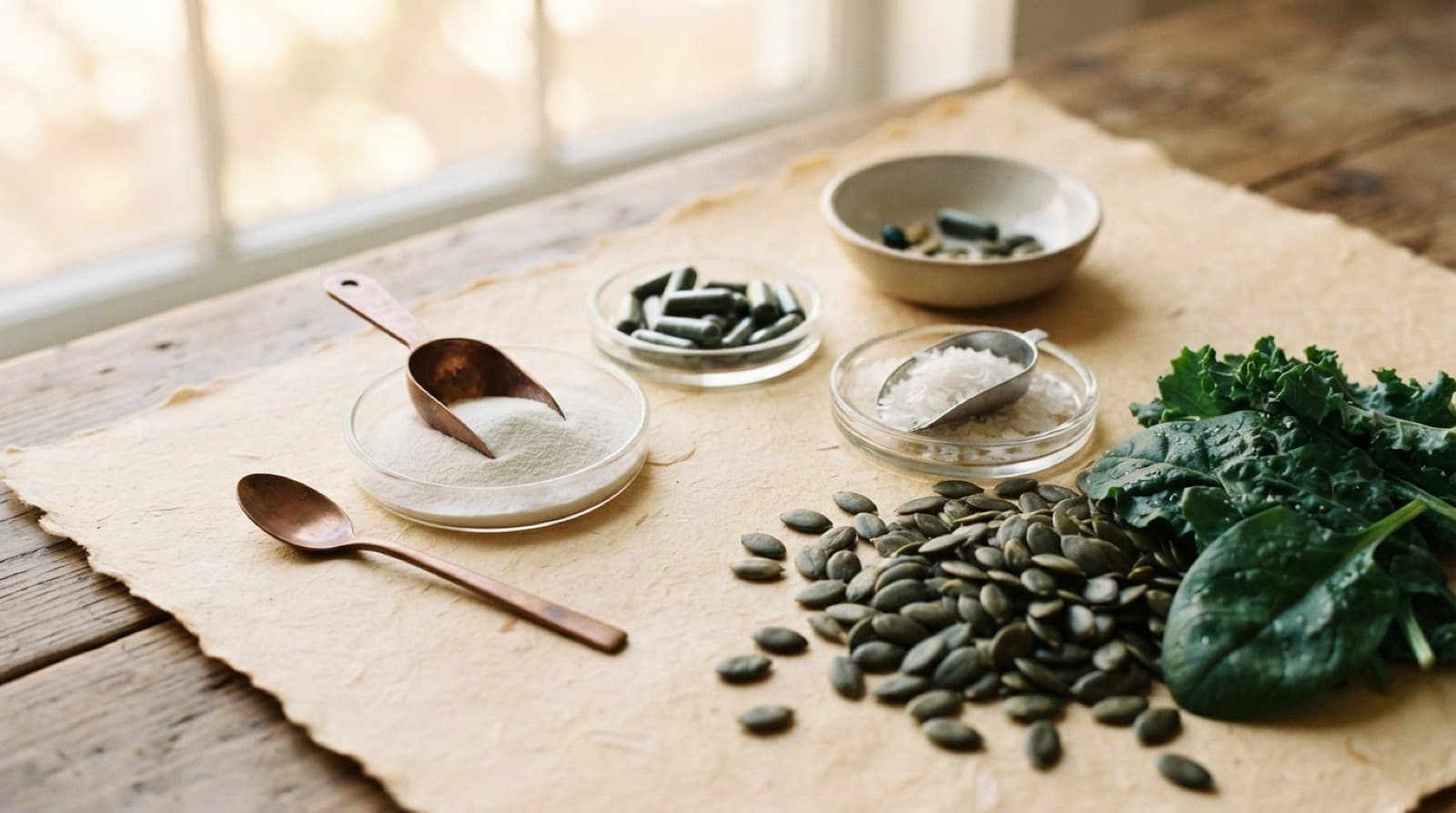
The RDA is 400-420 mg/day for men and 310-320 mg/day for women. The supplemental upper limit is 350 mg/day. The daily magnesium number by age, sex, and source.
What people ask us next.
- How much magnesium should I take per day?
- The RDA is 400-420 mg/day for adult men and 310-320 mg/day for adult women (NIH Office of Dietary Supplements). Pregnancy raises it to ~350-360 mg/day. That total can and ideally should come mostly from food. If you supplement, a typical dose is 100-200 mg/day, kept under the 350 mg/day supplemental upper limit, with dietary magnesium making up the rest.
- Is 500 mg of magnesium per day too much?
- It depends on the source. 500 mg/day from food is fine and carries no upper limit, because the gut self-limits absorption as intake rises (NIH ODS). A 500 mg supplement is above the 350 mg/day supplemental upper limit and risks osmotic diarrhea, especially with poorly absorbed magnesium oxide. The cap applies only to supplemental magnesium, not to magnesium from food.
- How much magnesium per day for a woman?
- 310 mg/day for women aged 19-30 and 320 mg/day for women 31 and older (NIH ODS). Pregnancy raises it to ~350-360 mg/day and lactation is ~310-320 mg/day. Most of that should come from food; supplement only the measured gap, and stay under the 350 mg/day supplemental upper limit.
- Can I get enough magnesium from food alone?
- Yes, for most people. A day with 1 oz pumpkin seeds (156 mg), 1 cup cooked spinach (157 mg), and 1 cup black beans (120 mg) already exceeds 430 mg (USDA FoodData Central). The reason ~48% of Americans fall short is refined carbohydrates, which displace the seeds, greens, legumes, and whole grains that carry magnesium (NHANES, Moshfegh 2009).
- What happens if I take too much magnesium?
- From food, nothing: the gut down-regulates absorption and the excess is not absorbed. From supplements above the 350 mg/day upper limit, the main effect is osmotic diarrhea, cramping, and nausea, worst with magnesium oxide (NIH ODS). True magnesium toxicity (hypermagnesemia) is rare and occurs mainly in people with impaired kidney function, who should not supplement without medical advice.
- Which magnesium form is best for daily use?
- Glycinate and citrate are the best-tolerated, best-absorbed everyday forms; oxide is the cheapest but mostly excreted and the most likely to cause diarrhea (Walker et al. 2003). Glycinate is gentle and good for general use and sleep; citrate is well absorbed and mildly laxative, useful if constipation is also a concern. See our full magnesium forms comparison for the ranking.
Every claim, cited.
- [01]NIH Office of Dietary Supplements. Magnesium Fact Sheet for Health Professionals. RDA 400-420 mg/day (men), 310-320 mg/day (women), pregnancy ~350-360 mg/day; supplemental UL 350 mg/day; food magnesium has no UL.
- [02]Institute of Medicine. 1997. Dietary Reference Intakes for Calcium, Phosphorus, Magnesium, Vitamin D, and Fluoride. National Academies Press. Original derivation of the magnesium RDA and UL.
- [03]Moshfegh A, Goldman J, Cleveland L, et al. 2009. What We Eat in America, NHANES. ~48% of the US population consumes less than the EAR for magnesium from food.
- [04]Walker AF, Marakis G, Christie S, Byng M. 2003. Mg citrate found more bioavailable than other Mg preparations in a randomised, double-blind study. Magnes Res 16(3):183-191. Citrate and organic forms outperform oxide on absorption.
- [05]Workinger JL, Doyle RP, Bortz J. 2018. Challenges in the diagnosis of magnesium status. Nutrients 10(9):1202. Serum magnesium reflects <1% of total body stores; normal serum does not exclude deficiency.
The Larderlab Team builds evidence-led frameworks for eating, lifting, and stocking a kitchen. We cite every claim. We publish the spreadsheet when possible. We buy what we review at retail price. When new data lands, we revise with a dated note.
Next in this hub.
What to Avoid When Taking Collagen: Five Caveats With Evidence Behind Them
Do not count it toward your protein target, do not judge it before 8 to 12 weeks, and if you form kidney stones, know that 30 g of gelatin raised urinary oxalate by 43 percent in a controlled study. The real caveats, and the myths.
8 min · rev 2026-08-24Foods High in Collagen: Why the Real List Is Shorter Than You Think
Collagen exists only in animal connective tissue, so no plant food contains any. Gelatin powder leads at 85.6 g of protein per 100 g, pork skin at 61.3 g. And the most-marketed source, bone broth, tested poorly against supplements.
8 min · rev 2026-08-24Ashwagandha Benefits: What the Trials Show, and the Liver Signal
Pooled across 12 trials in 1,002 people, stress fell with a standardised mean difference of 1.75 and anxiety by 1.55, but heterogeneity was above 83 percent and the certainty of evidence was rated low. The dose that was tested, and the hepatic case series.
8 min · rev 2026-08-24Get the Larderlab Macro Planner.
A Google Sheet that calculates your protein target, splits it across 3-5 meals, and ranks 20 protein sources by $/gram. Free. Copy-and-modify your own version.
By subscribing, you agree to our Privacy Policy. Unsubscribe anytime.