Turmeric with black pepper, and what the absorption data shows
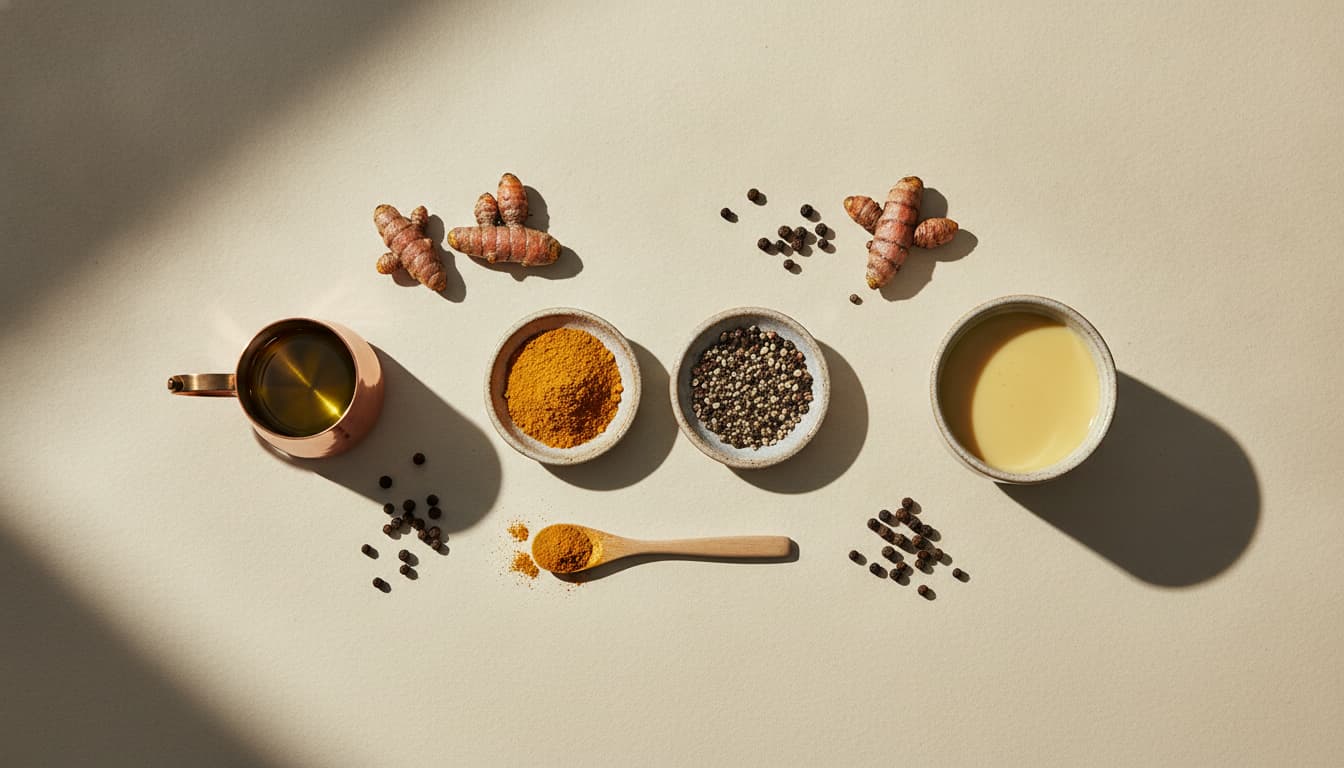
The 2,000 percent number is real and comes from one 1998 study using 20 mg of piperine. Without it, 8 g of curcumin left no detectable serum trace in 24 volunteers. The absorption problem, and the liver signal that came with the fix.
- 01
The 2,000 percent figure: one 1998 study, 20 mg of piperine
The number traces to a single study in Planta Med. Healthy volunteers given 2 g of curcumin alone had serum levels that were either undetectable or very low. Adding 20 mg of piperine produced much higher concentrations from 0.25 to 1 hour post-dose, and the reported increase in bioavailability was 2,000 percent (Shoba et al. 1998). In rats at 2 g per kg curcumin with 20 mg per kg piperine the increase was 154 percent. The effect is real and mechanistically sound; it is also a large multiple of a baseline that was close to zero.
- 02
How bad the baseline is: 8 g produced no detectable serum curcumin
A dose-escalation study gave healthy volunteers single oral doses of standardised milled curcumin from 500 mg to 12,000 mg. No curcumin was detected in serum at 500, 1,000, 2,000, 4,000, 6,000 or 8,000 mg. Low levels appeared in only two subjects, at 10,000 or 12,000 mg (Lao et al. 2006). That is the context the piperine finding sits in: the problem being solved is not modest absorption but a compound that mostly fails to appear in blood at all, which is why every delivery technology on the market targets this single step.
- 03
The mechanism: piperine slows glucuronidation
Curcumin's poor bioavailability is driven by low absorption, rapid metabolism, and rapid systemic elimination, a profile reviewed in detail by Anand et al. 2007. Piperine is a known inhibitor of hepatic and intestinal glucuronidation, the conjugation step that clears curcumin before it can reach circulation. Slowing that step leaves more unmetabolised curcumin in plasma, which is precisely what the 1998 pharmacokinetic curves show. The same mechanism is the reason the pairing is a drug-interaction consideration and not a free upgrade.
- 04
Culinary turmeric is a seasoning, not a dose
The trials that generated these numbers used gram-scale quantities of standardised extract, from 500 mg up to 12,000 mg in a single sitting. Ground turmeric is used by the teaspoon and delivers a fraction of a percent of that exposure. Adding black pepper to a dish that contains turmeric is sound cooking practice and has no measurable relationship to the pharmacokinetics above. Anyone hoping to reproduce a trial result with a spice jar is working three orders of magnitude below the tested amounts.
- 05
The liver signal, and where piperine appears in it
The US Drug-Induced Liver Injury Network found ten adjudicated cases of turmeric-associated liver injury between 2004 and 2022, all enrolled since 2011 and six since 2017. Eight were women, median age 56, injury was hepatocellular in nine of ten, five were hospitalised and one died of acute liver failure, with a latency of one to four months. Three of the seven products analysed also contained piperine, and the authors noted the rise may reflect increased combination with black pepper (Halegoua-DeMarzio et al. 2023).
- 06
HLA-B*35:01: the susceptibility marker
Seven of the ten DILIN patients carried HLA-B*35:01, two of them homozygous, giving an allele frequency of 0.450 against population controls of 0.056 to 0.069 (Halegoua-DeMarzio et al. 2023). That is a strong linkage and it reframes the risk: turmeric hepatotoxicity looks like an idiosyncratic reaction concentrated in a genetically susceptible minority rather than a dose-dependent hazard for everyone. Nobody is genotyped before buying a capsule, so the practical version is to treat new jaundice, dark urine, or right-upper-quadrant discomfort during the first four months as a reason to stop and get liver tests.
- 07
What the absorption data does not settle
Raising plasma curcumin is a pharmacokinetic result, not a clinical one, and the two are frequently conflated in marketing. Higher serum levels do not by themselves establish that a given condition improves, and the dose-escalation authors noted that systemic bioavailability may not even be essential for some proposed uses such as colorectal chemoprevention (Lao et al. 2006). Supplements are also not pre-approved for safety, effectiveness, or label accuracy before marketing (FDA), so the standardisation claim on the front of the bottle is the buyer's problem to verify.
What people ask us next.
- Does turmeric need black pepper to be absorbed?
- Piperine measurably increases curcumin absorption. In healthy volunteers, 2 g of curcumin alone produced serum levels that were undetectable or very low, and adding 20 mg of piperine raised bioavailability by 2,000 percent (Shoba et al. 1998). The mechanism is inhibition of hepatic and intestinal glucuronidation, the step that clears curcumin. The effect is real; whether higher plasma curcumin translates into a clinical benefit is a separate and much less settled question.
- How much black pepper do you need with turmeric?
- The human arm of the study that generated the widely quoted figure used 20 mg of piperine alongside 2 g of curcumin (Shoba et al. 1998). Most commercial curcumin products with a pepper extract are formulated in that range, which is why the ingredient appears at a few milligrams per capsule rather than as a spoonful of pepper. There is no dose-response curve in humans establishing an optimum, so 20 mg is a reference point from one trial rather than an established target.
- Is turmeric in food enough to get the benefits studied in trials?
- No. Trials use standardised curcumin extract in gram quantities, from 500 mg up to 12,000 mg in a single dose in the dose-escalation study (Lao et al. 2006). Ground turmeric is used by the teaspoon and delivers a small fraction of that. Cooking with turmeric and pepper is reasonable and pleasant; it is not a route to the exposures those studies produced, and no food-level intake has been tested against the outcomes the supplement literature reports.
- Can turmeric supplements damage the liver?
- Rarely, and the cases are documented. The US Drug-Induced Liver Injury Network identified ten adjudicated turmeric-associated cases from 2004 to 2022, all since 2011 and six since 2017, with five hospitalisations and one death from acute liver failure, latency of one to four months, and hepatocellular injury in nine of ten (Halegoua-DeMarzio et al. 2023). Seven of ten carried HLA-B*35:01 against a population frequency of 0.056 to 0.069, indicating an idiosyncratic reaction in a susceptible minority.
- How much curcumin is too much?
- Single-dose tolerance was good up to 12,000 mg, with seven of twenty-four volunteers reporting minimal toxicity that was not dose-related (Lao et al. 2006). That is a single-dose safety observation in healthy adults, not a chronic upper limit, and it sits alongside the DILIN hepatic cases that occurred at ordinary consumer doses over one to four months. The defensible position is that there is no established safe chronic ceiling, so daily gram-scale use warrants a reason and a clinician who knows about it.
- Is a curcumin extract better than turmeric powder?
- For matching trial exposures, yes, because trial doses are only reachable with concentrated extract. That advantage comes with two costs. The absorption enhancer works by inhibiting glucuronidation, which is a genuine drug-interaction pathway for anything else being metabolised the same way, and the concentrated products are the ones appearing in the liver-injury series. Supplements are not pre-approved for safety, effectiveness, or label accuracy before marketing (FDA), so the standardisation claim needs third-party verification.
Every claim, cited.
- [01]Shoba G, Joy D, Joseph T, Majeed M, Rajendran R, Srinivas PS. 1998. Influence of piperine on the pharmacokinetics of curcumin in animals and human volunteers. Planta Med 64(4):353-6. 2 g curcumin alone: serum undetectable or very low; with 20 mg piperine, bioavailability increased 2000%; rats +154%.
- [02]Lao CD, Ruffin MT, Normolle D, Heath DD, Murray SI, Bailey JM, Boggs ME, Crowell J, Rock CL, Brenner DE. 2006. Dose escalation of a curcuminoid formulation. BMC Complement Altern Med 6:10. Single doses 500-12,000 mg in 24 volunteers; no serum curcumin detected at 500-8,000 mg; low levels in two subjects at 10,000-12,000 mg; 7 of 24 reported minimal toxicity, not dose-related.
- [03]Anand P, Kunnumakkara AB, Newman RA, Aggarwal BB. 2007. Bioavailability of curcumin: problems and promises. Mol Pharm 4(6):807-18. The reference account of poor absorption, rapid metabolism, and rapid systemic elimination.
- [04]Halegoua-DeMarzio D, Navarro V, Ahmad J, et al. 2023. Liver Injury Associated with Turmeric, A Growing Problem: Ten Cases from the Drug-Induced Liver Injury Network. Am J Med 136(2):200-206. Ten cases, all since 2011 and six since 2017; 5 hospitalised, 1 death from acute liver failure; latency 1-4 months; 3 of 7 products also contained piperine; HLA-B*35:01 in 7 of 10 (allele frequency 0.450 vs controls 0.056-0.069).
- [05]FDA: Questions and Answers on Dietary Supplements. Dietary supplements are not approved for safety, effectiveness, or label accuracy before marketing.
The Larderlab Team builds evidence-led frameworks for eating, lifting, and stocking a kitchen. We cite every claim. We publish the spreadsheet when possible. We buy what we review at retail price. When new data lands, we revise with a dated note.
Next in this hub.
Third-Party Tested Supplements: What Certification Actually Verifies
Supplements are not FDA-approved for safety and effectiveness before sale. Of 57 botanical sports products analysed, 40 percent held no detectable amount of the labeled ingredient and 12 percent a prohibited compound.
13 min · rev 2026-09-04Does Gatorade Have Electrolytes? The Milligrams Per Bottle, Compared
Yes: about 460 mg of sodium and 130 mg of potassium per litre, per USDA branded data. Set against an American football player losing sodium at roughly 1,290 mg an hour, the numbers explain what it is and is not for.
8 min · rev 2026-08-20Best Creatine Monohydrate, Ranked by $/gram
Creapure-certified creatine ranked by $/gram, with third-party testing status and brand transparency.
10 min · rev 2026-04-21Get the Larderlab Macro Planner.
A Google Sheet that calculates your protein target, splits it across 3-5 meals, and ranks 20 protein sources by $/gram. Free. Copy-and-modify your own version.
By subscribing, you agree to our Privacy Policy. Unsubscribe anytime.