Raw or cooked vegetables, and the trade that runs in both directions
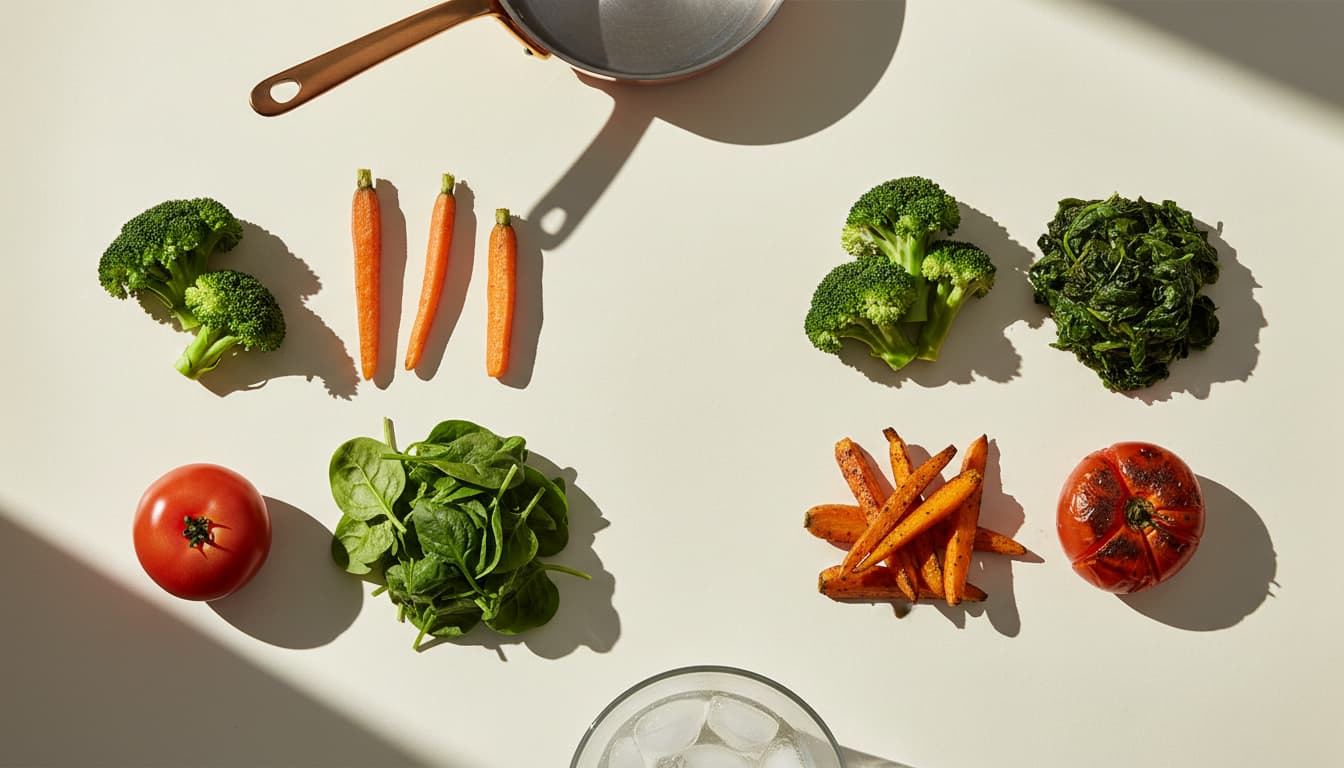
Heating tomatoes for 30 minutes cut vitamin C by 29 percent and raised trans-lycopene 2.6-fold in the same samples. Boiling cabbage removed 56 percent of glucosinolates in 2 minutes. The answer is per compound.
- 01
Both directions, one dataset
Raw tomato held 0.76 micromol vitamin C per gram, falling to 0.68, 0.64 and 0.54 after 2, 15 and 30 minutes at 88 degrees Celsius, while trans-lycopene rose from 2.01 to 3.11, 5.45 and 5.32 milligrams per gram over the same intervals, with no significant change in total phenolics or flavonoids (Dewanto et al. 2002). The same heat that removed a third of the vitamin C multiplied the bioaccessible lycopene.
- 02
Antioxidant activity tracked the lycopene, not the vitamin C
Total antioxidant activity of raw tomatoes was 4.13 micromol vitamin C equivalent per gram, rising significantly to 5.29, 5.53 and 6.70 after 2, 15 and 30 minutes of heat treatment at 88 degrees Celsius (Dewanto et al. 2002). The authors noted that vitamin C in apples contributed under 0.4 percent of total antioxidant activity, which is why losing it does not move the aggregate measure.
- 03
The absorption data agrees with the analytical data
From a single dose of fresh tomatoes or tomato paste, both supplying 23 milligrams of lycopene with 15 grams of corn oil, tomato paste yielded 2.5-fold higher total and all-trans-lycopene peak concentrations and 3.8-fold higher area under the curve in the chylomicron fraction, with no difference in alpha- and beta-carotene response (Gartner et al. 1997). Processing releases what the raw matrix withholds.
- 04
Boiling brassicas costs 56 percent in two minutes
Pilot-scale boiling of white cabbage produced a dramatic decrease of 56 percent in total glucosinolate levels within the plant matrix during the first 2 minutes, progressing to over 70 percent after 8 to 12 minutes, with progoitrin declining faster than the other glucosinolates (Volden et al. 2008). The steepest part of the curve is at the start, which is why brief cooking is not a safe assumption here.
- 05
Most of that loss is transfer, not destruction
The concentration profile was modelled as leaching of glucosinolates to the water phase due to cell lysis combined with thermal degradation in both the plant matrix and the water phase, and the estimated degradation rate constants were significantly higher in the plant matrix than in the water phase (Volden et al. 2008). A preparation that retains the cooking liquid retains a substantial part of what left the vegetable.
- 06
Cooking moves the conversion into the colon
Feeding trials have shown that hydrolysis of glucosinolates and absorption of isothiocyanates are greater following ingestion of raw brassica with active plant myrosinase than after consumption of the cooked plant with denatured myrosinase, and that after cooked brassica the glucosinolates are hydrolysed in the colon by the resident microflora (Rungapamestry et al. 2007). Where the reaction happens changes, not only how much substrate survives.
- 07
Method comparison: water-cooking preserved most
Across carrots, courgettes and broccoli assessed for polyphenols, carotenoids, glucosinolates and ascorbic acid, water-cooking treatments better preserved the antioxidant compounds, particularly carotenoids, and ascorbic acid in carrots and courgettes; steamed vegetables maintained better texture quality than boiled, boiled showed limited discolouration, and fried showed the lowest softening but retained antioxidant compounds least (Miglio et al. 2008).
- 08
Measured antioxidant capacity rose in every cooked sample
An overall increase of the Trolox equivalent antioxidant capacity, ferric reducing antioxidant power and total radical-trapping antioxidant parameter values was observed in all cooked vegetables, probably because of matrix softening and increased extractability of compounds, which could be partially converted into more antioxidant chemical species (Miglio et al. 2008). Extractability is doing work that a raw-food framing does not account for.
- 09
The conclusion is per vegetable, not per ideology
The authors of the three-method comparison concluded that their findings defy the notion that processed vegetables offer lower nutritional quality and that for each vegetable a cooking method would be preferred to preserve the nutritional and physicochemical qualities (Miglio et al. 2008). That is the correct shape of the answer: a per-food decision, not a rule about heat.
What people ask us next.
- Are raw vegetables more nutritious than cooked ones?
- Not as a general rule, because heat moves compounds in both directions within the same food. Heating tomatoes at 88 degrees Celsius for 30 minutes dropped vitamin C from 0.76 to 0.54 micromol per gram while raising trans-lycopene from 2.01 to 5.32 milligrams per gram and total antioxidant activity from 4.13 to 6.70 micromol vitamin C equivalent per gram (Dewanto et al. 2002). Which direction matters depends on the compound you are after.
- Does cooking really increase lycopene absorption?
- The human data says yes. From a single dose supplying 23 milligrams of lycopene with 15 grams of corn oil, tomato paste produced 2.5-fold higher total and all-trans-lycopene peak concentrations and 3.8-fold higher area under the curve in the chylomicron fraction than fresh tomatoes, with the same isomer pattern in both and no difference in alpha- and beta-carotene response (Gartner et al. 1997).
- How much do I lose by boiling broccoli or cabbage?
- In white cabbage, boiling produced a decrease of 56 percent in total glucosinolates within the plant matrix in the first 2 minutes, rising to over 70 percent after 8 to 12 minutes (Volden et al. 2008). The model attributes much of that to leaching into the water phase from cell lysis rather than to destruction, so a preparation that keeps the cooking liquid keeps a meaningful share of it.
- Why does raw broccoli behave differently in digestion?
- Because the plant enzyme survives. Hydrolysis of glucosinolates and absorption of isothiocyanates are greater following ingestion of raw brassica with active plant myrosinase than after consumption of the cooked plant with denatured myrosinase, and after cooked brassica the glucosinolates are hydrolysed in the colon by resident microflora instead (Rungapamestry et al. 2007). Cooking relocates the conversion as well as reducing the substrate.
- Which cooking method is best overall?
- The comparison that tested three methods across three vegetables declined to name one. Water-cooking treatments better preserved antioxidant compounds, particularly carotenoids, steaming maintained better texture than boiling, boiling limited discolouration, and frying softened least but retained antioxidant compounds least, leading the authors to conclude that for each vegetable a cooking method would be preferred (Miglio et al. 2008). The decision is per food.
- Does this change how I should plan meals?
- Mainly by making the choice deliberate rather than doctrinal. Cook carotenoid-dense foods and include fat, since that is the combination the absorption trial used. Keep some raw or lightly cooked brassica in rotation if the isothiocyanate pathway is the goal, and where they are cooked, use a method that does not discard the liquid. Treat vitamin C as the compound being spent, because its losses are measurable and largely unavoidable at temperature.
Every claim, cited.
- [01]Dewanto V, Wu X, Adom KK, Liu RH. 2002. Thermal processing enhances the nutritional value of tomatoes by increasing total antioxidant activity. J Agric Food Chem 50(10):3010-3014. The raw tomato had 0.76 plus or minus 0.03 micromol of vitamin C per gram of tomato; after 2, 15, and 30 min of heating at 88 degrees Celsius, the vitamin C content significantly dropped to 0.68, 0.64 and 0.54 micromol per gram (p less than 0.01). The raw tomato had 2.01 plus or minus 0.04 mg of trans-lycopene per gram; after 2, 15, and 30 min of heating at 88 degrees Celsius, the trans-lycopene content had increased to 3.11, 5.45 and 5.32 mg per gram (p less than 0.01). The antioxidant activity of raw tomatoes was 4.13 plus or minus 0.36 micromol of vitamin C equivalent per gram; with heat treatment at 88 degrees Celsius for 2, 15, and 30 min, total antioxidant activity significantly increased to 5.29, 5.53 and 6.70 micromol of vitamin C equivalent per gram (p less than 0.01). There were no significant changes in either total phenolics or total flavonoids. This research group found vitamin C in apples contributed less than 0.4 percent of total antioxidant activity.
- [02]Gartner C, Stahl W, Sies H. 1997. Lycopene is more bioavailable from tomato paste than from fresh tomatoes. Am J Clin Nutr 66(1):116-122. Lycopene bioavailability from a single dose of fresh tomatoes or tomato paste (23 mg lycopene) ingested together with 15 g corn oil was compared by analyzing carotenoid concentrations in the chylomicron fraction. The lycopene isomer pattern was the same in both fresh tomatoes and tomato paste, and the triacylglycerol response in chylomicrons was not significantly different after both treatments. Ingestion of tomato paste yielded 2.5-fold higher total and all-trans-lycopene peak concentrations and 3.8-fold higher area under the curve responses than ingestion of fresh tomatoes. No difference was observed in the alpha- and beta-carotene response.
- [03]Volden J, Wicklund T, Verkerk R, Dekker M. 2008. Kinetics of changes in glucosinolate concentrations during long-term cooking of white cabbage (Brassica oleracea L. ssp. capitata f. alba). J Agric Food Chem 56(6):2068-2073. Cabbage was boiled, resulting in a dramatic decrease of 56 percent in the total glucosinolate levels within the plant matrix during the first 2 minutes; after 8 to 12 minutes of boiling the decrease progressed to over 70 percent. Progoitrin had an exceptionally higher decline rate in comparison to all other glucosinolates. A mathematical model described the concentration profile of the glucosinolates in the plant matrix based on leaching of glucosinolates to the water phase due to cell lysis and thermal degradation of the glucosinolates both in the plant matrix and in the water phase; the degradation rate constants found were significantly higher in the plant matrix than in the water phase for all glucosinolates.
- [04]Rungapamestry V, Duncan AJ, Fuller Z, Ratcliffe B. 2007. Effect of cooking brassica vegetables on the subsequent hydrolysis and metabolic fate of glucosinolates. Proc Nutr Soc 66(1):69-81. Glucosinolates are hydrolysed by plant myrosinase following damage of plant tissue. During cooking of brassica the glucosinolate-myrosinase system may be modified as a result of inactivation of plant myrosinase, loss of enzymic cofactors such as epithiospecifier protein, thermal breakdown and/or leaching of glucosinolates and their metabolites, or volatilisation of metabolites. Feeding trials with human subjects have shown that hydrolysis of glucosinolates and absorption of isothiocyanates are greater following ingestion of raw brassica with active plant myrosinase than after consumption of the cooked plant with denatured myrosinase. After consumption of cooked brassica devoid of plant myrosinase, glucosinolates are hydrolysed in the colon under the action of the resident microflora.
- [05]Miglio C, Chiavaro E, Visconti A, Fogliano V, Pellegrini N. 2008. Effects of different cooking methods on nutritional and physicochemical characteristics of selected vegetables. J Agric Food Chem 56(1):139-147. The effect of boiling, steaming and frying on polyphenols, carotenoids, glucosinolates and ascorbic acid, on total antioxidant capacity measured by Trolox equivalent antioxidant capacity, total radical-trapping antioxidant parameter and ferric reducing antioxidant power, and on physicochemical parameters was evaluated in carrots, courgettes and broccoli. Water-cooking treatments better preserved the antioxidant compounds, particularly carotenoids, in all vegetables analyzed and ascorbic acid in carrots and courgettes. Steamed vegetables maintained a better texture quality than boiled ones, whereas boiled vegetables showed limited discoloration. Fried vegetables showed the lowest degree of softening, even though antioxidant compounds were less retained. An overall increase of TEAC, FRAP and TRAP values was observed in all cooked vegetables, probably because of matrix softening and increased extractability of compounds, which could be partially converted into more antioxidant chemical species. The findings defy the notion that processed vegetables offer lower nutritional quality and suggest that for each vegetable a cooking method would be preferred.
The Larderlab Team builds evidence-led frameworks for eating, lifting, and stocking a kitchen. We cite every claim. We publish the spreadsheet when possible. We buy what we review at retail price. When new data lands, we revise with a dated note.
Next in this hub.
Is Raw Milk Safe? The Relative Risk Has Been Quantified
Unpasteurised dairy is consumed by a small share of the population and causes most dairy outbreak illness. The modelled figures are 840 times more illnesses and 45 times more hospitalisations per unit consumed, and the nutritional claims do not survive review.
8 min · rev 2026-08-31Foods High in Nitrates: The Vegetables That Boost Nitric Oxide
Dietary nitrates from vegetables convert to nitric oxide, which relaxes blood vessels and can lower blood pressure and aid exercise. The ranking led by beetroot and leafy greens, why vegetable nitrates are healthy while processed-meat nitrates are not, and what the beet-juice evidence shows.
8 min · rev 2026-08-12How Much Protein in a Chicken Breast? By Weight, Cooked vs Raw
A typical cooked chicken breast (~150 g) has about 46 g of protein, or ~31 g per 100 g cooked. The numbers by size, why cooked beats raw, and the $/g context.
7 min · rev 2026-07-02Get the Larderlab Macro Planner.
A Google Sheet that calculates your protein target, splits it across 3-5 meals, and ranks 20 protein sources by $/gram. Free. Copy-and-modify your own version.
By subscribing, you agree to our Privacy Policy. Unsubscribe anytime.