Is raw milk safe, and what the outbreak modelling shows
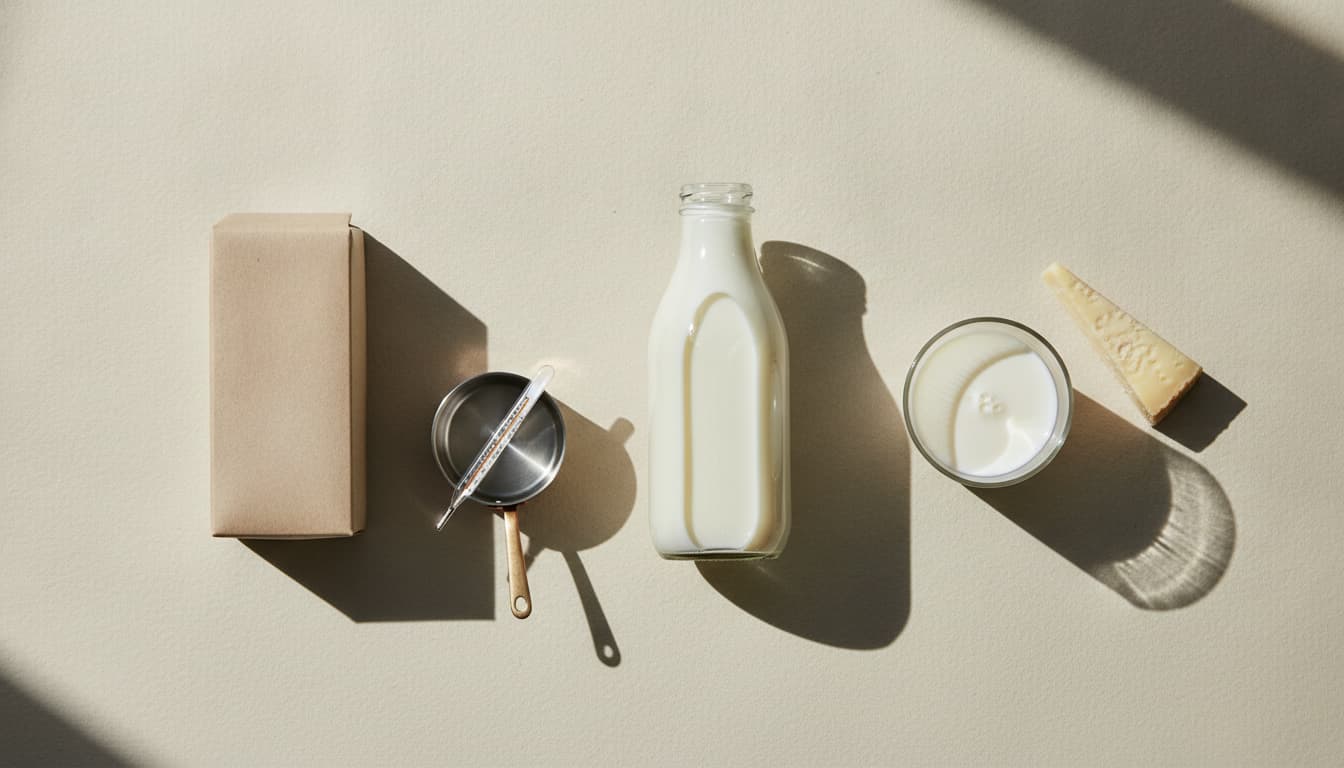
Unpasteurised dairy is consumed by a small share of the population and causes most dairy outbreak illness. The modelled figures are 840 times more illnesses and 45 times more hospitalisations per unit consumed, and the nutritional claims do not survive review.
- 01
The relative risk, normalised for consumption
Unpasteurised milk, consumed by only 3.2 percent of the population, and unpasteurised cheese, consumed by only 1.6 percent, caused 96 percent of illnesses attributed to contaminated dairy products, which makes unpasteurised dairy responsible for 840 times more illnesses, 95 percent credible interval 611 to 1,158, and 45 times more hospitalisations, credible interval 34 to 59, than pasteurised products (Costard et al. 2017). That is a per-unit-consumed comparison, which is the right denominator for an individual choice.
- 02
The absolute annual burden is small, and that is not a defence
Dairy-associated outbreaks in the United States cause on average 760 illnesses and 22 hospitalisations a year, mostly from Salmonella and Campylobacter (Costard et al. 2017). The absolute number is low because the exposed population is small, not because the product is safe, and the model projected that a doubling of unpasteurised consumption could increase outbreak-related illnesses by 96 percent.
- 03
The surveillance record agrees
Of 121 dairy-associated outbreaks from 1993 to 2006 with known pasteurisation status, 73, or 60 percent, involved nonpasteurised products and resulted in 1,571 cases, 202 hospitalisations and 2 deaths. Nonpasteurised products caused approximately 150 times more outbreaks and outbreak-associated illnesses per unit of product consumed (Langer et al. 2012). Two independent analyses reaching the same direction from different denominators is what makes this case unusually settled.
- 04
The harm skews young
Nonpasteurised products disproportionately affected persons under 20 years of age in the US outbreak review (Langer et al. 2012), and modelled campylobacteriosis estimates for raw milk from vending machines ranged from 1,013.7 to 8,110.3 cases per 100,000 population for young consumers under the more conservative dose-response model against 79.4 to 333.1 per 100,000 for adults under the less conservative one (Giacometti et al. 2015). This is the strongest single argument against household-wide adoption.
- 05
Legal availability tracks incidence
A total of 55, or 75 percent, of the nonpasteurised-product outbreaks occurred in the 21 states that permitted sale of these products, and the incidence of nonpasteurised-product-associated outbreaks was higher in those states, with the authors concluding that states restricting sale had fewer outbreaks and illnesses and that stronger restrictions and enforcement should be considered (Langer et al. 2012).
- 06
Boiling removed the modelled risk entirely
A quantitative risk assessment of raw milk sold in Italian vending machines, built on official microbiological records from 2008 to 2011 plus growth during storage and consumption data, predicted no human campylobacteriosis cases per year in the case of boiling the raw milk, either under regulated 4 degree Celsius handling throughout or under the worst observed time-temperature field conditions (Giacometti et al. 2015). Heat is the entire variable.
- 07
Herd health is a weak predictor of contamination
In some studies up to a third of all raw milk samples contained pathogens, even when sourced from clinically healthy animals or from milk that appeared to be of good quality (Lucey 2015). This undercuts the most common defence, which is that the risk depends on the farm. The organisms of concern do not necessarily make the animal ill or the milk look or smell wrong, so source quality is not a reliable screen.
- 08
The nutritional claims do not survive review
A review evaluating the popularly suggested benefits concluded that claims related to improved nutrition, prevention of lactose intolerance, or provision of beneficial bacteria from raw milk consumption have no scientific basis and are myths. It acknowledged epidemiological data linking a farming childhood with decreased allergy and asthma risk, but noted a variety of environmental factors may be involved and that there is no direct evidence raw milk is involved in any protective effect (Lucey 2015).
What people ask us next.
- How much riskier is raw milk than pasteurised milk?
- Per unit consumed, unpasteurised dairy has been estimated to cause 840 times more illnesses, 95 percent credible interval 611 to 1,158, and 45 times more hospitalisations, credible interval 34 to 59, than pasteurised products, with unpasteurised milk consumed by 3.2 percent of the population and unpasteurised cheese by 1.6 percent yet accounting for 96 percent of illnesses attributed to contaminated dairy (Costard et al. 2017). An earlier surveillance review put the figure at approximately 150 times per unit consumed (Langer et al. 2012).
- Does raw milk from a well-run, hygienic farm avoid the problem?
- Source quality is a weaker screen than it feels. In some studies up to a third of all raw milk samples contained pathogens, even when sourced from clinically healthy animals or from milk that appeared to be of good quality (Lucey 2015). The organisms of concern do not necessarily make the animal ill or change how the milk looks, smells or tastes, so neither herd health nor sensory inspection reliably identifies a contaminated batch.
- Is raw milk more nutritious than pasteurised milk?
- A review evaluating the suggested benefits concluded that claims related to improved nutrition, prevention of lactose intolerance, or provision of beneficial bacteria from raw milk have no scientific basis and are myths (Lucey 2015). Pasteurisation is a brief heat treatment, and the macronutrients, calcium and most vitamins survive it. The nutritional argument is therefore not the reason to accept an 840-fold relative risk.
- What about the finding that farm children have less asthma?
- That finding is real and the attribution is not. Some epidemiological data indicate children growing up in a farming environment are associated with a decreased risk of allergy and asthma, but a variety of environmental factors may be involved and there is no direct evidence that raw milk consumption is involved in any protective effect (Lucey 2015). Farm exposure includes animals, dust, endotoxin and microbial diversity, and the studies cannot isolate the milk.
- Who is most at risk?
- Young people. Nonpasteurised products disproportionately affected persons under 20 years of age in a review of 121 US dairy outbreaks (Langer et al. 2012), and modelled campylobacteriosis estimates ranged from 1,013.7 to 8,110.3 cases per 100,000 population for young consumers under a conservative dose-response model against 79.4 to 333.1 per 100,000 for adults under a less conservative one (Giacometti et al. 2015). The same asymmetry applies to pregnancy and to immunocompromised consumers.
- Does boiling raw milk make it safe?
- It removed the modelled risk in the one analysis that tested it directly. A quantitative risk assessment of raw milk from vending machines predicted no human campylobacteriosis cases per year in the case of boiling, both under regulated 4 degree Celsius handling throughout and under the worst observed time-temperature field conditions (Giacometti et al. 2015). Boiling is a harsher treatment than commercial pasteurisation, which achieves the same objective with less effect on flavour.
Every claim, cited.
- [01]Costard S, Espejo L, Groenendaal H, Zagmutt FJ. 2017. Outbreak-Related Disease Burden Associated with Consumption of Unpasteurized Cow's Milk and Cheese, United States, 2009-2014. Emerg Infect Dis 23(6):957-964. Dairy-associated outbreaks cause on average 760 illnesses per year and 22 hospitalisations per year, mostly from Salmonella spp. and Campylobacter spp.; unpasteurised milk consumed by only 3.2 percent of the population and cheese by only 1.6 percent caused 96 percent of illnesses caused by contaminated dairy products; unpasteurised dairy products cause 840 times (95 percent credible interval 611 to 1,158) more illnesses and 45 times (34 to 59) more hospitalisations than pasteurised products; a doubling in consumption of unpasteurised milk or cheese could increase outbreak-related illnesses by 96 percent.
- [02]Langer AJ, Ayers T, Grass J, Lynch M, Angulo FJ, Mahon BE. 2012. Nonpasteurized dairy products, disease outbreaks, and state laws, United States, 1993-2006. Emerg Infect Dis 18(3):385-91. 121 outbreaks with known pasteurisation status; 73 (60 percent) involved nonpasteurised products, resulting in 1,571 cases, 202 hospitalisations and 2 deaths; 55 (75 percent) occurred in the 21 states that permitted sale of nonpasteurised products, where incidence was higher; nonpasteurised products caused a disproportionate number, approximately 150 times greater per unit of product consumed, of outbreaks and outbreak-associated illnesses and disproportionately affected persons under 20 years of age; states restricting sale had fewer outbreaks and illnesses.
- [03]Lucey JA. 2015. Raw Milk Consumption: Risks and Benefits. Nutr Today 50(4):189-193. In some studies up to a third of all raw milk samples contained pathogens, even when sourced from clinically healthy animals or from milk that appeared to be of good quality; claims related to improved nutrition, prevention of lactose intolerance, or provision of beneficial bacteria from raw milk consumption have no scientific basis and are myths; some epidemiological data indicate children growing up in a farming environment are associated with a decreased risk of allergy and asthma, but a variety of environmental factors may be involved and there is no direct evidence that raw milk consumption is involved in any protective effect.
- [04]Giacometti F, Bonilauri P, Amatiste S, et al. 2015. Human campylobacteriosis related to the consumption of raw milk sold by vending machines in Italy: Quantitative risk assessment based on official controls over four years. Prev Vet Med 121(1-2):151-8. Model built on official microbiological records of raw milk samples from vending machines 2008 to 2011, microbial growth during storage, destruction experiments, consumption frequency, serving size and consumer age; no human campylobacteriosis cases predicted per year in either best (4 degrees Celsius) storage conditions or thermal abuse when the milk was boiled; for raw consumption, annual estimated cases for young consumers under the more conservative dose-response model ranged between 1,013.7 and 8,110.3 per 100,000 population, and for adult consumers under the less conservative model between 79.4 and 333.1 per 100,000.
The Larderlab Team builds evidence-led frameworks for eating, lifting, and stocking a kitchen. We cite every claim. We publish the spreadsheet when possible. We buy what we review at retail price. When new data lands, we revise with a dated note.
Next in this hub.
Raw vs Cooked Vegetables: What Each Method Costs and Returns
Heating tomatoes for 30 minutes cut vitamin C by 29 percent and raised trans-lycopene 2.6-fold in the same samples. Boiling cabbage removed 56 percent of glucosinolates in 2 minutes. The answer is per compound.
9 min · rev 2026-09-02Foods High in Lectins: The Real Risk, and Why Cooking Solves It
Lectins are proteins in beans, grains, and nightshades, and raw kidney beans really can make you sick, but cooking destroys them. The ranking, why the anti-lectin diet overstates the danger, and why most high-lectin foods are among the healthiest.
8 min · rev 2026-08-13How Much Caffeine Per Day? The Safe Limit, by the Numbers
Regulators treat up to 400 mg of caffeine a day as safe for healthy adults, roughly four 8-oz cups of coffee; pregnancy caps at 200 mg and teenagers at 100 mg. The daily number, what it is in real drinks, and why timing matters as much as dose.
8 min · rev 2026-07-17Get the Larderlab Macro Planner.
A Google Sheet that calculates your protein target, splits it across 3-5 meals, and ranks 20 protein sources by $/gram. Free. Copy-and-modify your own version.
By subscribing, you agree to our Privacy Policy. Unsubscribe anytime.