Magnesium-rich foods, ranked by mg per serving
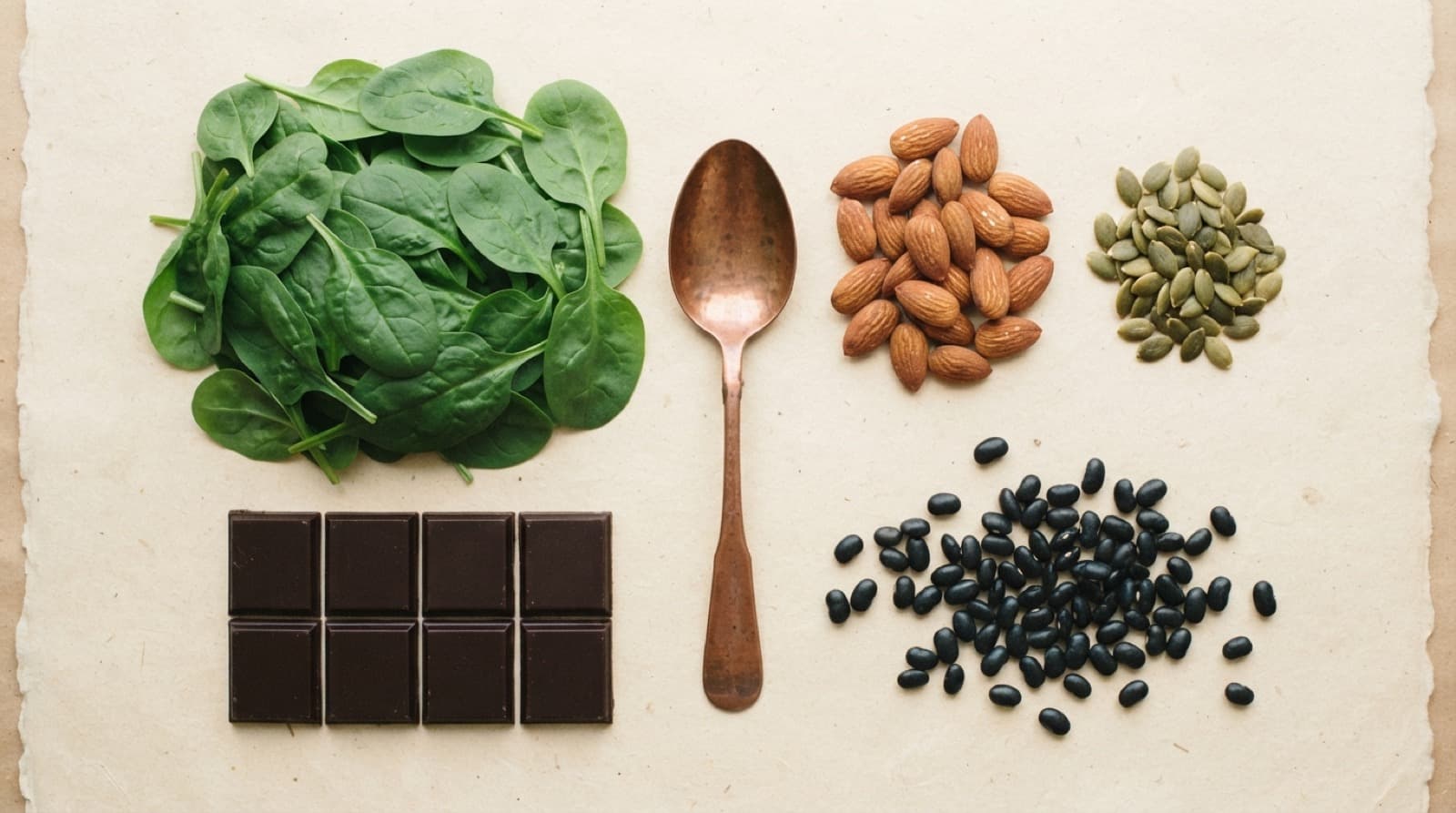
Pumpkin seeds (156 mg/oz), spinach (157 mg/cup cooked), and black beans (120 mg/cup) lead on magnesium. The mg-per-serving and cost ranking, plus when food is not enough.
- 01
Pumpkin seeds (pepitas): 156 mg per 1 oz
The single densest convenient source: 156 mg of magnesium per 28 g ounce, ~37% of a man's RDA, per USDA FoodData Central. Also ~8.5 g protein and ~5 g fiber per ounce. A handful on yogurt or in a trail mix is the highest magnesium-per-effort move on this list. Buy raw bulk to keep cost near ~$0.01 per 10 mg magnesium.
- 02
Cooked spinach: 157 mg per 1 cup
One cup of boiled spinach delivers 157 mg (~37% RDA) because cooking collapses ~10 cups of raw leaves into one dense cup (USDA). Raw spinach is far less practical at ~24 mg per cup. The oxalate in spinach modestly lowers absorption, but the sheer concentration still makes cooked greens a top source. Swiss chard (150 mg/cup cooked) is essentially interchangeable.
- 03
Black beans: 120 mg per 1 cup cooked
120 mg per cup (~29% RDA), plus 15 g protein and 15 g fiber (USDA). Among the best cost-per-mg sources on the list when bought dry in bulk (see our bulk-buying math). Most cooked legumes cluster here: cooked edamame ~100 mg/cup, kidney beans ~75 mg/cup, lentils ~71 mg/cup.
- 04
Almonds: 80 mg per 1 oz
80 mg per 28 g (~19% RDA), with 6 g protein (USDA). Cashews are close at ~74 mg/oz. Nuts are calorie-dense (~160 kcal/oz), so they are an add-on source, not something to eat by the cup. A 1 oz portion in the afternoon is a clean ~19% of the target.
- 05
Dark chocolate (70-85% cacao): 65 mg per 1 oz
~65 mg per 28 g of 70-85% dark chocolate (USDA), the rare source most people will not skip. Magnesium content tracks cacao percentage, so 85% beats 70%. At ~160 kcal/oz it is a treat-shaped source; useful for hitting the last 15% of the daily target, not the base.
- 06
Cooked quinoa: 118 mg per 1 cup
118 mg per cooked cup (~28% RDA), plus 8 g protein and a complete amino-acid profile (USDA). The best whole-grain carb base on magnesium, ahead of brown rice (~86 mg/cup) and whole-wheat pasta (~42 mg/cup). Building meals on quinoa instead of white rice quietly raises daily magnesium by ~100 mg.
- 07
Avocado: 58 mg per medium fruit
58 mg per medium avocado (~14% RDA), with 13 g fiber and potassium (USDA). A convenient source that pairs with the eggs and greens most people already eat. Not a base source on its own, but it stacks well with the seeds and beans above to clear the target without supplements.
- 08
Why food beats a magnesium pill (until it doesn't)
Food magnesium arrives with fiber, potassium, and protein, and does not trigger the osmotic diarrhea that high-dose magnesium oxide causes. The catch: refining strips it, so white bread, white rice, and processed foods are near-zero, which is how ~48% of Americans fall short (NHANES, Moshfegh 2009). If you eat seeds, cooked greens, legumes, and whole grains daily you likely clear the RDA from food. Supplement only the gap, and when you do, choose glycinate or citrate over oxide for absorption.
How this was specified
- 01Inputs measured
- Retail price (dated) · label claim · Certificate of Analysis · third-party test (Informed Sport / NSF / ConsumerLab / Clean Label) · leucine per serving from COA, not marketing.
- 02Protocols tested
- Per-kg target from four literature ranges (IOM RDA, Phillips 2017, Morton 2018, ISSN). Brands scored against Moore 2015 leucine-per-dose threshold (~0.4 g/kg).
- 03Cost-basis verified
- $/gram of protein and $/gram of leucine at warehouse pricing (Costco), mail-order (Amazon), and DTC retail. Re-checked quarterly, flagged when drift exceeds 15%.
- 04Confidence level
- High on ranked order. Medium on absolute $/g (prices drift). Low on serving-size claims where COA is older than 18 months, flagged [VERIFY].
Every claim, cited.
- [01]NIH Office of Dietary Supplements. Magnesium Fact Sheet for Health Professionals. RDA 400-420 mg/day (men), 310-320 mg/day (women); supplemental UL 350 mg/day; food sources.
- [02]USDA FoodData Central. Seeds, pumpkin and squash seed kernels, roasted: ~156 mg magnesium per 1 oz (28 g).
- [03]USDA FoodData Central. Spinach, cooked, boiled, drained: ~157 mg magnesium per 1 cup (180 g).
- [04]USDA FoodData Central. Beans, black, mature seeds, cooked, boiled: ~120 mg magnesium per 1 cup (172 g).
- [05]USDA FoodData Central. Quinoa, cooked: ~118 mg magnesium per 1 cup (185 g). Almonds: ~80 mg per 1 oz.
- [06]Moshfegh A, Goldman J, Cleveland L, et al. 2009. What We Eat in America, NHANES. ~48% of the US population consumes less than the EAR for magnesium from food.
The Larderlab Team builds evidence-led frameworks for eating, lifting, and stocking a kitchen. We cite every claim. We publish the spreadsheet when possible. We buy what we review at retail price. When new data lands, we revise with a dated note.
Next in this hub.
Foods High in Omega-3, Ranked by EPA+DHA per Serving
Salmon (~1.5-2 g), sardines (~1.4 g), and mackerel (~2.5 g) per 100 g lead on EPA+DHA. The per-serving ranking, why plant ALA does not count the same, and when food beats a capsule.
8 min · rev 2026-07-01Foods High in Vitamin D, Ranked by IU per Serving
Salmon (~570 IU), trout (~645 IU), and sardines (~180 IU) per serving lead; UV mushrooms and fortified milk fill the gaps. The per-serving ranking, and why food rarely covers the daily target alone.
8 min · rev 2026-07-02Iron-Rich Foods: The Densest Sources, by Milligrams
The RDA is 8 mg/day for men and 18 mg for women aged 19-50, and clams, liver, and fortified cereal top the list, but heme iron from meat absorbs far better than the non-heme iron in beans and spinach. The mg-per-serving ranking, why absorption matters more than the label, and how vitamin C changes the math.
8 min · rev 2026-07-08Get the Larderlab Macro Planner.
A Google Sheet that calculates your protein target, splits it across 3-5 meals, and ranks 20 protein sources by $/gram. Free. Copy-and-modify your own version.
By subscribing, you agree to our Privacy Policy. Unsubscribe anytime.