Wie viel Eiweiß pro Tag, nach Körpergewicht
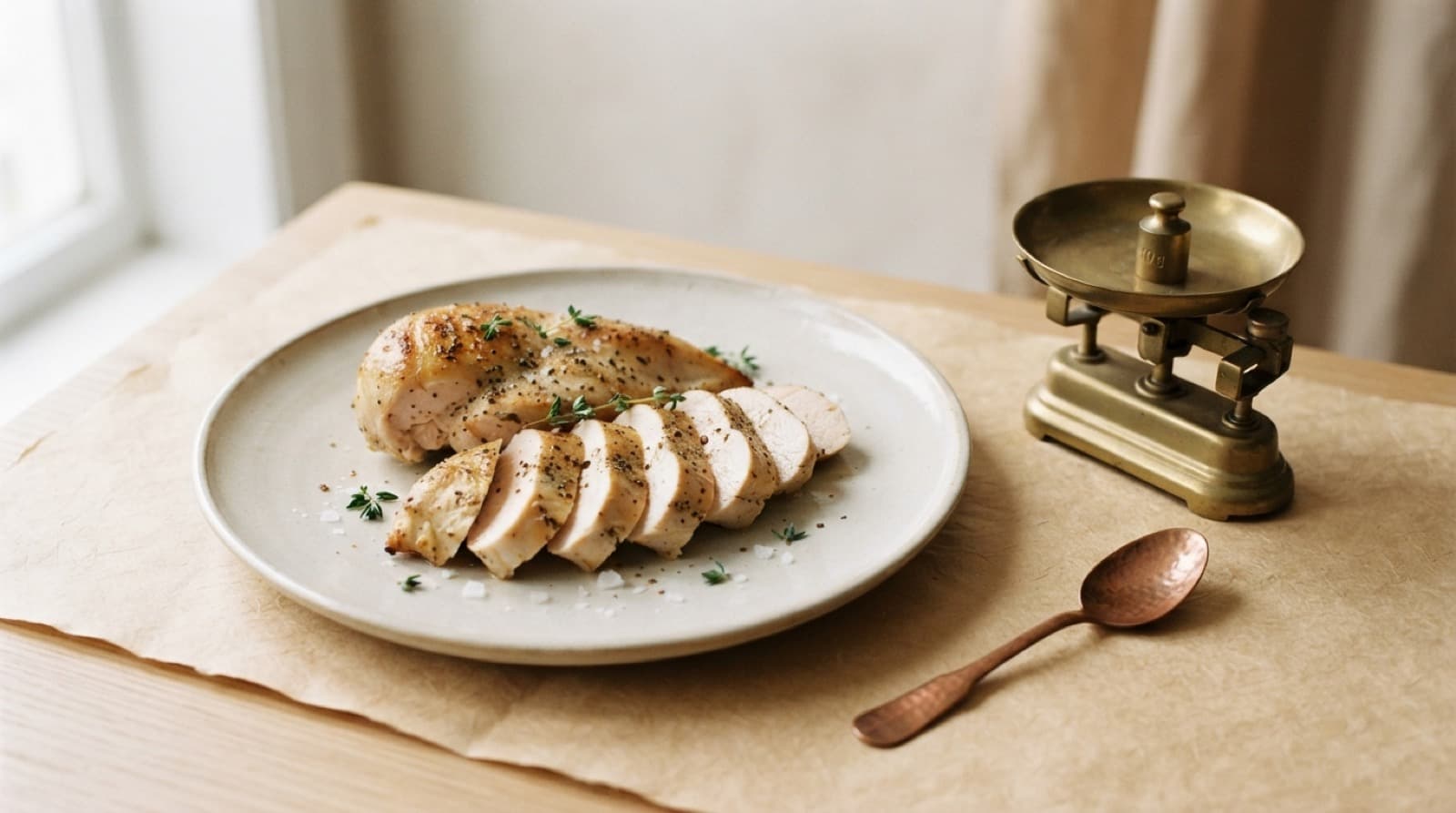
1,6 g/kg/day für krafttrainierte Erwachsene, 0,8 g/kg als RDA-Untergrenze, 1,2 g/kg für Ausdauer. Vier Expertenbereiche, eine Körpergewichtstabelle und die Quellen.
Was als Nächstes gefragt wird.
- Ist 1 Gramm pro Pfund Körpergewicht dasselbe wie 1,6 g/kg?
- Nein, und der Unterschied ist von Bedeutung. 1 g/lb ergibt rund 2,2 g/kg, am oberen Ende des Bereichs von Morton 2018. Das lässt sich für aggressive Diätphasen oder fortgeschrittene Trainierende vertreten, liegt aber für die meisten Kraftsportler oberhalb des Punkts abnehmender Erträge. 1,6 g/kg (0,73 g/lb) ist das evidenzbasierte Ziel; 1 g/lb ist eine Faustregel mit runder Zahl, die ohne Schaden über das Ziel hinausschießt.
- Wie viel Eiweiß sollte eine Frau mit 150 lb essen?
- 150 lb = 68 kg. Krafttrainiertes Ziel: 68 x 1,6 = 109 g/Tag. In der Diät oder perimenopausal: hoch auf 68 x 2,0 = 136 g/Tag. Reine Ausdauer oder untrainiert: 68 x 1,2 = 82 g/Tag. Kerksick et al. 2018 weitet den ISSN-Bereich ausdrücklich ohne Anpassung auf trainierte Sportlerinnen aus. Die absolute Zahl verschiebt sich mit dem Körpergewicht; das Ziel pro kg bleibt unverändert.
- Sind 100 g Eiweiß pro Tag ausreichend?
- Das hängt von Körpergewicht und Ziel ab. Für einen trainierten Kraftsportler mit 60 kg (132 lb) erreichen 100 g 1,67 g/kg, im Ziel. Für einen Kraftsportler mit 80 kg (176 lb) sind 100 g 1,25 g/kg, unterhalb des Bereichs von Morton 2018 und lassen wahrscheinlich Zuwächse an Magermasse ungenutzt. Verwenden Sie den Multiplikator pro kg, nicht die runde Zahl.
- Verändert sich der Eiweißbedarf mit dem Alter?
- Ja, nach oben. Phillips 2016 und Moore 2015 dokumentieren anabole Resistenz: ältere Erwachsene (50+) benötigen mehr Leucin pro Portion, um den Schwellenwert der MPS zu überschreiten. Die ISSN und der PROT-AGE-Konsens (Bauer et al. 2013) empfehlen 1,2-1,6 g/kg für gesunde ältere Erwachsene und bis zu 2,0 g/kg während der Genesung von Krankheit oder Verletzung. Heben Sie die Untergrenze an, nicht die Obergrenze.
- Gibt es eine Obergrenze, die Nierenschäden verursacht?
- Nicht für gesunde Erwachsene. Antonio et al. 2014-2016 ließen trainierte Männer bis zu einem Jahr lang 3,4-4,4 g/kg/day zu sich nehmen, ohne renale, hepatische oder lipidbezogene Funktionsstörungen. Die renale Vorsicht gilt nur bei vorbestehender chronischer Nierenerkrankung (Martin et al. 2005). Für gesunde Erwachsene sind 2,2 g/kg die praktische Obergrenze des Leistungsertrags, keine Sicherheitsgrenze.
- Inwiefern ist die Dosis pro Mahlzeit von Bedeutung?
- Moore 2015 ermittelte einen Schwellenwert pro Mahlzeit von rund 0,4 g/kg, etwa 2,5-3 g Leucin, um die MPS maximal zu stimulieren. Für einen Kraftsportler mit 80 kg sind das rund 32 g Eiweiß pro Mahlzeit. Die tägliche Gesamtdosis treibt den Großteil des Effekts (Schoenfeld & Aragon 2018), doch den Schwellenwert bei 3-4 Mahlzeiten zu erreichen, schlägt das Vorausladen oder Nachladen eines einzelnen Bolus von 80 g.
Jede Aussage, belegt.
- [01]Morton RW et al. 2018. Meta-analysis of protein and resistance-training gains. Br J Sports Med 52(6):376-384.
- [02]Jager R et al. 2017. ISSN Position Stand: protein and exercise. J Int Soc Sports Nutr 14:20.
- [03]Phillips SM, Chevalier S, Leidy HJ. 2016. Protein 'requirements' beyond the RDA. Appl Physiol Nutr Metab 41(5):565-572.
- [04]Moore DR et al. 2015. Protein ingestion to stimulate myofibrillar protein synthesis in older versus younger men. J Gerontol A 70(1):57-62.
- [05]Bauer J et al. 2013. Evidence-based recommendations for optimal dietary protein intake in older people: a position paper from the PROT-AGE Study Group. J Am Med Dir Assoc 14(8):542-559.
- [06]Antonio J et al. 2016. A high protein diet has no harmful effects: a one-year crossover study in resistance-trained males. J Nutr Metab 2016:9104792.
Das Larderlab-Team entwickelt evidenzbasierte Rahmenwerke fürs Essen, Trainieren und Bestücken einer Küche. Wir belegen jede Aussage. Wir veröffentlichen die Tabelle, wo möglich. Wir kaufen, was wir testen, zum Ladenpreis. Wenn neue Daten erscheinen, überarbeiten wir mit einer datierten Notiz.
Als Nächstes in diesem Ressort.
Casein oder Whey: Whey gewinnt die Stunde, Casein gewinnt die Nacht
Whey hob die Muskelproteinsynthese um rund 93 Prozent über Casein in Ruhe und um 122 Prozent nach dem Training, doch Casein lieferte die bessere Nettobilanz über 7 Stunden. Casein vor dem Schlaf brachte über 12 Wochen 3,6 Quadratzentimeter mehr Quadrizepswachstum gegenüber Placebo.
14 Min. · Rev. 2026-09-10Beste Proteinpulver, sortiert nach $/Gramm Leucin
Wir haben 14 Proteinpulver nach der Kennzahl sortiert, die tatsächlich zählt: den Kosten pro Gramm geliefertem Leucin, mit Filtern für Tests durch Dritte.
14 Min. · Rev. 2026-04-21Beste Vollwert-Proteinquellen, sortiert nach $/Gramm
20 Vollwert-Proteinquellen, bepreist pro Gramm Protein, mit Costco- und Supermarkt-Benchmarks. Vierteljährlich aktualisiert.
10 Min. · Rev. 2026-04-21Holen Sie sich den Larderlab-Makroplaner.
Ein Google Sheet, das Ihren Proteinbedarf berechnet, ihn auf 3-5 Mahlzeiten verteilt und 20 Proteinquellen nach $/Gramm sortiert. Kostenlos. Kopieren und nach Belieben anpassen.
Mit der Anmeldung stimmen Sie unserer Datenschutzerklärung zu. Jederzeit kündbar.