Foods high in zinc, ranked by milligrams
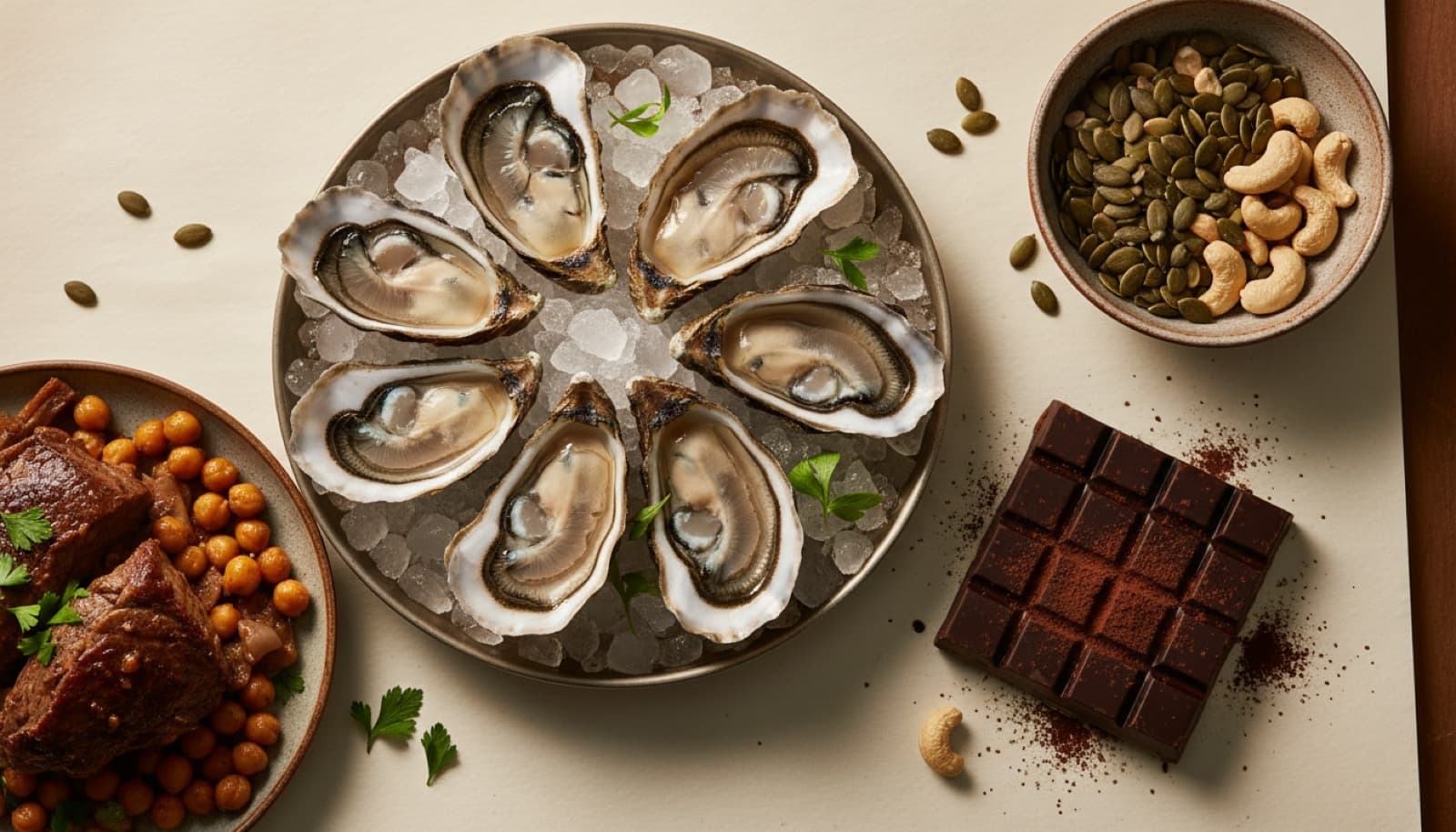
The daily zinc target is 11 mg for men and 8 mg for women, and oysters, beef, pumpkin seeds, and legumes are the densest sources. The mg-per-serving ranking, why plant zinc absorbs worse, and how to hit the number from food.
- 01
Oysters: ~30-70 mg per 100 g
Oysters are the single densest source by a wide margin, carrying roughly 30-70 mg of zinc per 100 g depending on species and season, several times the daily target in one serving (USDA FoodData Central). Six medium oysters can supply well over 30 mg. They also deliver B12, copper, and selenium. Because the dose is so high, oysters are an occasional powerhouse rather than a daily food, and eating them a few times a month meaningfully raises average intake.
- 02
Beef and lamb: ~5-7 mg per 100 g cooked
Red meat is the most practical everyday zinc source: a 100 g cooked serving of beef supplies ~5-7 mg, roughly half to two-thirds of the daily target, and lamb is similar (USDA). The zinc is highly bioavailable, absorbed better than plant zinc, and arrives with heme iron, B12, and complete protein. A modest daily or near-daily serving of red meat effectively guarantees adequate zinc, which is why deficiency is rare among people who eat it regularly.
- 03
Crab and other shellfish: ~4-7 mg per 100 g
Crab supplies ~4-7 mg of zinc per 100 g, with lobster, mussels, and shrimp adding useful amounts (USDA). Like oysters, shellfish zinc is well absorbed and comes with selenium and B12. Shellfish are a strong option for people who want marine sources without the very high dose of oysters, and they pair naturally with the oily fish that anchor omega-3 intake, so a seafood-forward week tends to cover several nutrients at once.
- 04
Pumpkin seeds: ~2.2 mg per ounce
Pumpkin seeds are the densest plant source at ~2.2 mg per ounce (28 g), alongside magnesium, iron, and healthy fats (USDA). As a seed they carry some phytates, so absorption is lower than from meat, but roasting and the fact that they are eaten in concentrated handfuls make them a genuinely useful top-up. A daily ounce stirred into yogurt or eaten as a snack adds meaningful zinc and doubles as one of the densest magnesium sources too.
- 05
Legumes: chickpeas and lentils, ~2.5 mg per cup cooked
A cup of cooked chickpeas or lentils supplies ~2.5 mg of zinc, making legumes the backbone of plant-based zinc (USDA). The catch is phytate: absorption is lower than from animal sources, which is why vegetarians are advised to aim higher. Soaking dried legumes before cooking, and choosing sprouted or fermented forms, breaks down phytate and improves uptake. Legumes also anchor low-cost protein, so they do double duty in a budget-conscious, zinc-adequate diet.
- 06
Cashews and other nuts: ~1.6 mg per ounce
Cashews lead the nuts at ~1.6 mg of zinc per ounce, with almonds and peanuts adding smaller amounts (USDA). As with seeds and legumes, phytate limits absorption, so nuts are a supporting source rather than a base. Their value is convenience and stacking: an ounce of cashews plus an ounce of pumpkin seeds already approaches half a woman's daily target from snacks alone, before any meal-based zinc from meat or legumes.
- 07
Dairy, eggs, and whole grains: the steady background
Milk, cheese, yogurt, and eggs supply modest, well-absorbed zinc (~1 mg per serving) with no phytate penalty, and whole grains add more, though refining strips it, which is why white flour is near-zero (USDA). None is a standout, but together they form the steady background intake that, stacked with a daily protein source, clears the target for most mixed eaters. For vegetarians, fermented and leavened whole grains (sourdough) are better than unleavened, because leavening reduces phytate.
How this was specified
- 01Inputs measured
- Retail price (dated) · label claim · Certificate of Analysis · third-party test (Informed Sport / NSF / ConsumerLab / Clean Label) · leucine per serving from COA, not marketing.
- 02Protocols tested
- Per-kg target from four literature ranges (IOM RDA, Phillips 2017, Morton 2018, ISSN). Brands scored against Moore 2015 leucine-per-dose threshold (~0.4 g/kg).
- 03Cost-basis verified
- $/gram of protein and $/gram of leucine at warehouse pricing (Costco), mail-order (Amazon), and DTC retail. Re-checked quarterly, flagged when drift exceeds 15%.
- 04Confidence level
- High on ranked order. Medium on absolute $/g (prices drift). Low on serving-size claims where COA is older than 18 months, flagged [VERIFY].
Every claim, cited.
- [01]National Institutes of Health, Office of Dietary Supplements. Zinc Fact Sheet for Health Professionals. RDA 11 mg/day (men) and 8 mg/day (women); upper limit 40 mg/day.
- [02]US Department of Agriculture, Agricultural Research Service. FoodData Central. Zinc content of oysters, beef, shellfish, pumpkin seeds, legumes, and nuts.
- [03]Institute of Medicine. 2001. Dietary Reference Intakes for Vitamin A, Vitamin K, Arsenic, Boron, Chromium, Copper, Iodine, Iron, Manganese, Molybdenum, Nickel, Silicon, Vanadium, and Zinc. National Academies Press. Vegetarians may require ~50% more zinc due to phytate.
- [04]Roohani N, Hurrell R, Kelishadi R, Schulin R. 2013. Zinc and its importance for human health: an integrative review. J Res Med Sci 18(2):144-157. Phytate as the main inhibitor of dietary zinc absorption.
The Larderlab Team builds evidence-led frameworks for eating, lifting, and stocking a kitchen. We cite every claim. We publish the spreadsheet when possible. We buy what we review at retail price. When new data lands, we revise with a dated note.
Next in this hub.
Foods High in Vitamin C: The Densest Sources, by Milligrams
The daily target is 90 mg for men and 75 mg for women, and one guava, one red bell pepper, or a cup of strawberries clears it in a single serving. The mg-per-serving ranking, why oranges are not the top source, and how cooking cuts the number.
8 min · rev 2026-07-10High-Fiber Foods: The Densest Sources, by Grams
The target is ~25 g/day for women and 38 g for men, and beans, lentils, chia, avocado, and whole grains are the densest sources. The grams-per-serving ranking, why most people hit only half the number, and how to close the gap without bloating.
8 min · rev 2026-07-09Foods High in Thiamin (Vitamin B1): The Densest Sources, by Milligrams
The RDA is 1.2 mg a day for men and 1.1 mg for women, and pork, fortified grains, legumes, and sunflower seeds cover it easily. The mg-per-serving ranking, why refined grains are fortified for a reason, and who is actually at risk of deficiency.
7 min · rev 2026-08-14Get the Larderlab Macro Planner.
A Google Sheet that calculates your protein target, splits it across 3-5 meals, and ranks 20 protein sources by $/gram. Free. Copy-and-modify your own version.
By subscribing, you agree to our Privacy Policy. Unsubscribe anytime.