How much melatonin to take, and why the shelf dose is ten to thirty times the dose that was studied
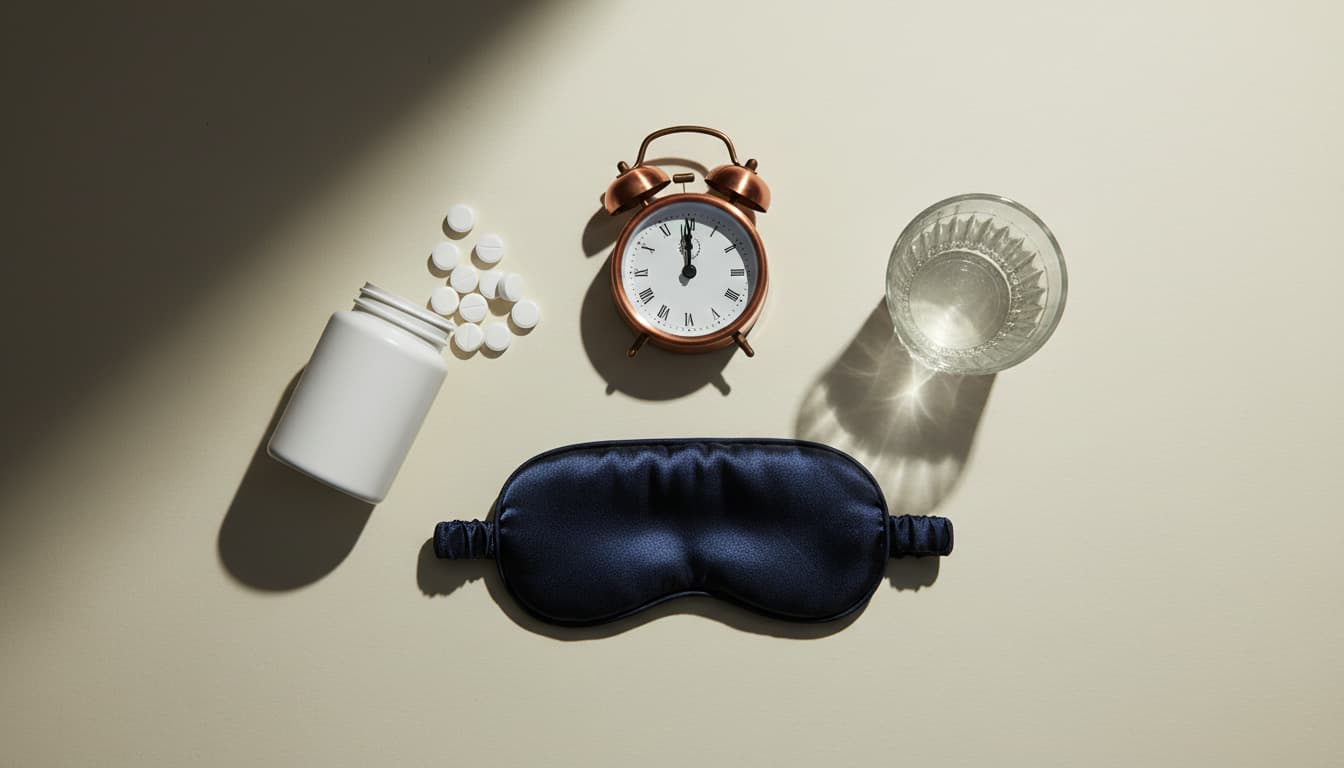
The physiologic dose that restored sleep efficiency under polysomnography was 0.3 mg, while 3.0 mg induced hypothermia and left plasma melatonin elevated into daylight hours. Pooled across 19 trials, melatonin cut sleep onset latency by 7.06 minutes.
- 01
The dose that worked under polysomnography was 0.3 mg
In a double-blind placebo-controlled crossover with polysomnography, the physiologic dose of 0.3 mg restored sleep efficiency at P less than 0.0001 in adults over 50 with confirmed reduced sleep efficiency, acting principally in the middle third of the night, and raised plasma melatonin to normal nocturnal levels at P less than 0.0008 (Zhdanova et al. 2001). That is the number the retail market has never adopted. Products at 3, 5 and 10 mg are ten to thirty times it.
- 02
3.0 mg also worked, and produced the side effects
In the same trial the pharmacologic dose of 3.0 mg improved sleep as well, but it induced hypothermia and caused plasma melatonin to remain elevated into the daylight hours (Zhdanova et al. 2001). That is the mechanism behind the morning grogginess and heavy-headed feeling people describe, stated as a measured pharmacokinetic finding rather than as anecdote. Escalating the dose does not buy a better night; it extends the signal past the point where the signal is wanted.
- 03
Normal sleepers got nothing at any dose
The control group in the same crossover also had low melatonin levels, yet their sleep was unaffected by any of the three doses (Zhdanova et al. 2001). This is the finding that separates melatonin from a hypnotic. It is a replacement signal for a deficient nocturnal rhythm rather than a sedative that suppresses wakefulness in anyone who swallows it, which is why it underperforms expectations set by comparison with prescription sleep drugs.
- 04
The pooled effect on falling asleep is 7.06 minutes
Across 19 randomised placebo-controlled trials in 1,683 subjects with primary sleep disorders, melatonin reduced sleep onset latency by a weighted mean of 7.06 minutes, 95 percent confidence interval 4.37 to 9.75, and increased total sleep time by 8.25 minutes, 95 percent confidence interval 1.74 to 14.75 (Ferracioli-Oda et al. 2013). Both are statistically solid and neither is large. Anyone expecting to be unconscious within minutes of a tablet is working from a different number than the one the literature reports.
- 05
Higher doses moved the clock measures but not the quality measure
The meta-regression found that trials with longer duration and higher doses of melatonin showed greater effects on decreasing sleep latency and increasing total sleep time, but no significant effect of trial duration or dose was observed on sleep quality, which improved with a standardised mean difference of 0.22, 95 percent confidence interval 0.12 to 0.32 (Ferracioli-Oda et al. 2013). Dose escalation therefore buys minutes on a polysomnograph without buying the subjective outcome most users are actually chasing.
- 06
The sleep medicine guideline suggests clinicians not use it
The American Academy of Sleep Medicine states that clinicians should not use melatonin as a treatment for sleep onset or sleep maintenance insomnia versus no treatment in adults, graded weak, while in the same document suggesting clinicians use ramelteon, a melatonin receptor agonist available on prescription, for sleep onset insomnia, also graded weak (Sateia et al. 2017). Two recommendations in opposite directions for the same receptor, separated by whether the dose in the bottle is guaranteed.
- 07
A guideline can decline to recommend something that works
Under GRADE, a recommendation weighs effect magnitude, certainty of evidence, harms, patient values and the reliability of what a patient will actually obtain. A seven-minute latency reduction (Ferracioli-Oda et al. 2013) delivered by products whose content spans 83 percent below to 478 percent above label (Erland and Saxena 2017) is a weak basis for a clinical instruction even when the molecule itself is doing something. That is a statement about the supply chain as much as about the pharmacology.
- 08
The regulator writes two different claims for two different uses
In the EU framework, the claim that melatonin contributes to the reduction of time taken to fall asleep may be used only for a food containing 1 mg per quantified portion, consumed close to bedtime, while the separate authorised claim for alleviation of subjective feelings of jet lag requires at least 0.5 mg per portion, taken close to bedtime on the first day of travel and on following days (EFSA NDA Panel 2011; Regulation 432/2012). The second is the chronobiotic use, where timing rather than milligrams carries the effect.
- 09
Timing is the lever that dose escalation is substituting for
Melatonin functions as a timing signal to the circadian system, so the variable that determines whether it helps a delayed schedule is when it is taken relative to a person's own melatonin onset, not how many milligrams the capsule holds. The regulatory jet lag claim encodes exactly this by specifying a dosing schedule across travel days rather than a single quantity (Regulation 432/2012). Someone taking 10 mg at midnight with no benefit has usually made a timing error, and a bigger dose does not correct it.
- 10
Content ran from 83 percent below label to 478 percent above
Analysis of 31 supplements by ultraperformance liquid chromatography found melatonin content ranging from 83 percent below to 478 percent above the labelled amount, with content failing to meet the label within a 10 percent margin in more than 71 percent of products (Erland and Saxena 2017). At those tolerances a person cannot know whether they took 0.3 mg or 3 mg, which makes the careful dose selection described above partly theoretical unless the product carries batch-level testing.
- 11
Lot-to-lot variability of 465 percent means the bottle is not the product
In the same analysis, lot-to-lot variability within a particular product reached 465 percent, and this variability did not appear to be correlated with manufacturer or product type (Erland and Saxena 2017). That is the most practically damaging of the quality findings: a person who identifies a product that suits them has no assurance the next bottle of the same product delivers the same dose. Serotonin, a controlled substance, was identified in eight supplements at 1 to 75 micrograms.
- 12
Gummies are the worst-labelled format in the category
Across 25 melatonin gummy products, one contained no detectable melatonin, measured quantity ranged from 74 to 347 percent of the labelled amount, only 3 products, 12 percent, were within 10 percent of the declared quantity, and 22 of 25, 88 percent, were inaccurately labelled (Cohen et al. 2023). Five contained cannabidiol at 104 to 118 percent of label, and the product declaring 30 mg of melatonin with none detectable contained 31.3 mg of cannabidiol. A gummy also cannot be split to reach 0.3 mg.
- 13
Paediatric ingestions rose 530 percent in ten years
Between 2012 and 2021, 260,435 paediatric melatonin ingestions were reported to United States poison control centres, rising from 8,337 in 2012 to 52,563 in 2021, and melatonin accounted for 4.9 percent of all paediatric ingestions in 2021 against 0.6 percent in 2012. Of those receiving facility care, 4,097, or 14.7 percent, were hospitalised, 287 required intensive care, five children required mechanical ventilation and two died (Lelak et al. 2022). Sales rose from 285 to 821 million dollars over the same window.
- 14
The protocol is short, and escalation is not part of it
Take 0.3 to 0.5 mg thirty minutes before the intended bedtime, at the same clock time nightly, in a splittable tablet rather than a gummy, from a product with batch-level third-party testing. If 0.5 mg does not work, the answer is almost never 5 mg. The realistic causes at that point are evening light exposure, an irregular schedule, caffeine timing or a sleep disorder that melatonin was never going to address, and the next step is a clinician rather than a larger bottle.
What people ask us next.
- How much melatonin should I take?
- 0.3 to 0.5 mg, roughly thirty minutes before the intended bedtime. In a double-blind placebo-controlled crossover with polysomnography, 0.3 mg restored sleep efficiency at P less than 0.0001 and raised plasma melatonin to normal nocturnal levels, while 3.0 mg also improved sleep but induced hypothermia and left plasma melatonin elevated into the daylight hours (Zhdanova et al. 2001). Retail products at 3, 5 and 10 mg are ten to thirty times the physiologic dose. Buy a splittable tablet rather than a gummy, because a gummy cannot be titrated to 0.3 mg.
- Is 10 mg of melatonin too much?
- It is roughly thirty times the dose that reproduced normal nocturnal physiology in the trial that tested a dose range directly, and the trial found that a tenfold smaller dose of 3.0 mg already induced hypothermia and left plasma melatonin elevated into the following daylight hours (Zhdanova et al. 2001). Higher doses did produce slightly larger effects on sleep latency and total sleep time in meta-regression, but no additional effect on sleep quality (Ferracioli-Oda et al. 2013). So 10 mg buys carryover into the morning without buying the outcome people want.
- Does melatonin actually work?
- Yes, measurably and modestly. Pooled across 19 randomised placebo-controlled trials in 1,683 subjects, melatonin reduced sleep onset latency by a weighted mean of 7.06 minutes, 95 percent confidence interval 4.37 to 9.75, increased total sleep time by 8.25 minutes and improved overall sleep quality with a standardised mean difference of 0.22 (Ferracioli-Oda et al. 2013). The authors describe the effects as modest, note that they do not dissipate with continued use, and state that the absolute benefit is smaller than for other pharmacological insomnia treatments.
- Why do sleep specialists recommend against melatonin?
- The American Academy of Sleep Medicine suggests that clinicians not use melatonin as a treatment for sleep onset or sleep maintenance insomnia versus no treatment in adults, a weak recommendation, while suggesting that clinicians use ramelteon for sleep onset insomnia, also weak (Sateia et al. 2017). The distinction is instructive: both act at melatonin receptors, but one has a guaranteed dose. A seven-minute effect delivered by products whose content ranges from 83 percent below to 478 percent above label (Erland and Saxena 2017) is a weak basis for a clinical instruction.
- When should melatonin be taken?
- At a consistent clock time, roughly thirty minutes before the intended bedtime, and the timing matters more than the quantity. Melatonin acts as a timing signal to the circadian system, which is why the EU framework carries two separate authorised claims: 1 mg per portion close to bedtime for reducing the time taken to fall asleep, and at least 0.5 mg per portion taken close to bedtime on the first day of travel and following days for jet lag (EFSA NDA Panel 2011; Regulation 432/2012). A dose taken at an inconsistent hour is working against itself.
- Is melatonin safe for children?
- It is a question for a paediatrician rather than a shelf, and the population data explains why. Between 2012 and 2021, 260,435 paediatric melatonin ingestions were reported to United States poison control centres, a 530 percent rise, and among children receiving facility care 4,097, or 14.7 percent, were hospitalised, 287 required intensive care, five required mechanical ventilation and two died (Lelak et al. 2022). Gummy formats aimed at households with children are also the worst labelled, with only 12 percent of 25 products within 10 percent of the declared amount (Cohen et al. 2023).
- Why does melatonin leave me groggy in the morning?
- Because the dose is outlasting the night. The trial that compared 0.1, 0.3 and 3.0 mg found that the 3.0 mg dose caused plasma melatonin to remain elevated into the daylight hours and induced hypothermia, while 0.3 mg restored sleep efficiency and normalised plasma melatonin without that carryover (Zhdanova et al. 2001). A 5 or 10 mg product amplifies the same effect. The fix is to reduce the dose toward 0.3 to 0.5 mg rather than to move the timing earlier, which usually makes the carryover worse.
- Are melatonin gummies accurately labelled?
- Mostly not. Across 25 melatonin gummy products sold in the United States, one contained no detectable melatonin at all, the measured quantity ranged from 74 to 347 percent of the labelled amount, only 3 products, 12 percent, fell within 10 percent of the declared quantity, and 22 of 25, 88 percent, were inaccurately labelled (Cohen et al. 2023). Five contained cannabidiol, at 10.6 to 31.3 mg per serving. Given that the useful dose is 0.3 to 0.5 mg, a format that cannot be split and cannot be trusted to its label is the wrong format.
Every claim, cited.
- [01]Zhdanova IV, Wurtman RJ, Regan MM, Taylor JA, Shi JP, Leclair OU. 2001. Melatonin treatment for age-related insomnia. J Clin Endocrinol Metab 86(10):4727-30. In a double-blind, placebo-controlled study, subjects over 50 who slept normally, n equals 15, or exhibited actigraphically confirmed decreases in sleep efficiency, n equals 15, received in randomised order a placebo and three melatonin doses of 0.1, 0.3 and 3.0 mg orally 30 minutes before bedtime for a week, with one-week washout periods and polysomnography on the last three nights of each treatment period. The physiologic melatonin dose of 0.3 mg restored sleep efficiency, P less than 0.0001, acting principally in the middle third of the night, and elevated plasma melatonin levels to normal, P less than 0.0008. The pharmacologic dose of 3.0 mg, like the lowest dose of 0.1 mg, also improved sleep; however, it induced hypothermia and caused plasma melatonin to remain elevated into the daylight hours. Although control subjects also had low melatonin levels, their sleep was unaffected by any melatonin dose.
- [02]Ferracioli-Oda E, Qawasmi A, Bloch MH. 2013. Meta-analysis: melatonin for the treatment of primary sleep disorders. PLoS One 8(5):e63773. Nineteen studies involving 1,683 subjects were included. Melatonin significantly reduced sleep latency, weighted mean difference 7.06 minutes, 95 percent confidence interval 4.37 to 9.75, Z equals 5.15, P less than 0.001, and increased total sleep time, weighted mean difference 8.25 minutes, 95 percent confidence interval 1.74 to 14.75, Z equals 2.48, P equals 0.013. Overall sleep quality improved with a standardised mean difference of 0.22, 95 percent confidence interval 0.12 to 0.32, P less than 0.001. Trials with longer duration and higher doses showed greater effects on sleep latency and total sleep time, but no significant effects of trial duration or dose were observed on sleep quality. The authors conclude that the effects are modest, do not appear to dissipate with continued use, and that the absolute benefit is smaller than for other pharmacological treatments for insomnia.
- [03]Sateia MJ, Buysse DJ, Krystal AD, Neubauer DN, Heald JL. 2017. Clinical practice guideline for the pharmacologic treatment of chronic insomnia in adults: an American Academy of Sleep Medicine clinical practice guideline. J Clin Sleep Med 13(2):307-349. The guideline states that clinicians should not use melatonin as a treatment for sleep onset or sleep maintenance insomnia versus no treatment in adults, graded WEAK under GRADE. In the same document the guideline suggests that clinicians use ramelteon, a melatonin receptor agonist available on prescription, as a treatment for sleep onset insomnia versus no treatment in adults, also graded WEAK. The contrast between the two recommendations for agents acting at the same receptor is the clearest statement in the sleep medicine literature that dose reliability, not mechanism, is the limiting factor for over-the-counter melatonin.
- [04]Erland LA, Saxena PK. 2017. Melatonin natural health products and supplements: presence of serotonin and significant variability of melatonin content. J Clin Sleep Med 13(2):275-281. A total of 31 supplements were analysed by ultraperformance liquid chromatography with electrochemical detection, with confirmation by mass spectrometry. Melatonin content ranged from 83 percent below to 478 percent above the labelled content. Lot-to-lot variability within a particular product varied by as much as 465 percent, and this variability did not appear to be correlated with manufacturer or product type. Serotonin, a related indoleamine and controlled substance, was identified in eight of the supplements at levels of 1 to 75 micrograms. Melatonin content did not meet label within a 10 percent margin of the label claim in more than 71 percent of supplements, and an additional 26 percent were found to contain serotonin.
- [05]Cohen PA, Avula B, Wang YH, Katragunta K, Khan I. 2023. Quantity of melatonin and CBD in melatonin gummies sold in the US. JAMA 329(16):1401-1402. Twenty-five melatonin gummy products were analysed. One product contained no detectable melatonin. Among the remainder the quantity of melatonin ranged from 1.3 mg to 13.1 mg per serving, and measured melatonin ranged from 74 percent to 347 percent of the labelled quantity. Only 3 products, 12 percent, contained a quantity of melatonin within 10 percent of the declared quantity, and 22 of 25 products, 88 percent, were inaccurately labelled. Five products contained cannabidiol, with actual quantity ranging from 104 percent to 118 percent of the labelled quantity at 10.6 mg to 31.3 mg per serving; the product declaring 30 mg of melatonin, in which melatonin was not detected, contained 31.3 mg of cannabidiol.
- [06]Lelak K, Vohra V, Neuman MI, Toce MS, Sethuraman U. 2022. Pediatric melatonin ingestions, United States, 2012 to 2021. MMWR Morb Mortal Wkly Rep 71(22):725-729. Using the National Poison Data System, 260,435 paediatric melatonin ingestions were reported during the ten-year period and the annual number of ingestions increased 530 percent, from 8,337 in 2012 to 52,563 in 2021. Paediatric melatonin ingestions accounted for 4.9 percent of all paediatric ingestions reported to poison control centres in 2021 compared with 0.6 percent in 2012. Among children receiving care at a health care facility, 4,097, or 14.7 percent, were hospitalised and 287, or 1.0 percent, required intensive care. Five children required mechanical ventilation and two died, aged 3 months and 13 months, both at home. Melatonin sales rose from 285 million dollars in 2016 to 821 million dollars in 2020.
- [07]EFSA Panel on Dietetic Products, Nutrition and Allergies. 2011. Scientific opinion on the substantiation of a health claim related to melatonin and reduction of sleep onset latency, ID 1698, 1780, 4080, pursuant to Article 13(1) of Regulation (EC) No 1924/2006. EFSA Journal 9(6):2241. The Panel concluded that a cause and effect relationship has been established between the consumption of melatonin and reduction of sleep onset latency, with 1 mg of melatonin to be consumed close to bedtime. Under Commission Regulation (EU) No 432/2012 the resulting authorised claim, that melatonin contributes to the reduction of time taken to fall asleep, may be used only for food containing 1 mg of melatonin per quantified portion, with information to the consumer that the beneficial effect is obtained by consuming 1 mg close to bedtime. A separate authorised claim covers alleviation of subjective feelings of jet lag and may be used only for food containing at least 0.5 mg of melatonin per quantified portion, taken close to bedtime on the first day of travel and on the following days.
The Larderlab Team builds evidence-led frameworks for eating, lifting, and stocking a kitchen. We cite every claim. We publish the spreadsheet when possible. We buy what we review at retail price. When new data lands, we revise with a dated note.
Next in this hub.
How Much Magnesium Glycinate Should You Take? The Elemental Math
A 1,000 mg magnesium glycinate capsule is not 1,000 mg of magnesium. It is roughly 140 mg. The conversion, the 350 mg supplemental ceiling, and how to size the dose against what food already supplies.
8 min · rev 2026-08-20How Much Creatine Should I Take? The Dose, by Bodyweight
The evidence-backed dose is 3-5 g/day of creatine monohydrate, every day. Loading (20 g/day for 5-7 days) is optional. The dose by bodyweight, plus when to load.
8 min · rev 2026-06-28When to Take Magnesium: Timing, Food, and Drug Spacing
For blood levels the clock is close to irrelevant. Timing matters for four specific things: tolerance, dose splitting, sleep use, and spacing around medications that magnesium binds. The rules, with the reasons.
7 min · rev 2026-08-21Get the Larderlab Macro Planner.
A Google Sheet that calculates your protein target, splits it across 3-5 meals, and ranks 20 protein sources by $/gram. Free. Copy-and-modify your own version.
By subscribing, you agree to our Privacy Policy. Unsubscribe anytime.