Foods high in glutathione, and the absorption problem
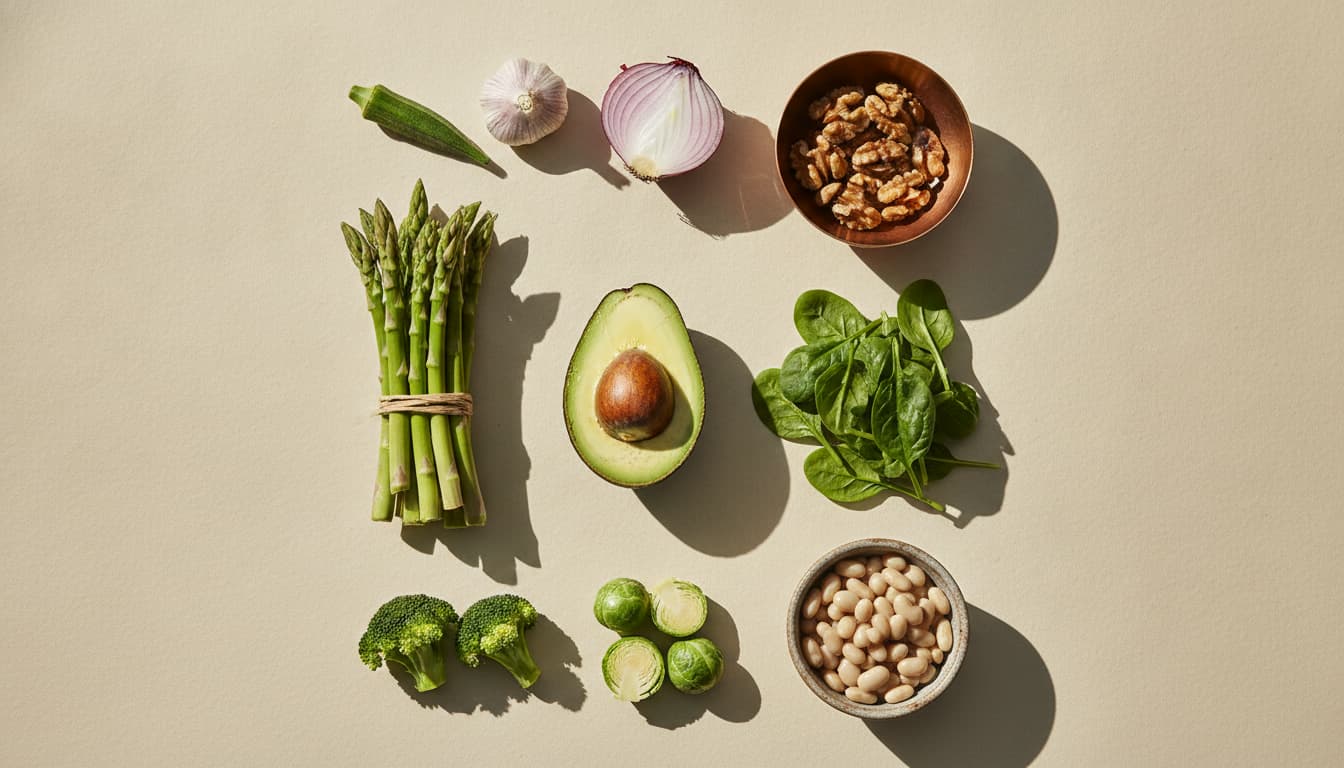
Glutathione is the body's own master antioxidant, but the glutathione in food is largely broken down before absorption. The foods that contain it, why the sulfur-amino-acid precursors matter more, and what the evidence says about boosting your own levels.
- 01
Asparagus: among the richest food sources
Asparagus is consistently cited as one of the richest dietary sources of glutathione, especially when raw or lightly cooked (nutrition literature; USDA). It is the food most often highlighted in glutathione discussions. The important qualifier is that even from a rich source, much of the glutathione is broken down in digestion before absorption, so asparagus is a good vegetable for many reasons but not a reliable way to raise blood glutathione on its own. Lightly steaming rather than boiling preserves more.
- 02
Avocado, spinach, and okra
Avocado, spinach, and okra are among the fruits and vegetables with notable glutathione content, part of a broader pattern that fresh produce carries more than processed foods (nutrition literature). As with asparagus, the catch is absorption: the glutathione is largely digested before it reaches the bloodstream intact. These foods are worth eating for their overall nutrition, and they contribute to the fresh-vegetable pattern that supports the body's own antioxidant systems, rather than acting as a direct glutathione top-up.
- 03
Fresh, raw produce beats cooked
Glutathione content is highest in raw or minimally cooked fruits and vegetables, because heat degrades the molecule and processing and long storage reduce it further (nutrition literature). This is why the glutathione in a fresh salad is higher than in the same vegetables boiled, and why heavily processed foods contain little. It is a general reason to include some raw or lightly cooked produce, though it does not overcome the fundamental limit that much dietary glutathione is digested regardless of how it is prepared.
- 04
The better lever: cysteine-rich, sulfur foods
Because dietary glutathione is poorly absorbed, the more effective strategy is supplying the raw materials the body uses to build its own, and the rate-limiting one is cysteine, a sulfur amino acid (nutrition literature). This makes sulfur-rich foods, eggs, whey protein, garlic, onions, and cruciferous vegetables like broccoli and Brussels sprouts, more logically connected to glutathione status than glutathione-containing foods themselves. A diet with adequate protein and plenty of these foods gives the body what it needs to maintain its own glutathione.
- 05
Cruciferous vegetables and their sulfur compounds
Cruciferous vegetables, broccoli, Brussels sprouts, cauliflower, and cabbage, are relevant here both for their sulfur amino acids and for compounds like sulforaphane that appear to stimulate the body's own antioxidant and detoxification enzyme systems (nutrition literature). This is a more indirect and plausible mechanism than eating glutathione directly. It also ties glutathione to the broader case for cruciferous vegetables, and it is one reason these vegetables feature so often in discussions of the body's internal defenses.
- 06
What the supplement evidence shows
Oral glutathione supplements have historically shown poor bioavailability, because the molecule is broken down in digestion, though some newer studies using higher doses or liposomal formulations report modest increases in body stores (nutrition literature; NIH). N-acetylcysteine, a cysteine precursor, is a better-established way to raise glutathione and is used medically, including for acetaminophen overdose. For the general population, though, the evidence does not support standard glutathione supplements as a reliable antioxidant boost, and a whole-food diet is the sounder approach.
How this was specified
- 01Inputs measured
- Retail price (dated) · label claim · Certificate of Analysis · third-party test (Informed Sport / NSF / ConsumerLab / Clean Label) · leucine per serving from COA, not marketing.
- 02Protocols tested
- Per-kg target from four literature ranges (IOM RDA, Phillips 2017, Morton 2018, ISSN). Brands scored against Moore 2015 leucine-per-dose threshold (~0.4 g/kg).
- 03Cost-basis verified
- $/gram of protein and $/gram of leucine at warehouse pricing (Costco), mail-order (Amazon), and DTC retail. Re-checked quarterly, flagged when drift exceeds 15%.
- 04Confidence level
- High on ranked order. Medium on absolute $/g (prices drift). Low on serving-size claims where COA is older than 18 months, flagged [VERIFY].
Every claim, cited.
The Larderlab Team builds evidence-led frameworks for eating, lifting, and stocking a kitchen. We cite every claim. We publish the spreadsheet when possible. We buy what we review at retail price. When new data lands, we revise with a dated note.
Next in this hub.
Foods High in Lectins: The Real Risk, and Why Cooking Solves It
Lectins are proteins in beans, grains, and nightshades, and raw kidney beans really can make you sick, but cooking destroys them. The ranking, why the anti-lectin diet overstates the danger, and why most high-lectin foods are among the healthiest.
8 min · rev 2026-08-13Foods High in Nitrates: The Vegetables That Boost Nitric Oxide
Dietary nitrates from vegetables convert to nitric oxide, which relaxes blood vessels and can lower blood pressure and aid exercise. The ranking led by beetroot and leafy greens, why vegetable nitrates are healthy while processed-meat nitrates are not, and what the beet-juice evidence shows.
8 min · rev 2026-08-12Foods High in Cholesterol: Which Ones Actually Matter for Your Heart
Dietary cholesterol turned out to have far less effect on blood cholesterol than saturated fat does, which is why the old 300 mg limit was dropped. The ranking of high-cholesterol foods, why eggs and shrimp are not the problem they were made out to be, and what actually raises LDL.
8 min · rev 2026-08-11Get the Larderlab Macro Planner.
A Google Sheet that calculates your protein target, splits it across 3-5 meals, and ranks 20 protein sources by $/gram. Free. Copy-and-modify your own version.
By subscribing, you agree to our Privacy Policy. Unsubscribe anytime.